The Best Workshop & DIY Air Compressors
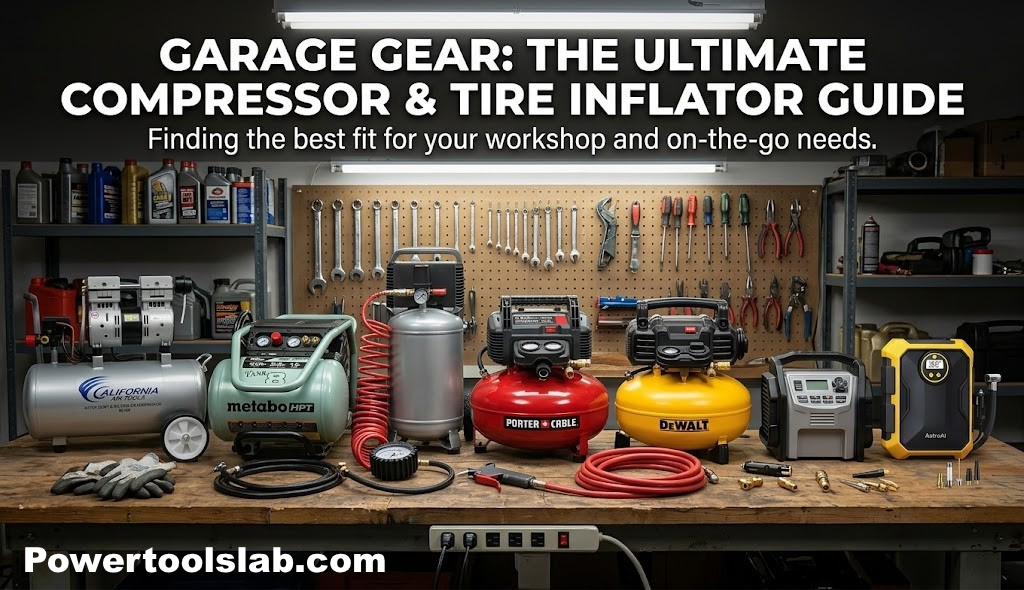
From pancake-style shop compressors that run your nail guns to pocket-sized inflators that live in your glovebox, here’s what’s actually worth buying and why.
Why Every DIYer Eventually Needs an Air Compressor
There’s a specific moment that happens in almost every garage or home workshop. You’re partway through a trim carpentry project, or you’re trying to build a simple picture frame, and you realize that hand-nailing everything is going to take three times as long and leave you with more split wood than finished product. That’s usually the moment people start shopping for their first air compressor.
An air compressor is one of those tools that quietly multiplies the usefulness of everything else in your garage. On its own, it doesn’t build anything. But hook it up to a brad nailer, a framing nailer, an impact wrench, a sander, a spray gun, or even just a blow gun for clearing sawdust out of tight corners, and suddenly you have access to an entire category of pneumatic tools that are faster, lighter, and often cheaper than their cordless electric equivalents.
There’s also a second, completely different use case that has nothing to do with woodworking at all: keeping your vehicle’s tires properly inflated. A slow leak, a seasonal temperature drop, or a a long road trip can all leave you with tires running low on air, and having a dedicated portable inflator in your trunk means you’re never stuck waiting for a gas station air pump that may or may not be working.
This guide covers both categories. If you already know which type you need, feel free to jump straight to the tank-style compressors or the portable inflators using the menu on the side. If you’re not sure which one fits your situation, the next section breaks down exactly how to tell the difference.
Curious about the mechanics first? Our companion guide on how air compressors work walks through pumps, tanks, and duty cycles in plain language.
Tank-Style vs. Portable: Which Do You Actually Need?
Before getting into specific models, it’s worth settling the more fundamental question: do you need a stationary shop compressor, or a portable inflator? These two categories solve completely different problems, and buying the wrong one is the single most common mistake first-time buyers make.
A tank-style, pancake-shaped compressor is built to sit in your garage, plug into a wall outlet, and power pneumatic tools through a hose. These units store pressurized air in a tank so the pump doesn’t have to run continuously while you’re firing nails or running a sander. They’re heavier, louder, and not something you’d want to carry very far, but they deliver far more sustained air volume than any battery-powered unit could manage.
A portable tire inflator, on the other hand, is built around convenience and mobility. These are small, light, and either plug into your car’s 12V outlet, clip onto your battery terminals, or run entirely on an internal rechargeable battery. They’re not meant to run a framing nailer, but they excel at the specific job of getting a tire from low to properly inflated in a few minutes, wherever your vehicle happens to be.
| Factor | Tank-Style Compressor | Portable Inflator |
|---|---|---|
| Primary use | Nail guns, staplers, impact tools, spray guns, blow guns | Car, bike, and sports equipment tires |
| Power source | 110V wall outlet | 12V car outlet, battery clamps, or internal battery |
| Portability | Low — meant to stay in the garage or job site | High — fits in a trunk, glovebox, or toolbox |
| Typical noise level | 60–85 decibels depending on the model | Generally quieter, shorter run times |
| Setup time | A few minutes to connect hose and tools | Seconds — plug in and go |
If your project list includes trim work, deck building, upholstery, or anything involving a nail gun, you want a tank-style compressor. If your goal is simply peace of mind about tire pressure, a portable inflator is the far more practical and affordable choice. Some people, especially anyone who does both DIY projects and road trips, end up owning one of each — and that’s a completely reasonable outcome.
Not sure exactly what capacity to look for? Our detailed breakdown on what size air compressor you need walks through matching tank size and CFM output to your specific tools.
Best Workshop & DIY Tank-Style Air Compressors
These are the standard pancake and hot-dog style tank compressors built for running pneumatic power tools such as nail guns and staplers, blowing dust and debris out of a work area, and handling larger inflation tasks around the house. All five of the models below are widely available, well-established in the DIY space, and represent different price points and priorities — from pure value to whisper-quiet indoor operation.
1. PORTER-CABLE C2002 6-Gallon Pancake Compressor
Best for: Overall value and everyday DIY home projects.
The PORTER-CABLE C2002 has been a go-to recommendation for years, and it earns that reputation by simply doing the fundamentals well without overcomplicating anything. It uses the classic pancake-style tank shape, which sits flat and low to the ground, giving it a stable footprint that won’t tip over when you’re pulling on a hose mid-project.
The pump is oil-free, which is the right call for a compressor aimed at occasional home use — it means no oil changes, no risk of forgetting maintenance, and a lighter overall unit to carry around the garage. With a maximum pressure rating of 135 PSI, it has enough headroom to keep most trim nailers and staplers running comfortably even as the tank cycles down between refills.
Pros
- Stable, low-profile pancake tank that resists tipping
- Oil-free pump means minimal ongoing maintenance
- Long track record as a reliable budget-friendly choice
- 135 PSI max gives solid headroom for trim tools
Cons
- 6-gallon tank means more frequent recovery cycles under heavy use
- Not intended for continuous, high-demand pneumatic tools
- Standard noise level typical of oil-free pumps

2. DEWALT DWFP55126 6-Gallon Pancake Compressor
Best for: High pressure output in a compact footprint.
If the PORTER-CABLE C2002 is the value pick, the DEWALT DWFP55126 is the step up for anyone who wants more headroom without moving to a bigger, heavier unit. It shares the same general 6-gallon pancake shape and footprint, but DEWALT pushed the maximum pressure to 165 PSI, which translates directly into longer tool runtimes between refill cycles and a quicker recovery when the tank does need to build pressure back up.
DEWALT also paid specific attention to noise on this model. At roughly 75.5 decibels, it’s not silent, but it’s noticeably more tolerable than many bargain-bin compressors if you’ll be running it in an attached garage or a shared workspace where the sound carries into living areas.
Pros
- 165 max PSI allows longer tool runtimes between refills
- Quicker recovery time than standard pancake units
- Relatively quiet for its class at 75.5 dBA
- Compact, familiar pancake footprint
Cons
- Costs more than baseline 135 PSI pancake models
- Still a 6-gallon tank, so heavy continuous use has limits

3. Craftsman CMEC6150K 6-Gallon Kit
Best for: Beginners who want a complete starter setup in one box.
Buying your first compressor often comes with an unglamorous surprise: you also need a hose, fittings, and probably a blow gun and a couple of nozzle attachments, none of which are included with most bare-tank compressors. The Craftsman CMEC6150K solves that problem directly by bundling a solid 150 max PSI tank with a 13-piece accessory kit, so you can go from unboxing to actually using the tool the same afternoon.
For someone who has never owned a compressor before, that bundled kit is worth more than it might seem. It removes a second shopping trip, prevents the frustration of getting the unit home and discovering you can’t hook anything up to it yet, and gives you a reasonable starting set of nozzles and adapters to figure out what you actually need going forward.
Pros
- Ships with a 13-piece accessory kit including hose and nozzles
- 150 max PSI is solid for a beginner-focused bundle
- Everything needed to start working right out of the box
Cons
- Bundled accessories are a good starting point, not premium-grade
- Standard 6-gallon capacity limits heavy continuous tool use

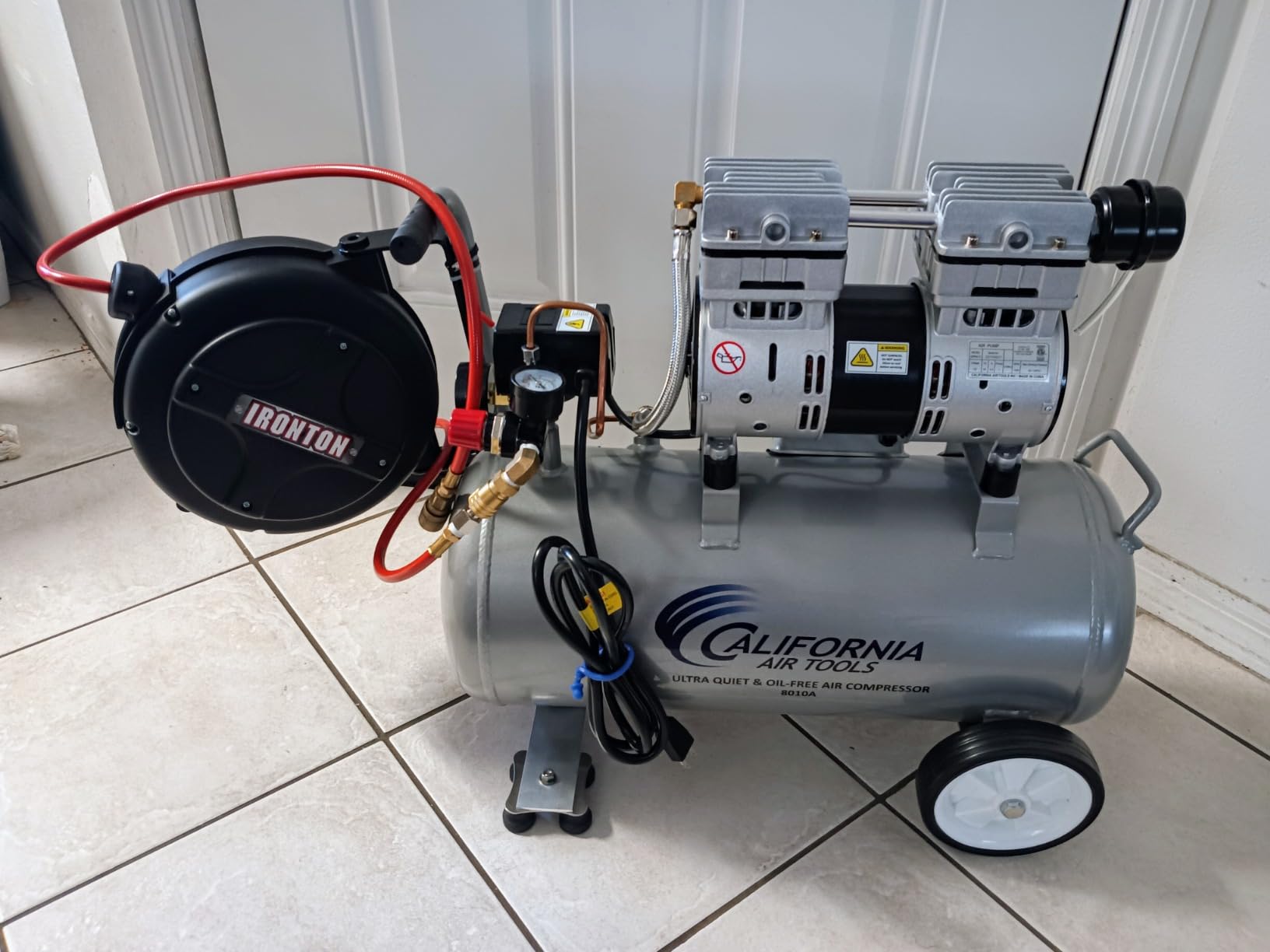
4. California Air Tools 8010 Ultra Quiet Compressor
Best for: Indoor workshops, apartments, and noise-sensitive spaces.
Standard compressors are loud enough that running one indoors, especially near living spaces, can turn a quick project into a household disruption. California Air Tools built its reputation specifically around solving that problem, and the 8010 is one of the clearest examples of it. This unit runs at around 60 decibels, which is genuinely close to normal conversation volume — a dramatic difference from the 75 to 85 decibel range typical of most pancake compressors.
It also steps up in tank size compared to the three pancake models above, with an 8-gallon steel tank that holds more reserve air between pump cycles. That combination of size and quiet operation makes it a strong pick for anyone working in a garage attached to a house, an apartment building with shared walls, or any space where a loud compressor simply isn’t an option.
Pros
- Around 60 decibels — dramatically quieter than typical compressors
- 8-gallon steel tank offers more reserve air than pancake models
- Purpose-built for indoor and noise-restricted environments
Cons
- Costs more than standard pancake units at similar tank size
- Larger footprint than a pancake-style compressor

5. Metabo HPT “The Tank” EC1315SM (8-Gallon)
Best for: Jobsite performance and heavy-duty use.
When the workload gets more demanding — running multiple nailers, keeping up with framing work, or simply needing air on tap without long pauses — Metabo HPT’s aptly nicknamed “The Tank” is built for exactly that. It delivers 4.0 CFM at 90 PSI with a 225 max PSI ceiling, numbers that put it a clear step above the pancake compressors on this list in terms of sustained output.
Despite that jump in performance, it’s still designed to be carried around a job site rather than bolted into a permanent shop corner. For anyone who splits time between home projects and more demanding jobsite work, or who has simply outgrown a 6-gallon pancake unit, this is the natural upgrade.
Pros
- 4.0 CFM at 90 PSI supports demanding, continuous tool use
- 225 max PSI is well above typical pancake compressors
- Still portable enough for jobsite transport
Cons
- Larger and heavier than a basic 6-gallon pancake unit
- More capability than most casual DIYers actually need

Best Handheld & Portable Tire Inflators
If you don’t need to run air tools and just want something reliable to keep in the trunk for car tires, bike tires, or sports equipment, these compact, cordless, or 12V DC options are built specifically for that job. None of these will power a nail gun, but each one solves the portability problem that a shop compressor simply can’t.
6. AstroAI Portable Tire Inflator (12V DC)
Best for: Budget-friendly car emergency kits.
The AstroAI inflator is the kind of tool you buy once, toss in the trunk, and forget about until the exact moment you actually need it. It plugs directly into your car’s 12V cigarette lighter outlet, so there’s no battery to keep charged and no risk of finding it dead when a tire warning light comes on.
It includes a digital display gauge so you can watch the exact PSI as it climbs, along with an auto-shutoff feature that stops the pump once your target pressure is reached — a small detail that prevents accidental overinflation. A built-in LED flashlight rounds out the emergency-kit usefulness, since low tire pressure has an unfortunate habit of showing up at night.
Pros
- Simple 12V plug-in operation with no battery to charge
- Digital display makes it easy to hit an exact PSI target
- Auto-shutoff helps prevent overinflating a tire
- Built-in LED flashlight for nighttime roadside use
Cons
- Requires the vehicle’s engine or accessory power to run
- Slower on larger truck or SUV tires than higher-output units

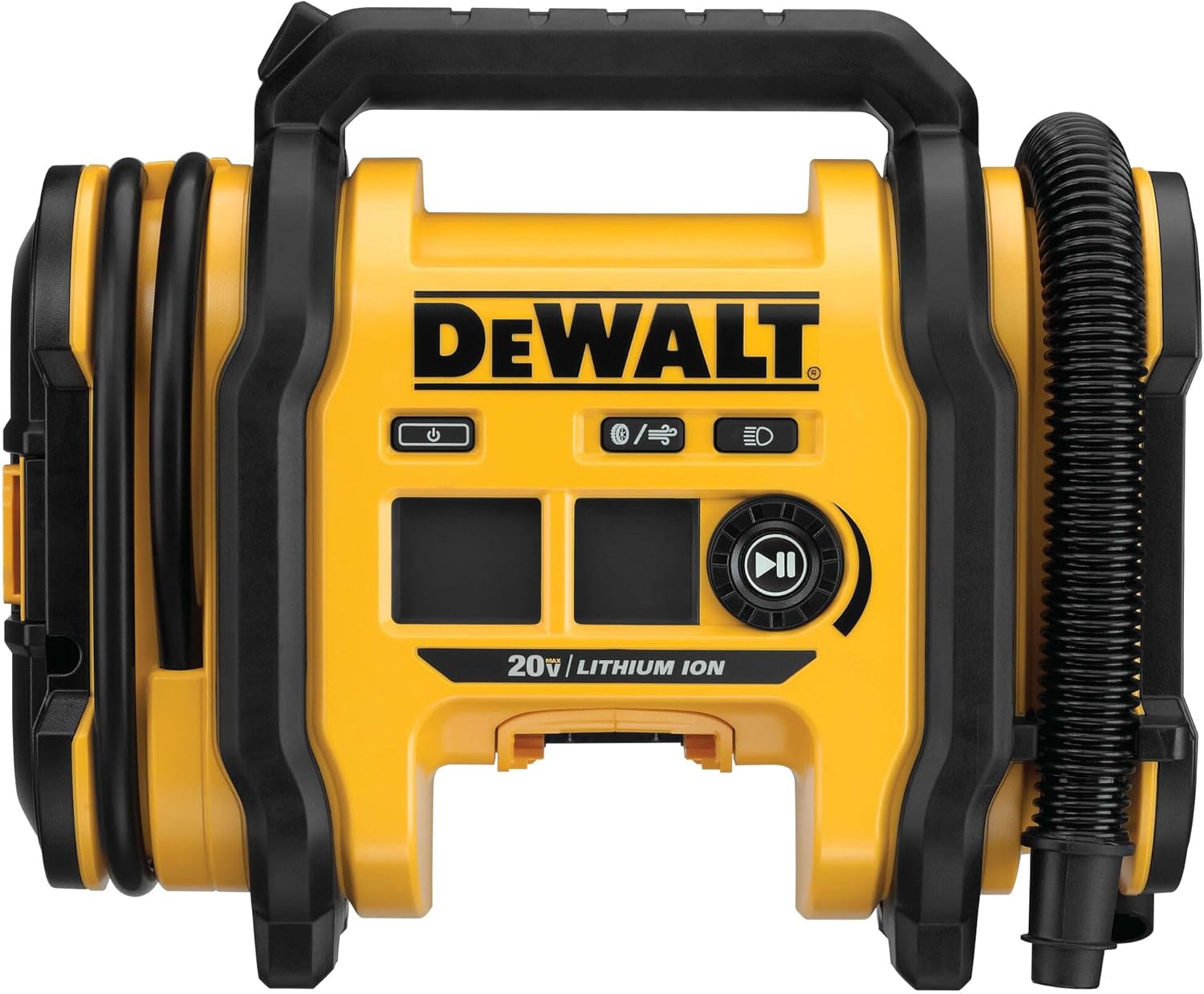
7. DEWALT 20V MAX Tire Inflator (DCC020IB)
Best for: Drivers who already own DeWalt power tools.
If you already have a shelf of DeWalt 20V batteries from other tools, the DCC020IB is an easy addition, since it can run off that same battery platform instead of forcing you to buy yet another proprietary power source. It’s also genuinely versatile beyond just the battery option — it can run from a 12V car plug or standard 110V wall power as well, covering essentially every situation you might find yourself in.
It ships with two separate hoses: a high-pressure hose for tires and a high-volume hose for larger inflatables like air mattresses or pool toys, which makes it more of an all-purpose inflation tool than a single-use tire pump.
Pros
- Runs on DeWalt 20V batteries you may already own
- Also works from a 12V car plug or 110V wall outlet
- Dual hoses cover both tires and larger air-filled items
Cons
- Battery not always included depending on the kit purchased
- Bulkier than ultra-compact cordless inflators
8. Airmoto Portable Cordless Tire Inflator
Best for: Compact glovebox storage.
Roughly the size of a large power bank, the Airmoto is built around the idea that a tire inflator shouldn’t take up trunk space you’d rather use for something else. Its internal battery means there’s no cord to manage at all — you charge it at home, toss it in the glovebox, and it’s ready whenever a tire, bike, or basketball needs air.
It has become a major seller for exactly this reason: it’s lightweight, genuinely portable in a way plug-in units aren’t, and versatile enough to handle more than just car tires.
Pros
- Fully cordless — no vehicle power or outlet required
- Compact enough to store in a glovebox or small bag
- Versatile enough for bikes and sports equipment, not just tires
Cons
- Internal battery needs periodic recharging like any cordless device
- Smaller build means more time needed for larger tires

9. VIAIR 88P Portable Air Compressor
Best for: Off-roading, trucks, and larger SUVs.
Lightweight plug-in inflators can struggle with the sheer volume of air a large truck or SUV tire needs, especially if you’re airing up regularly after off-road trips. The VIAIR 88P is built specifically to handle that heavier-duty use case by clipping directly onto your vehicle’s battery terminals instead of a lighter socket, giving it a much stronger, more consistent power source.
That difference matters most on tires up to around 33 inches, where the 88P keeps working efficiently without the overheating and slowdowns that smaller lighter-socket inflators tend to experience under sustained use.
Pros
- Battery-clamp power delivers more consistent output than lighter-socket units
- Handles large truck and SUV tires without overheating
- Built with off-road and heavier-duty use in mind
Cons
- Battery clamp setup is less convenient than a simple plug-in for quick top-offs
- Overkill for small passenger car tires used only occasionally

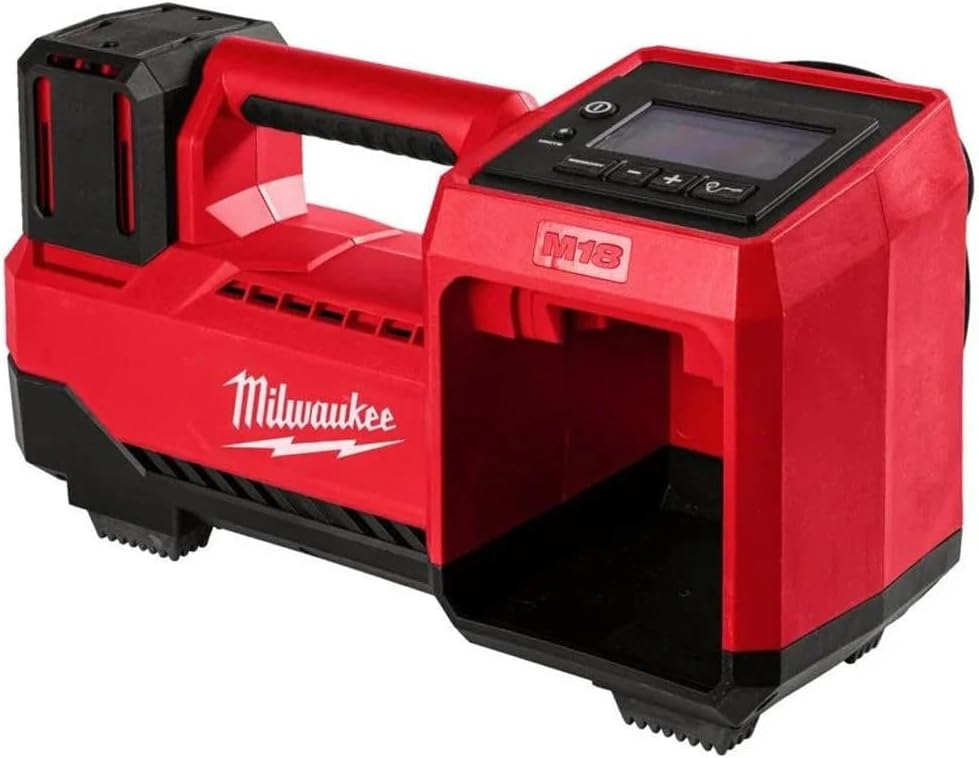
10. Milwaukee M18 Fuel 2-Gallon Compact Compressor (2840-20)
Best for: Cordless professional carpentry and trim work.
The Milwaukee 2840-20 sits in an interesting middle ground between the pancake compressors and the portable inflators on this list: it’s a genuine tank compressor, just built to run entirely on Milwaukee’s M18 battery system instead of a wall outlet. That gives you 1.2 CFM at 90 PSI without tethering yourself to an extension cord, which matters a lot on job sites or in detached structures without easy power access.
It’s also notably quiet for a tank compressor, running at only 68 dBA, which pairs well with its cordless convenience for anyone doing finish carpentry in spaces where noise and cord management both matter.
Pros
- Cordless operation on the Milwaukee M18 battery platform
- Quiet at only 68 dBA for a true tank compressor
- No extension cords needed on job sites or detached workspaces
Cons
- Smaller 2-gallon tank compared to corded pancake units
- Runtime is limited by battery charge like any cordless tool
Full Side-by-Side Comparison
Here’s every model from this guide in one place, so you can compare tank size, power source, and standout feature at a glance before making a decision.
| Model | Type | Capacity / Power | Standout Feature |
|---|---|---|---|
| PORTER-CABLE C2002 | Pancake Tank | 6 Gal / 135 PSI | Best overall value |
| DEWALT DWFP55126 | Pancake Tank | 6 Gal / 165 PSI | High pressure, quieter operation |
| Craftsman CMEC6150K | Pancake Tank | 6 Gal / 150 PSI | Complete 13-piece starter kit |
| California Air Tools 8010 | Steel Tank | 8 Gal / 60 dBA | Ultra-quiet indoor use |
| Metabo HPT EC1315SM | Jobsite Tank | 8 Gal / 225 PSI | Heavy-duty jobsite output |
| AstroAI Inflator | 12V Plug-In | Car Outlet | Digital gauge + auto-shutoff |
| DEWALT DCC020IB | Multi-Power Inflator | 20V / 12V / 110V | Runs on DeWalt battery platform |
| Airmoto Inflator | Cordless Inflator | Internal Battery | Glovebox-sized portability |
| VIAIR 88P | Battery-Clamp Inflator | Direct Battery Power | Handles up to 33-inch tires |
| Milwaukee 2840-20 | Cordless Tank | 2 Gal / M18 Battery | Cordless tank compressor, 68 dBA |
Using Your Compressor Safely
Air compressors are simple to operate, but they store energy under real pressure, and a little bit of care goes a long way toward avoiding an injury or damaged equipment. Always check the maximum PSI rating on any tool or accessory before connecting it to your compressor, and never exceed that rating even if the compressor itself is capable of more.
Drain condensation from the tank after each use — moisture builds up inside the tank over time and can lead to rust if it’s left sitting. Keep the air filter clean, store the unit somewhere dry, and always relieve pressure from the line before disconnecting hoses or changing attachments.
For a full rundown of safe operating practices, see our dedicated guide on air compressor safety, and if you’re setting one up for the first time, our walkthrough on how to use an air compressor covers the entire process step by step.
How to Choose the Right Air Compressor for Your Needs
The right compressor almost always comes down to matching three things: what tools you plan to run, how much noise you can tolerate, and how much space you have to store the unit. Start by listing the tools you actually intend to use — a brad nailer and stapler need far less air than a sander or impact wrench, and that difference should drive your tank size and CFM decision far more than price alone.
If you’re working in or near living spaces, noise level deserves more weight than most buyers give it upfront. A compressor that’s perfectly fine in a detached garage can become genuinely disruptive in an attached one, especially if you’re running it during evenings or weekends when neighbors or family members are around.
Finally, think honestly about portability. A pancake compressor is portable in the sense that you can carry it, but it’s not something you’ll want to move often. If your work happens across multiple locations — different rooms, a job site, a friend’s garage — a cordless option like the Milwaukee 2840-20 removes a real point of friction that a corded unit can’t.
For a deeper walkthrough of this entire decision process, read our full guide on how to choose an air compressor. And if your project list extends beyond pneumatic tools, our roundup of the best power saws covers the other half of a well-equipped workshop.
Frequently Asked Questions
What size air compressor do I need for a home workshop?
For most home workshops running a single finish nailer, stapler, or brad nailer at a time, a 6-gallon pancake compressor is enough. If you plan to run impact wrenches, sanders, or multiple tools back to back, an 8-gallon or larger tank with a higher CFM rating will keep up better without long recovery pauses.
What is the difference between PSI and CFM?
PSI measures how much pressure the compressor can build, while CFM measures how much air volume it can deliver over time. Small trim tools mostly care about PSI, but air-hungry tools like impact wrenches, sanders, and spray guns depend heavily on CFM to run continuously without stalling.
Are oil-free air compressors as durable as oil-lubricated ones?
Oil-free pumps are generally less durable under heavy continuous use than oil-lubricated pumps, but they require far less maintenance and are lighter, which is why most consumer pancake compressors use oil-free designs. For occasional DIY use, this tradeoff is rarely noticeable.
Can I use a pancake compressor to inflate car tires?
Yes, a pancake compressor can inflate car tires using a standard chuck attachment, but it is not designed to be portable in the way a dedicated 12V or cordless tire inflator is. For quick roadside top-offs, a small dedicated inflator is far more practical.
How loud is too loud for an indoor workshop compressor?
Most standard pancake compressors run between 75 and 85 decibels, which is comparable to a garbage disposal. Anything under 70 decibels is considered relatively quiet for a compressor, and ultra-quiet models can run as low as 60 decibels, which is closer to normal conversation volume.
Do cordless tire inflators lose power over time?
Like any battery-powered tool, cordless inflators will see reduced runtime as the internal or shared battery ages. Most are still capable of airing up several tires on a single charge when new, but heavy or daily use will shorten the practical runtime faster than occasional use.
What PSI should I inflate my tires to?
Always inflate to the PSI listed on the sticker inside your driver’s side door jamb or in your owner’s manual, not the maximum PSI printed on the tire’s sidewall. The sidewall number is the tire’s maximum rating, not the recommended pressure for your vehicle.
Is a 12V plug-in inflator strong enough for truck or SUV tires?
Small 12V plug-in inflators can air up truck and SUV tires, but they will take noticeably longer and generate more heat doing it. For larger tires used regularly, a battery-terminal unit or a higher-output inflator built for bigger volumes is a better long-term fit.
How much maintenance does a pancake air compressor need?
Oil-free pancake compressors need very little upkeep beyond draining condensation from the tank after use and periodically checking the air filter. Oil-lubricated units require occasional oil changes in addition to those steps.
Can I run a nail gun and a stapler off the same compressor at the same time?
It depends on the compressor’s CFM output and tank size relative to the combined air demand of both tools. Many 6-gallon pancake units can handle brief overlapping bursts, but sustained simultaneous use is more reliable on an 8-gallon or larger tank with a higher CFM rating.
Do I need a moisture filter or water separator for my air compressor?
A moisture filter or in-line water separator is a smart addition if you are spray painting, running pneumatic tools sensitive to condensation, or working in a humid climate, since it prevents water in the air line from reaching your tools and workpiece.
What is the advantage of a battery-powered compressor over a plug-in one?
Battery-powered compressors let you work anywhere without hunting for an outlet or running an extension cord, which is especially useful on job sites, in garages without nearby power, or for quick outdoor tasks. The tradeoff is limited runtime compared to a corded unit plugged into wall power.
Final Recommendation
If you only take one thing away from this guide, let it be this: match the tool to the job, not the other way around. For most home workshops handling trim work, small repairs, and general DIY projects, the PORTER-CABLE C2002 remains an excellent, low-risk starting point. If noise is a concern in your space, the California Air Tools 8010 is worth the extra cost. And if your needs are purely about tire pressure rather than pneumatic tools, the Airmoto or AstroAI inflators cover that job for a fraction of the price of any tank compressor.
Whichever direction fits your project list, the goal is the same: less time fighting your tools, and more time actually finishing the work in front of you.
