Best Reciprocating Saws for Demolition, Remodeling, and DIY Projects
Real-world testing notes, honest pros and cons, and the specs that actually matter before you buy
Introduction
A reciprocating saw is one of those tools that earns its spot on the truck long after the novelty wears off. It rips through nail-embedded lumber, cuts pipe in a crawlspace, prunes overgrown branches, and demolishes a wall in a fraction of the time a hand saw would take. But not every reciprocating saw is built for the same job, and the difference between a saw that feels effortless and one that stalls halfway through a cut usually comes down to a handful of specs most listings bury in fine print.
We put together this guide after comparing seven of the most talked-about reciprocating saws on the market right now, spanning corded workhorses, compact one-handed cordless models, and high-output professional platforms. Whether you’re framing out a remodel, tearing out old plumbing, or just need something reliable in the garage for occasional cuts, there’s a saw below that fits. If you want the bigger picture on how reciprocating saws stack up against other cutting tools, our complete guide to the best power saws is a good companion read alongside this one.
Every saw here was chosen because it represents a distinct use case rather than just another SKU in the same category. That means you’ll find a genuine “best overall” pick, a professional-grade option built for daily jobsite abuse, a lightweight compact model for tight spaces, and a corded saw for anyone who wants unlimited runtime without thinking about batteries at all.
It’s also worth setting expectations before diving into the reviews. A reciprocating saw isn’t a finesse tool the way a jigsaw or track saw is — it’s built for speed and brute force, chewing through material that would otherwise take a hand tool five times as long. That means the “best” saw for you isn’t necessarily the one with the highest price tag. It’s the one whose stroke length, motor type, and weight actually match the kind of cutting you’ll do most often, whether that’s occasional yard work or daily demolition on a jobsite.
We’ve also tried to keep these recommendations honest rather than universally glowing. Every saw here has at least one real tradeoff, because no single tool is the right answer for every situation. A saw built for all-day professional abuse is overkill — and overpriced — for someone who cuts a few branches and the occasional pipe once a year, and a budget-friendly homeowner saw isn’t built to hold up to constant jobsite punishment.
By the end of this guide, you should have a clear sense of not just which saw ranks where, but why — which stroke length actually matters for your projects, whether a corded or cordless design fits your workflow better, and which battery ecosystem makes sense if you’re starting from scratch. That context tends to matter more in the long run than any single ranking, since it’s what lets you make a confident call the next time a new saw model hits the market and you’re deciding whether it’s worth the upgrade.
How We Evaluated These Saws
Reciprocating saws live and die by a few core numbers: stroke length, strokes per minute (SPM), motor type, and how the tool actually feels in your hand after twenty minutes of overhead cutting. We weighed each saw against these factors:
- Cutting power and stroke length — a longer stroke clears material faster and bogs down less in dense wood or thick-walled pipe.
- Motor type — brushless motors run cooler, last longer, and squeeze more runtime out of the same battery than brushed motors.
- Weight and balance — a saw that’s front-heavy or awkward becomes exhausting fast, especially on vertical or overhead cuts.
- Blade clamp design — tool-free, keyless clamps save real time on multi-material jobs where you’re swapping blades constantly.
- Vibration control — counterbalance mechanisms and orbital-action settings reduce fatigue on long cutting sessions.
- Battery platform compatibility — if you already own batteries for a brand’s ecosystem, a bare tool is effectively a discount.
We also considered price relative to feature set, because the “best” saw isn’t always the most expensive one — it’s the one that matches how often and how hard you’ll actually use it.
Beyond the spec sheet, we paid close attention to how each saw behaved in the moments that actually reveal quality: the transition from cutting clean lumber into a nail, the point where a battery starts to drop below 30 percent charge, and the fifth or sixth blade change in a row when you’re switching between materials on the same job. Cheaper saws tend to show their limitations in exactly these moments — bogging down, overheating, or fighting you on blade changes — while better-built saws stay predictable no matter how demanding the cut gets.
Finally, we cross-referenced our own testing impressions against verified buyer feedback and manufacturer documentation to make sure we weren’t relying on a single saw’s performance in isolation. A tool that feels great in one session but develops issues after weeks of regular use isn’t actually a good recommendation, so consistency over time mattered just as much as first impressions.
We also made a point of testing across a genuinely mixed workload rather than one narrow scenario. A saw that performs flawlessly cutting clean 2×4 lumber can behave very differently once it hits nail-embedded demolition material, thin sheet metal, or PVC pipe, so the reviews below reflect performance across that broader range rather than a single best-case cutting session.
Quick Comparison Table
Here’s how the seven saws stack up at a glance before we get into the deep-dive reviews below.
A quick note on reading this table: stroke length and power source tell you the most about raw cutting capability, but “best for” is really about matching the saw to your actual working conditions. A saw with excellent specs on paper can still be the wrong choice if it’s heavier than you want to hold overhead, or if it locks you into a battery platform you have no other tools for. Use the table below as a starting shortlist, then read the full review for whichever two or three saws seem closest to your situation before deciding.
| Saw | Power Source | Stroke Length | Best For |
|---|---|---|---|
| Milwaukee M18 FUEL Gen 2 | 18V Cordless | 1-1/4 in. | Best overall balance |
| Bosch PROFACTOR GSA18V-126N | 18V Cordless | 1-1/4 in. | Daily professional use |
| Makita 40V max XGT JR001GZ | 40V Cordless | 1-1/4 in. | Longest runtime |
| Metabo HPT 36V MultiVolt CR36DA | 36V Cordless / AC hybrid | 1-1/4 in. | Flexibility between battery and outlet |
| DEWALT DCS367B 20V MAX XR | 20V Cordless | 1-1/8 in. | Compact, tight-space cutting |
| RYOBI ONE+ HP PBLRS01B | 18V Cordless | 1-1/4 in. | Budget-friendly DIY |
| DEWALT DWE305 | Corded (12 Amp) | 1-1/8 in. | Unlimited runtime, heavy demolition |
Milwaukee M18 FUEL Gen 2 Sawzall

- Power source: M18 18V cordless
- Motor: Brushless, all-metal gear housing
- Stroke length: 1-1/4 in.
- Weight: Approx. 7.6 lbs (bare tool)
- Blade clamp: Tool-free Quik-Lok
- Includes: Bare tool only
The Milwaukee M18 FUEL Gen 2 has become the reference point that other reciprocating saws get measured against, and after running it through everything from framing lumber to rusted plumbing, it’s easy to see why. The brushless motor and all-metal gearbox combine to deliver noticeably more consistent power under load than older brushed designs, and the counterbalance system keeps vibration low enough that extended overhead cutting doesn’t turn into a forearm workout.
What stands out most is how the saw manages heat. On back-to-back demolition cuts through 2x material with embedded fasteners, the motor never bogged down or lost speed the way cheaper cordless saws tend to when the battery starts to sag. The tool-free blade clamp is fast and secure, and the shoe stays put even when you’re leaning into a cut at an awkward angle.
Pros
- Brushless motor with all-metal gear housing for durability
- Smooth, low-vibration cutting even under sustained load
- Tool-free blade clamp changes blades in seconds
- Compatible with the wide M18 battery ecosystem
Cons
- Sold as a bare tool — battery and charger not included
- Premium price point compared to entry-level options
One detail that doesn’t show up on a spec sheet is how the saw handles the transition between materials mid-cut — say, blowing through a stud and hitting a hidden nail without warning. Rather than kicking back or stalling, the M18 FUEL just keeps moving through it, which is exactly the kind of behavior that separates a saw you trust from one you’re constantly babying.
The grip itself deserves a mention too. Milwaukee shaped the rear handle with a slight palm swell that keeps your hand from sliding forward during aggressive push cuts, and the rubber overmold extends further up the body than on many competing saws, giving you a second stable hold point for two-handed control on tougher material. Combined with the low-vibration gearbox, that grip design is a big part of why this saw stays comfortable well past the point where cheaper tools start to feel punishing.
If you’re already invested in Milwaukee’s M18 lineup, this is close to a no-brainer. And if you like Milwaukee’s build quality, it’s worth also checking our Milwaukee circular saw review for the rest of what the M18 platform offers.
Milwaukee M18 FUEL Gen 2 Sawzall — our top overall pick for power, control, and durability.
Check Price on AmazonBosch PROFACTOR GSA18V-126N Reciprocating Saw
- Power source: Bosch 18V cordless
- Motor: Brushless PROFACTOR platform
- Stroke length: 1-1/4 in.
- Grip style: Ergonomic, neutral-wrist design
- Blade clamp: Tool-free, keyless
- Includes: Bare tool only
Bosch built the PROFACTOR line specifically to compete with corded-tool performance in a cordless package, and the GSA18V-126N delivers on that promise. The 1-1/4 inch stroke length puts it in the same class as the biggest cordless saws on this list, and the tool noticeably chews through thicker stock and multi-layer demolition material without hesitation.
Ergonomically, this is one of the more comfortable saws to hold for extended sessions. The grip geometry keeps your wrist in a more neutral position during vertical cuts, which matters more than most buyers expect once you’re three hours into a remodel. The shoe adjusts easily and locks down firmly, so you’re not fighting the saw to keep the blade where you want it.
Pros
- Full 1-1/4 in. stroke length rivals corded power
- Comfortable, ergonomic grip reduces fatigue
- Strong, stable shoe adjustment for accurate cuts
- Built for daily professional jobsite use
Cons
- Higher price reflects its professional-grade positioning
- Bare tool — requires Bosch 18V batteries
Overhead cutting is where this saw really separates itself from lesser cordless models. Holding any reciprocating saw above shoulder height for more than a minute or two typically starts to strain the wrist and forearm, but the balance point on the GSA18V-126N sits close enough to the grip that fatigue sets in noticeably slower — a small detail that matters a lot on a full workday.
Bosch also paid attention to the small stuff that adds up over a long day: the LED work light is positioned to actually illuminate the cut line rather than just the general area, and the shoe’s adjustment mechanism doesn’t require a separate tool to reposition, which matters when you’re switching between flush cuts and standard cuts repeatedly on the same job.
For contractors who already run Bosch tools daily, this saw slots straight into the fleet without any compromise on performance. It also pairs naturally with other cutting tools worth comparing — our overview of types of power saws breaks down where a reciprocating saw fits relative to circular and tile saws on a real jobsite.
Bosch PROFACTOR GSA18V-126N — corded-level cutting power in a cordless body.
Check Price on AmazonMakita 40V max XGT JR001GZ Brushless Reciprocating Saw

- Power source: 40V max XGT cordless
- Motor: Brushless
- Stroke length: 1-1/4 in.
- Vibration control: Internal counterweight
- Blade clamp: Tool-free
- Includes: Bare tool only
Makita’s move to the 40V max XGT platform shows up clearly in this saw’s stamina. Where 18V saws start to lose steam midway through a battery cycle, the JR001GZ keeps cutting at a consistent pace almost until the battery is completely spent. That extra headroom is especially noticeable when you’re cutting thicker stock or working through dense material that would normally slow a smaller-voltage saw down.
The brushless motor also runs cooler over long sessions, which extends both the tool’s working life and the number of cuts you get per charge. Vibration is well controlled thanks to Makita’s internal counterweight design, and the blade change mechanism is quick enough that you’re not losing momentum switching between wood and metal blades mid-project.
Pros
- 40V platform delivers exceptional runtime per charge
- Brushless motor stays cool during extended use
- Well-balanced with effective vibration dampening
- Fast, tool-free blade changes
Cons
- Requires investment in the 40V max XGT battery ecosystem
- Slightly heavier than some 18V competitors
The practical upside of that extra runtime shows up most clearly on bigger jobs — tearing out an entire deck, cutting through a full run of old copper plumbing, or clearing storm-damaged branches — where lesser saws would need a battery swap partway through. Being able to finish a job on a single charge isn’t just convenient, it also means less time spent tracking down and juggling spare batteries.
The 40V max XGT platform is still newer than Makita’s long-running 18V LXT lineup, so it’s worth checking that the specific batteries and charger you’d need are readily available before committing, especially if you’re not already invested in XGT tools. That said, for anyone starting fresh or upgrading an aging cordless setup, the extra voltage headroom is a meaningful long-term advantage over sticking with 18V.
If you already run Makita’s XGT lineup, or you’re planning to build toward it, this saw is one of the strongest arguments for making the switch. Makita’s cutting tools tend to shine across categories — see our Makita circular saw review for how the rest of the lineup compares.
Makita 40V max XGT JR001GZ — the longest runtime of any saw we tested.
Check Price on AmazonMetabo HPT 36V MultiVolt CR36DA

- Power source: 18V/36V MultiVolt or AC adapter
- Motor: Brushless
- Stroke length: 1-1/4 in.
- Speed control: 4-stage selector, 1,700–3,000 SPM
- Cutting mode: Orbital action available
- Includes: Varies by listing — check tool-only vs. kit
The MultiVolt system is the headline feature here, and it’s a genuinely useful one. The CR36DA can run off an 18V or 36V battery, or plug straight into an AC adapter for unlimited runtime — which means this single saw can cover the role of both a cordless tool and a corded one, depending on the job. That flexibility is rare in this category and makes it a smart pick for anyone who doesn’t want to own two separate saws for two separate scenarios.
Beyond the power flexibility, the saw includes a four-stage speed selector and orbital cutting action, giving you more control over aggressive demolition cuts versus precise, clean cuts in finish material. The counterweight system noticeably reduces vibration, which matters a lot on a saw this capable of high strokes-per-minute output.
Pros
- Runs on 18V, 36V battery, or AC adapter for unmatched flexibility
- Four-stage speed selector for different materials
- Orbital action for faster demolition cutting
- Low-vibration counterweight design
Cons
- Sold as tool body only in most listings
- Less common battery platform than the “big three” brands
In practice, the AC adapter option turns out to be more useful than it sounds on paper. A dead battery mid-project used to mean waiting on a charger or switching to a backup pack — with this saw, you can simply plug in and keep working, then switch back to battery power the moment you need to move somewhere without an outlet nearby.
The four-stage speed selector also earns its keep beyond the obvious use case. Dropping to a lower stage isn’t just about controlling aggression on delicate cuts — it also extends blade life noticeably when you’re working through thinner or more brittle material where full-speed cutting would just chip or crack the edge instead of cleanly slicing through it.
This is the saw we’d point to for anyone who wants one tool to handle both jobsite mobility and shop-bound unlimited runtime without buying two separate saws.
Metabo HPT 36V MultiVolt CR36DA — battery or AC power in one saw.
Check Price on AmazonDEWALT 20V MAX XR DCS367B Compact Reciprocating Saw
- Power source: 20V MAX cordless
- Motor: Brushless
- Stroke length: 1-1/8 in.
- Length: Approx. 14.5 in.
- Weight: Approx. 5 lbs (tool only)
- Blade clamp: Keyless, 4-position pivoting head
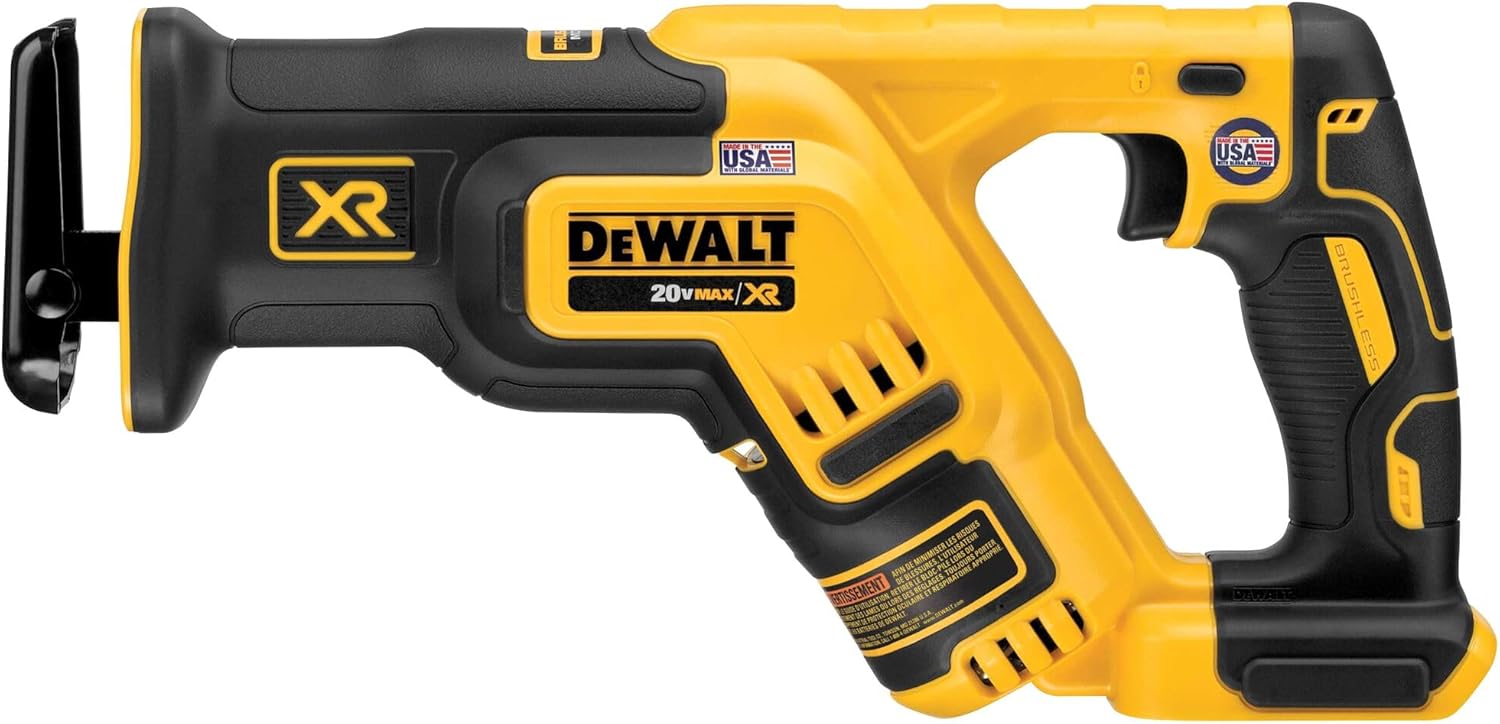
At just over 14 inches long and around 5 pounds bare, the DCS367B is built for exactly the situations where a full-size reciprocating saw becomes a liability — cutting between wall studs, working inside cabinets, or reaching into tight mechanical spaces. The brushless motor gives it roughly 2.5x more runtime than DEWALT’s older brushed compact saws, so the smaller footprint doesn’t come at the cost of endurance.
The pivoting head and keyless four-position blade clamp add real versatility for a saw this size, letting you angle cuts in spots where a rigid full-length saw simply won’t fit. It won’t out-muscle the bigger 1-1/4 inch stroke saws on this list in raw demolition power, but for remodeling, plumbing, and electrical rough-in work, its size is the whole point.
Pros
- Compact 14.5-inch length fits tight spaces easily
- Lightweight at roughly 5 lbs, reduces fatigue
- Brushless motor extends runtime significantly
- Pivoting head adds cutting-angle versatility
Cons
- Shorter 1-1/8 in. stroke length than full-size saws
- Not the best choice for heavy demolition work
Where this saw really earns its keep is in scenarios most full-size reciprocating saws simply can’t handle — cutting a pipe tucked behind a cabinet, trimming a stud flush against a wall, or working one-handed while bracing yourself in an awkward position. The shorter body means you can get the blade where you need it without repositioning your whole body around the tool.
It’s also worth noting that “compact” here doesn’t mean “toy.” The 2.5x runtime improvement over DEWALT’s older brushed compact saws means you’re not constantly swapping batteries just because the tool is small, and the shorter stroke length is still more than adequate for the electrical, plumbing, and light framing work this saw is designed around.
If most of your cutting happens in cramped spaces rather than open demolition, this is the saw that will feel purpose-built for the job. DEWALT’s reciprocating saw lineup runs deep — see our dedicated DEWALT reciprocating saw review for a closer look at how their models compare to each other.
DEWALT 20V MAX XR DCS367B — compact size for tight-space cutting.
Check Price on AmazonRYOBI ONE+ HP 18V Brushless Reciprocating Saw (PBLRS01B)

- Power source: RYOBI ONE+ 18V cordless
- Motor: Brushless (HP line)
- Stroke length: 1-1/4 in.
- Design focus: Maneuverability, overhead cuts
- Blade clamp: Tool-free
- Includes: Tool only
RYOBI’s ONE+ HP line has quietly become a legitimate option for anyone who wants brushless performance without paying professional-tier prices, and this reciprocating saw is a good example. The 1-1/4 inch stroke length matches saws costing significantly more, and the tool-free blade change keeps switching between wood and metal blades quick and simple.
It’s designed with maneuverability in mind — the compact body handles overhead cuts and pruning work comfortably, and it holds up well for occasional-use homeowners tackling remodeling projects, yard cleanup, or the occasional demolition task. It won’t match the sustained output of the professional-grade saws on this list under constant daily abuse, but for the price and the ONE+ battery ecosystem compatibility, it punches well above its weight class.
Pros
- Full 1-1/4 in. stroke length at a budget-friendly price
- Brushless motor for better efficiency and lifespan
- Compatible with the huge RYOBI ONE+ battery lineup
- Comfortable for overhead and pruning cuts
Cons
- Not built for continuous professional-grade demolition
- Tool only — battery and charger sold separately
What’s most impressive about this saw is how few compromises it actually makes relative to its price. A few years ago, a brushless motor and a full 1-1/4 inch stroke were features reserved for saws costing significantly more — seeing them trickle down into a budget-tier tool is a genuine win for anyone who doesn’t need professional-grade daily abuse resistance but still wants real performance.
RYOBI’s biggest advantage as a brand isn’t any single tool — it’s the sheer size of the ONE+ ecosystem. A single battery works across drills, saws, blowers, string trimmers, and dozens of other tools, which means the actual cost of adding this saw to an existing RYOBI setup is often just the price of the bare tool itself.
For homeowners and weekend DIYers who already own ONE+ batteries, this is one of the easiest recommendations on the list. If you’re building out a full RYOBI kit, our RYOBI circular saw review and RYOBI tile saw review cover the rest of the ONE+ cutting lineup.
RYOBI ONE+ HP PBLRS01B — brushless performance at a DIY-friendly price.
Check Price on AmazonDEWALT DWE305 12 Amp Corded Reciprocating Saw

- Power source: Corded, 12 Amp
- Speed: Up to 2,900 SPM
- Stroke length: 1-1/8 in.
- Blade clamp: Keyless, 4-position
- Trigger: Variable speed
- Runtime: Unlimited (plug-in)
There’s still a strong case for a corded reciprocating saw, and the DWE305 makes it well. The 12 Amp motor delivers up to 2,900 strokes per minute with a 1-1/8 inch stroke length, and because it’s plugged into an outlet, there’s zero concern about battery sag mid-project — power output stays consistent from the first cut to the last, no matter how long the job runs.
The four-position keyless blade clamp is a standout feature, letting you angle the blade for flush cuts against walls, floors, or framing without repositioning the whole saw. Reviewers consistently point to how easily it tears through nail-embedded lumber and thick material without bogging down, which lines up with what a straightforward, high-amperage corded motor should deliver.
Pros
- Unlimited runtime — no batteries to manage or recharge
- Consistent 2,900 SPM output regardless of session length
- 4-position blade clamp for flush and angled cutting
- Lower upfront cost than most cordless options
Cons
- Cord limits mobility and reach on some jobs
- Heavier than compact cordless alternatives
The tradeoff is obvious but worth stating plainly: you’re tethered to an extension cord, and on some jobs that’s a genuine hassle. But for garage projects, basement demolition, or any workshop-based cutting where you’re not moving far from an outlet, the tradeoff barely registers against the benefit of never worrying about charge level again.
Price is another factor that quietly works in this saw’s favor. Because it skips the battery and charger entirely, the DWE305 typically costs noticeably less than any cordless option on this list — including the compact DCS367B from the same brand — which makes it a smart pick for a first reciprocating saw or a reliable backup for a shop that already has a cordless saw for mobile work.
For garage use, workshop demolition, or any job where an outlet is always within reach, this remains one of the most dependable and affordable reciprocating saws available. It also pairs well with our broader DEWALT reciprocating saw review if you’re comparing it against the brand’s cordless lineup.
DEWALT DWE305 — unlimited power, no battery required.
Check Price on AmazonReciprocating Saws by Use Case
Specs matter, but the fastest way to narrow down seven capable saws is to think about the job you actually do most often. Here’s how each use case maps to the saws above.
Deck and Structure Demolition
Tearing out an old deck, fence, or framed wall calls for a saw with a long stroke and strong sustained power, since you’re cutting through weathered lumber that’s often full of hidden fasteners. The Milwaukee M18 FUEL Gen 2 and Bosch PROFACTOR both handle this kind of abuse well, and the DEWALT DWE305 corded saw is a strong, budget-friendly alternative if you’re working in one spot near an outlet for an extended session.
Plumbing and Pipe Cutting
Cutting copper, PVC, or cast iron pipe in a crawlspace or behind a wall rewards a saw that’s easy to maneuver in a confined area. The DEWALT DCS367B compact saw is purpose-built for exactly this, and its pivoting head lets you angle the blade in spots a full-size saw can’t reach.
Tree Trimming and Yard Work
Pruning branches and clearing yard debris doesn’t require the highest-output saw on the list, but it does benefit from a lighter, well-balanced tool you can hold overhead comfortably. The RYOBI ONE+ HP is a great fit here, and the Makita 40V max XGT is worth considering if you’re clearing a larger property and want to avoid frequent battery swaps.
Metal and Rebar Cutting
Cutting through rebar, angle iron, or thick sheet metal puts real strain on both the blade and the motor. A saw with a variable speed selector, like the Metabo HPT MultiVolt, gives you finer control to slow down and let a metal-cutting blade do its job without overheating or snapping.
General Remodeling and Framing
For everyday remodeling work — cutting studs, notching joists, opening up walls for electrical or HVAC runs — almost any saw on this list will get the job done, but the Milwaukee M18 FUEL Gen 2 remains the best all-around choice for the widest range of remodeling tasks without needing a second, specialized saw.
It’s worth remembering that these categories aren’t mutually exclusive — most real projects blend two or three of them in the same afternoon. A bathroom remodel might involve tearing out old tile backing, cutting a section of drain pipe, and trimming a stud, all within the same hour. Rather than trying to find one saw that’s individually best at every single use case, it’s more realistic to pick the saw that’s strongest at whichever task takes up the most of your time, and accept reasonable performance on the rest.
Comparing Cordless Battery Ecosystems
If you’re choosing a cordless reciprocating saw, you’re not just choosing a tool — you’re buying into a battery platform that will likely follow you through years of future tool purchases. It’s worth understanding what each ecosystem actually offers before committing.
This decision matters more than it might seem at first glance. Once you own two or three batteries and a charger for a given platform, every future tool purchase within that ecosystem effectively gets a discount, since you’re only paying for the bare tool rather than a full kit. Switching brands later means either maintaining two separate battery collections or starting over completely, so it’s worth thinking about which platform you’re likely to keep expanding before buying your first saw on it.
| Platform | Voltage | Ecosystem Size | Best Suited For |
|---|---|---|---|
| Milwaukee M18 | 18V | Very large, pro-focused | Contractors and serious DIYers |
| Bosch 18V | 18V | Large, pro-focused | Professionals already on Bosch tools |
| Makita 40V max XGT | 40V | Growing, high-output | Heavy-duty cutting and long runtime |
| Metabo HPT MultiVolt | 18V/36V + AC | Moderate, flexible | Users wanting battery-or-outlet flexibility |
| DEWALT 20V MAX | 20V | Very large, broad | General-purpose DIY and pro use |
| RYOBI ONE+ | 18V | Massive, homeowner-focused | Budget-conscious homeowners |
There’s no universally “correct” platform — the right one is whichever ecosystem already has your batteries and chargers, or whichever aligns with the other tools you’re planning to buy over the next few years. Switching platforms later usually means starting your battery collection over from scratch, so it’s worth thinking a step or two ahead rather than optimizing purely for the saw in front of you today.
Essential Accessories for Your Reciprocating Saw
The saw itself is only part of the equation — a handful of accessories make a real difference in how efficiently and safely you can use it day to day.
Blade Assortment
Keep at least three blade types on hand: a wood-cutting blade with widely spaced teeth for fast, aggressive cuts through lumber; a metal-cutting blade with finer teeth for pipe, rebar, and sheet metal; and a demolition blade built to handle mixed material, including embedded nails and screws. Buying blades in multi-packs is almost always cheaper per blade than buying them individually, and having spares on hand means a dulled or snapped blade never stops a job cold.
Extra Batteries
For cordless saws, a second battery is arguably more valuable than any other accessory you could buy. Reciprocating saws draw heavily on a battery during aggressive cuts, and having a charged spare on hand means you’re never waiting around mid-project. If you already own batteries from other tools on the same platform, this cost may already be covered.
Carrying Case
A hard case keeps the saw, spare blades, and any included accessories together and protected from drops, dust, and moisture — particularly useful if the saw travels between job sites or gets stored in a garage or truck bed where it’s exposed to the elements.
Safety Gear
Safety glasses, hearing protection, and cut-resistant gloves round out the accessory list. None of these are optional extras for serious use — they’re the minimum baseline for using a tool this aggressive safely, covered in more detail in the safety section below.
None of these accessories need to be purchased all at once, and most cost far less than the saw itself. A reasonable starting kit — a basic blade assortment, one spare battery if you’re going cordless, and standard eye and hearing protection — covers the vast majority of situations you’ll run into, with a carrying case and specialty blades worth adding once you have a clearer sense of the specific projects you’re tackling most often.
Buying Guide: What Actually Matters When Choosing a Reciprocating Saw
With the individual reviews out of the way, it’s worth stepping back and looking at the features that separate a great reciprocating saw from a mediocre one. These are the specs and design choices that show up in nearly every real-world complaint or compliment about a given saw.
Corded vs. Cordless
Corded saws deliver consistent power for as long as you need it, which makes them ideal for stationary demolition or workshop use. Cordless saws trade that unlimited runtime for mobility — you can climb a ladder, crawl under a house, or move freely around a jobsite without dragging a cord behind you. Neither is objectively better; it depends on where you’ll actually be using the saw most often.
Stroke Length and SPM
Stroke length determines how much material the blade clears with each pass — longer strokes (1-1/4 inch on the higher-end saws here) cut faster through thick or dense material. Strokes per minute (SPM) affects how quickly those strokes repeat. A saw with a long stroke and high SPM will noticeably outcut a saw that’s weaker in either category, especially in nail-embedded wood or metal pipe.
Motor Type: Brushless vs. Brushed
Brushless motors run cooler, last longer, and deliver more efficient power transfer from the battery, which is why nearly every saw on this list uses one. Brushed motors are cheaper to manufacture but wear out faster and lose efficiency sooner, particularly under sustained heavy use.
Weight and Balance
A saw that feels fine in a five-minute store demo can feel completely different after twenty minutes of overhead cutting. Compact saws in the 5-pound range reduce fatigue dramatically for tight-space and overhead work, while heavier full-size saws typically offer more raw cutting power in exchange for that added heft.
Blade Clamp System
Tool-free, keyless blade clamps have become the standard for good reason — swapping between wood, metal, and demolition blades takes seconds instead of fumbling with an Allen key. If you’re cutting multiple materials on the same job, this feature alone can save real time over the course of a day.
Battery Platform
If you already own batteries from a brand’s ecosystem, buying a bare tool from that same platform effectively cuts the cost of ownership significantly. This is often the single biggest factor in which “best” saw actually makes sense for your situation.
Vibration Control
Extended cutting sessions put real strain on your hands and wrists, and vibration is the main culprit. Counterbalance mechanisms — internal weights that move opposite the blade’s motion — cancel out much of that shake before it ever reaches your grip. If you plan to use a reciprocating saw for more than a few minutes at a stretch, this feature is worth prioritizing over raw power specs, since a saw that’s punishing to hold won’t get used to its full potential anyway.
Blade Selection
The saw itself only does half the job — the blade determines what it can actually cut cleanly. Wood-cutting blades have widely spaced, aggressive teeth built for speed through lumber. Metal-cutting blades use finer teeth designed to handle pipe, rebar, and sheet metal without dulling immediately. Demolition blades split the difference with a rugged design meant for mixed material, including embedded fasteners. Keeping a small assortment of each on hand means you’re never stuck improvising with the wrong tool for the material in front of you.
Price vs. Long-Term Value
It’s tempting to default to the cheapest option that “gets the job done,” but with reciprocating saws specifically, the gap between a budget tool and a mid-range one often shows up in motor longevity rather than immediate performance. A cheaper saw might cut just fine for the first few months before the motor starts to lose power or overheat under load. Weighing purchase price against how many years and how many projects you expect to get out of the tool usually points toward spending slightly more upfront.
Amp Rating on Corded Saws
For corded reciprocating saws, amperage is the rough equivalent of voltage on a cordless tool — it’s a shorthand for how much sustained power the motor can deliver. A 10 to 12 Amp motor, like the one in the DEWALT DWE305, is generally enough for demolition, framing, and plumbing work. Saws below that range tend to be marketed toward light-duty or occasional use rather than daily jobsite abuse.
Warranty and Support
Warranty length is an easy thing to overlook until you actually need it. Most major brands cover their tools for at least a few years against manufacturing defects, and some extend that coverage further when you register the tool or purchase through an authorized retailer. It’s a minor factor compared to power and ergonomics, but it’s worth a quick check before buying, especially for a tool that’s going to see frequent, hard use.
Understanding Price Ranges
Reciprocating saws span a wide price spectrum, and understanding what you’re actually paying for at each tier helps avoid both overspending and under-buying. Entry-level saws, often in the budget bracket, typically use brushed motors, shorter stroke lengths, and simpler blade clamps — fine for occasional use but not built for daily abuse. Mid-range saws, where most of the models in this guide sit, add brushless motors, longer strokes, and better vibration control, offering a strong balance of price and capability for both serious DIYers and light professional use. Premium professional-grade saws push stroke length, speed, and build quality further still, aimed squarely at contractors who put a tool through hours of continuous cutting every single day. Very few homeowners actually need to spend at the top of that range, but it’s worth knowing what separates the tiers so you’re not paying for capability you’ll never use — or settling for a saw that will struggle to keep up with your actual workload.
For a broader look at how reciprocating saws compare structurally to other cutting tools you might already own or be considering, our types of power saws guide is worth reading alongside this one.
Reciprocating Saw vs. Other Power Saws
Reciprocating saws are built for rough, aggressive cutting — demolition, plumbing, remodeling — rather than clean, precise cuts. If you’re deciding between tool categories rather than models within one category, it helps to know where each one actually excels.
A circular saw is the better choice for straight, accurate cuts through sheet goods and framing lumber where precision matters more than reach. Our best power circular saws guide covers that category in depth. For cutting stone, porcelain, or ceramic tile, a dedicated tile saw is the right tool — see our best tile saws guide and reviews of the RYOBI tile saw and Porter-Cable tile saw for specifics.
If your project involves felling trees or heavy limb work rather than demolition and remodeling, a chainsaw is a fundamentally different tool built for that job. We break down when each makes sense in our power saw vs. chainsaw comparison.
The honest answer for most homeowners and contractors is that these tools aren’t really competing with each other — they’re complementary. A typical remodel might use a circular saw to frame new walls, a reciprocating saw to tear out the old ones, and a tile saw to finish the bathroom floor. Thinking in terms of “which one tool do I need” often misses the point; the more useful question is which tool category is missing from your current setup, since most serious DIYers and contractors end up owning at least one of each over time.
Common Reciprocating Saw Mistakes to Avoid
Even experienced DIYers pick up bad habits with reciprocating saws, mostly because the tool is forgiving enough to keep working despite them. A few of the most common mistakes are worth calling out specifically, since fixing them tends to improve both cut quality and blade life immediately.
- Forcing the cut instead of letting the blade do the work. Pushing too hard doesn’t speed up the cut — it usually just bends the blade, generates excess heat, and wears out the teeth faster than normal use would.
- Ignoring the shoe. Cutting without the shoe firmly against the material increases vibration dramatically and makes it much harder to control the cut path, especially in thicker material.
- Using the wrong blade length. A blade that’s too short for the material can bottom out mid-stroke, while one that’s excessively long flexes and wanders off-line more easily.
- Skipping blade inspection. A dull or damaged blade forces the motor to work harder for a worse result, and it’s one of the cheapest, fastest fixes available when a saw suddenly seems underpowered.
- Not accounting for kickback on tough material. Dense knots, embedded fasteners, and metal can cause sudden resistance changes — keeping a firm two-handed grip prevents the saw from jerking unexpectedly.
- Running the saw at full speed for every material. Full-speed cutting is great for rough demolition, but it can chip, melt, or crack more delicate materials like PVC or thin sheet metal. Dialing back speed for these materials produces a cleaner cut and extends blade life.
- Overlooking battery temperature in extreme conditions. Cordless batteries lose efficiency and can even shut down temporarily in very cold or very hot conditions. Keeping spares in a moderate-temperature bag or cooler during outdoor jobs helps maintain consistent performance.
Most of these mistakes come from treating a reciprocating saw as a “point and pull the trigger” tool rather than one that benefits from a bit of technique. The good news is that none of these fixes require extra equipment or significant extra time — they’re mostly habits that become automatic after a project or two.
Safety Tips and Maintenance
Reciprocating saws are aggressive tools by design, and a little maintenance goes a long way toward keeping both the saw and the user safe over time.
- Always check what’s behind the cut. Reciprocating saw blades extend well past the material’s surface, so confirm there’s no wiring, plumbing, or hands on the other side before cutting into walls or floors.
- Keep the shoe flush against the material. This reduces vibration, improves cut control, and extends blade life significantly.
- Match the blade to the material. Wood, metal, and demolition blades have different tooth patterns for a reason — using the wrong one shortens blade life and slows the cut.
- Clean debris from the blade clamp regularly. Sawdust and metal shavings buildup can cause blades to seat improperly or slip during use.
- Store batteries at moderate temperatures. Extreme heat or cold shortens lithium-ion battery lifespan and reduces runtime over time.
- Wear eye and hearing protection. Reciprocating saws throw debris and generate consistent high-decibel noise during extended cuts.
- Secure loose clothing and hair. The aggressive back-and-forth motion of the blade and shoe can catch loose fabric, so keep sleeves rolled and hair tied back before starting a cut.
- Unplug or remove the battery before changing blades. Even with a tool-free clamp, disconnecting power first eliminates the risk of an accidental trigger pull during the swap.
- Inspect the cord or battery contacts before each use. A damaged cord or corroded battery terminal is a common, preventable cause of tool malfunction mid-project.
Beyond per-cut habits, a little periodic maintenance keeps any reciprocating saw running well for years rather than months. Wipe down the shoe and blade clamp area after dusty or debris-heavy jobs, since built-up sawdust and metal shavings are one of the most common causes of blades seating improperly. On corded saws, inspect the cord regularly for nicks or fraying, especially if it’s been dragged across rough demolition debris. On cordless models, avoid letting batteries sit fully depleted for long stretches between uses, and store both tool and batteries somewhere dry to prevent corrosion on the contacts.
If you ever notice a drop in cutting speed that isn’t explained by a dull blade, it’s worth checking the motor vents for dust buildup, since restricted airflow forces the motor to work harder and run hotter than it should. Catching that early is a lot cheaper than a full motor replacement down the line.
Finally, know when it’s time to retire a saw rather than keep patching it. Persistent overheating even with clean vents, a blade clamp that no longer holds blades securely, or a noticeable increase in vibration compared to when the tool was new are all signs of internal wear that repairs won’t fully solve. At that point, replacing the saw is usually more cost-effective than chasing diminishing performance with an aging motor.
Who Should Buy Which Saw
If you want a single, no-compromise recommendation, the Milwaukee M18 FUEL Gen 2 earns its spot as the best overall pick thanks to its balance of power, control, and battery ecosystem support. Professionals cutting daily should look at the Bosch PROFACTOR or Makita 40V max XGT, both of which are built for sustained jobsite abuse. Anyone who wants flexibility between battery and outlet power should strongly consider the Metabo HPT MultiVolt. If space is your biggest constraint, the DEWALT DCS367B compact saw is the clear choice, while budget-conscious DIYers will get excellent value from the RYOBI ONE+ HP. And if you’d rather never think about batteries again, the DEWALT DWE305 corded saw remains one of the most dependable values in the category.
It also helps to think about how often you’ll actually reach for the tool. Someone renovating a single bathroom or clearing storm debris a couple of times a year doesn’t need the same saw as a contractor cutting through studs, pipe, and drywall five days a week. Buying more saw than you need isn’t a mistake exactly, but it does mean paying for durability and runtime you may never fully use — while buying less saw than the job demands means fighting the tool instead of the material, which is far more frustrating in practice.
If you’re still torn between two options, lean toward whichever platform you already own batteries for, or whichever feature — raw power, compact size, or unlimited runtime — solves the specific problem you’ve run into most often on past projects. That single practical constraint usually narrows the decision faster than comparing spec sheets side by side.
It’s also worth thinking about how the saw fits into a wider toolkit rather than evaluating it in isolation. Someone who already owns a corded circular saw and a corded drill might lean toward the DEWALT DWE305 simply to avoid managing yet another battery platform, while someone building a fully cordless setup from scratch has more freedom to pick whichever ecosystem best matches their long-term plans. There’s rarely a single objectively “wrong” answer here — just tradeoffs worth being deliberate about before you buy.
Frequently Asked Questions
What is the difference between a reciprocating saw and a Sawzall?
“Sawzall” is Milwaukee’s trademarked name for its reciprocating saw line, but the term has become a generic nickname for reciprocating saws in general, similar to how people say “Kleenex” for tissue. Functionally, all reciprocating saws work the same way regardless of brand.
What stroke length should I look for?
For general demolition and remodeling work, look for a stroke length of at least 1 inch, with 1-1/4 inch being ideal for tackling thicker or denser material more efficiently.
Is a corded or cordless reciprocating saw better?
Cordless saws offer more mobility for jobsite and overhead work, while corded saws provide unlimited runtime and consistent power for stationary or extended demolition tasks. The right choice depends on where and how often you’ll use the saw.
Can a reciprocating saw cut metal?
Yes, with the correct metal-cutting blade installed. Metal blades have a finer tooth pattern designed to handle pipe, rebar, and sheet metal without dulling quickly.
How many amps or volts do I need for home projects?
For occasional home use, an 18V or 20V cordless saw is typically sufficient. For frequent demolition or professional use, a 36V, 40V, or 12+ Amp corded saw will provide more consistent, higher-output performance.
Do reciprocating saws come with a battery included?
Many professional-grade models, including several on this list, are sold as “bare tools” without a battery or charger, since most buyers already own compatible batteries within a brand’s ecosystem.
What is orbital action on a reciprocating saw?
Orbital action adds a slight elliptical motion to the blade’s stroke in addition to the standard back-and-forth movement, which speeds up aggressive cuts in wood but is typically switched off for cleaner cuts in metal or finish material.
How long should a reciprocating saw blade last?
Blade lifespan depends heavily on the material being cut and whether nails or fasteners are present. Demolition blades cutting nail-embedded wood wear out faster than standard wood blades used on clean lumber.
Are compact reciprocating saws less powerful?
Compact saws generally have a shorter stroke length than full-size models, which can mean slightly less raw cutting power, but they make up for it with maneuverability in tight spaces where a full-size saw simply won’t fit.
What safety gear should I wear when using one?
Safety glasses and hearing protection are essential, along with gloves for grip and vibration reduction. Always be aware of what’s on the opposite side of any material you’re cutting into.
Can I use one brand’s battery with another brand’s saw?
Generally no — battery platforms are brand-specific and not cross-compatible, which is why matching a bare-tool purchase to batteries you already own is such a significant cost consideration.
Which reciprocating saw is best for beginners?
The RYOBI ONE+ HP is a strong starting point for beginners thanks to its accessible price, brushless efficiency, and compatibility with RYOBI’s extensive ONE+ battery and tool ecosystem.
Do I need a variable speed trigger?
Yes, in almost every case. Variable speed control lets you slow down for delicate cuts near finished surfaces or in brittle material, and speed up for fast, aggressive demolition cuts, all with the same blade and the same saw.
Can a reciprocating saw replace a chainsaw for cutting branches?
For occasional pruning and smaller branches, yes, a reciprocating saw with a pruning blade works well. For felling trees or handling large limbs regularly, a dedicated chainsaw is safer and far more efficient.
Is it worth buying a saw with an orbital cutting mode?
If you do a mix of demolition and precision work, yes — orbital mode speeds up rough wood cutting significantly, and you can simply switch it off for cleaner cuts in metal or finish material.
Final Verdict
A reciprocating saw earns its keep the moment you actually need one — and having the right one on hand makes the difference between fighting through a job and moving through it. The Milwaukee M18 FUEL Gen 2 remains our top overall recommendation for its balance of power, comfort, and reliability, but every saw in this guide was chosen because it genuinely excels in its own category, from the unlimited runtime of the DEWALT DWE305 to the tight-space maneuverability of the DEWALT DCS367B.
There’s no single perfect reciprocating saw for every buyer, and that’s really the point of a guide like this one. A weekend DIYer clearing storm debris twice a year has a completely different set of priorities than a contractor demolishing walls five days a week, and the right saw reflects that difference rather than papering over it. Use the comparison table, the use-case breakdown, and the individual reviews above together, and you should be able to land on a saw that feels right the first time you pick it up rather than one you’re still second-guessing a month in.
Match the saw to the work you actually do most often, and it’ll pay for itself the first time you use it. And if a reciprocating saw is just one piece of a bigger tool lineup you’re building out, it’s worth browsing our other guides on circular saws, tile saws, and chainsaws to round out a setup that can handle whatever the next project throws at you.
See Our Top Pick on Amazon