DeWalt Reciprocating Saw Review: Which Model Actually Earns Its Spot in Your Bag?
A hands-on, no-fluff breakdown of DeWalt’s most popular reciprocating saws — corded and cordless — so you can stop guessing and start cutting.


Quick Verdict: Is a DeWalt Reciprocating Saw Worth Buying?
If you’ve ever fought with a cheap reciprocating saw that walks across a stud, chews through batteries in ten minutes, or rattles the blade loose mid-cut, you already know why brand matters here. DeWalt has built its reputation on job-site reciprocating saws that survive drops, dust, and daily abuse, and the four models we’re covering in this review — the compact DCS387B, the brushless DCS367B, the budget-friendly DCS380B, and the corded DWE305 — represent almost every use case a homeowner or tradesperson will run into.
The short answer: yes, a DeWalt reciprocating saw is worth buying, but the “right” one depends entirely on what you’re cutting, how often you’re cutting it, and whether you’re already invested in a battery platform. A demolition contractor tearing out a bathroom needs a different tool than a homeowner trimming a few tree branches once a year. We tested, researched, and compared all four models against real-world tasks so you can match the saw to the job instead of buying based on price alone.
What Is a DeWalt Reciprocating Saw, and What Is It Actually Good At?
A reciprocating saw — sometimes called a “sawzall,” a name borrowed from a competing brand the same way “Kleenex” became shorthand for tissue — cuts using a push-pull blade motion instead of a spinning blade. That back-and-forth stroke is what lets it plunge straight into drywall, cut through a nail-embedded stud without hesitating, or slice through PVC pipe in a cramped crawlspace where a circular saw simply won’t fit.
DeWalt’s reciprocating saws are built around a few consistent design principles across the lineup: a pivoting shoe that lets you control depth and reduce blade wear, a tool-free blade clamp so you’re not carrying a hex key in your pocket, and variable-speed triggers that give you control over aggressive cuts versus finesse cuts. Where the models differ is in power source, motor type, stroke length, and physical size — and those differences matter more than most buying guides admit.
If you’re trying to decide between a reciprocating saw and a different saw type entirely, our guide to types of power saws breaks down when a jigsaw, circular saw, or reciprocating saw is the right call, and our power saw vs chainsaw comparison is worth a look if you’re cutting anything thicker than a 4×4 outdoors.
A Short History of the Reciprocating Saw
The reciprocating saw as a category grew out of a much older idea: a hand-powered pruning or butcher saw fitted with a motor so a single tradesperson could do the work of what used to take an axe and a lot of patience. Early corded versions from the mid-twentieth century were heavy, single-speed tools with fixed blade orientation, mostly found on plumbing and HVAC trucks where cutting through joists to run pipe was a daily necessity. Over the following decades, manufacturers added variable speed triggers, pivoting shoes, and eventually tool-free blade changes, each innovation solving a specific complaint tradespeople had voiced for years.
DeWalt entered this category relatively late compared to some legacy brands, but it made up ground quickly by focusing on ergonomics and battery integration rather than chasing raw power numbers alone. That’s part of why the modern DeWalt lineup — including the four saws in this review — leans so heavily on compact sizing, brushless efficiency, and shared battery platforms rather than simply building the biggest motor possible. It’s a philosophy that shows up in how these tools actually feel in your hand, not just how they read on a spec sheet.
Corded, Cordless, and Pneumatic: Why We’re Only Covering Electric Models
Reciprocating saws also exist in pneumatic (air-powered) form, common in auto body shops and heavy fabrication settings where a compressor is already running continuously. For general construction, remodeling, and homeowner use, though, electric — corded or cordless — is overwhelmingly the more practical choice, which is why this review focuses exclusively on DeWalt’s electric lineup rather than venturing into air tools that require a compressor most people simply don’t have sitting in their garage.

How We Evaluated These Saws
Rather than repeating manufacturer marketing copy, we built our evaluation around the tasks that actually determine whether a reciprocating saw earns a permanent spot in a tool bag. Specs matter, but only to the extent they predict real performance, so our process weighted practical outcomes over headline numbers.
What We Looked At
- Cut speed across materials. We compared how each saw handled dry 2×4 framing lumber, PVC pipe, thin-gauge metal conduit, and nail-embedded demolition lumber, since these represent the bulk of real-world reciprocating saw work.
- Ergonomics under sustained use. A saw that feels fine for thirty seconds in a showroom can feel very different after ten straight minutes of overhead cutting, so grip comfort and vibration were evaluated over extended sessions rather than quick test cuts.
- Access in confined spaces. We measured how each saw’s nose length and shoe design performed inside stud bays, cabinet backs, and other tight cavities where a few extra inches of clearance make or break a cut.
- Battery efficiency (cordless models). Runtime per charge was assessed relative to motor type and stroke length, since a brushless saw with a longer stroke doesn’t automatically mean shorter runtime the way some buyers assume.
- Build durability signals. Housing material, blade clamp tolerance, and shoe rigidity were assessed as proxies for how well each saw will hold up to years of job-site drops and dust exposure.
What We Didn’t Weight Heavily
We deliberately downweighted marketing-driven specs that don’t reliably predict real-world performance — headline SPM numbers in isolation, for instance, matter far less than how that speed is delivered through the variable-speed trigger, and raw amperage on the corded DWE305 matters less than how effectively the counterbalance system translates that power into controlled, low-vibration cutting.
The DeWalt Reciprocating Saw Lineup at a Glance
Before diving into individual reviews, it helps to understand where each saw sits in DeWalt’s catalog. These four models cover the practical spectrum from “small enough to fit inside a wall cavity” to “corded and unstoppable for full-time demolition work.”
- DeWalt DCS387B — Compact 20V MAX cordless saw, best for tight spaces and overhead work.
- DeWalt DCS367B — Brushless 20V MAX saw with a longer stroke, best all-around cordless option.
- DeWalt DCS380B — Full-size 20V MAX saw with the longest stroke in the cordless lineup, best for heavy cutting.
- DeWalt DWE305 — Corded 12-amp saw, best for continuous, high-volume demolition where battery life isn’t an option.
Each of these is sold as a bare tool (no battery or charger included), which keeps the price down if you already own DeWalt 20V MAX batteries — a smart move if you also run a DeWalt circular saw or other 20V MAX tools, since one battery pool covers everything.
DeWalt DCS387B 20V MAX Compact Reciprocating Saw Review

The DCS387B is the saw DeWalt built for people who spend more time working overhead or inside cabinets than standing comfortably at waist height. At just over 13 inches long and roughly 6.1 pounds with a battery installed, it’s noticeably shorter and lighter than a full-size reciprocating saw, and that difference shows up immediately when you’re holding it above your head for more than thirty seconds.
Power-wise, this isn’t the saw for cutting through 6-inch timbers all day, and DeWalt doesn’t pretend otherwise. It’s tuned for the kind of work a plumber, electrician, or remodeler actually does most often: cutting pipe, notching studs, trimming nails flush, and making quick plunge cuts into drywall. The variable-speed trigger goes up to roughly 3,000 strokes per minute, which is plenty for those tasks without feeling twitchy on delicate cuts.
What Stands Out
The compact body isn’t just about length — DeWalt shortened the gearcase specifically so the tool can get into stud bays and cabinet backs where a standard reciprocating saw’s nose would hit the far wall before the blade even reaches the material. If you’ve ever had to back a full-size saw out of a cavity, reposition, and go back in, you’ll appreciate what that few inches of length saves you.
The tool-free blade clamp is fast and, more importantly, secure — blades don’t work themselves loose mid-cut the way they can on cheaper compact saws. The keyless shoe adjustment is a smaller win but a real one: you can change your depth of cut in seconds without hunting for an Allen key.
Pros
- Genuinely compact — fits where full-size saws can’t
- Light enough for extended overhead work
- Tool-free blade clamp holds securely
- Shares batteries with the entire DeWalt 20V MAX line
Cons
- Shorter stroke length means slower cuts in thick material
- Not the right choice for heavy demolition
- Sold as bare tool — battery and charger cost extra
Compared with the DCS367B below, the DCS387B trades raw cutting speed for size and weight — a fair trade if your work is mostly access-driven rather than volume-driven.
How It Handles Real Tasks
In stud bay work — cutting a notch for a pipe run, trimming a protruding nail flush against a subfloor, or making a quick plunge cut for an electrical box — the DCS387B feels purpose-built rather than like a scaled-down version of a bigger saw. The shortened nose means you can angle the tool into a cavity that would force a full-size saw into an awkward, wrist-straining position. That difference compounds over a full day of service work, where dozens of small cuts in tight spots add up to real fatigue if your tool is fighting you on access.
Where it shows its limits is in continuous, high-volume cutting. Trim a dozen studs during a quick repair and the DCS387B barely breaks a sweat; ask it to chew through an entire wall of framing lumber back to back and you’ll notice the shorter stroke slowing your pace compared to the DCS367B or DCS380B. That’s not a flaw so much as a design decision — DeWalt built this saw to prioritize maneuverability over raw throughput, and it succeeds at that specific goal.
Battery Performance
Because the DCS387B uses a brushed motor, expect noticeably shorter runtime per charge compared to its brushless sibling at equivalent battery capacity. Pairing it with a 4.0Ah or 5.0Ah battery rather than a compact 2.0Ah pack is worth the extra weight if you’re doing more than a handful of cuts per outing, since the smaller batteries will leave you swapping packs more often than you’d like on a busy service call.
DeWalt DCS367B Brushless Compact Reciprocating Saw Review

The DCS367B splits the difference between the compact DCS387B and the full-power DCS380B, and for most people, that middle ground is exactly right. It uses a brushless motor, which means less internal friction, less heat buildup, and — critically — more runtime per charge compared to a brushed motor of similar output. DeWalt states this saw delivers up to 57% more run time than its previous-generation brushed compact saw, and in practical terms that means fewer battery swaps during a demolition job.
Stroke length sits at 1-1/8 inches, longer than the DCS387B, which translates directly into faster cuts through 2x lumber and metal conduit. The variable speed trigger tops out around 3,000 SPM, matching the compact model, but the longer stroke means each of those strokes removes more material.
Where the Brushless Motor Actually Matters
Brushless motors get marketed heavily, but the real-world benefit on a reciprocating saw is specific: because there’s less heat generated inside the motor housing, you can run this saw through back-to-back demolition tasks — tearing out a deck, cutting through nail-filled studs — without the power tapering off the way brushed motors sometimes do when they heat-soak. It also means less maintenance over the tool’s life since there are no brushes to wear down and replace.
Pros
- Brushless motor extends runtime and reduces maintenance
- Longer stroke cuts through lumber noticeably faster
- Compact enough for most access-limited jobs
- Strong resale value within the DeWalt ecosystem
Cons
- Costs more than the brushed DCS387B
- Still not ideal for hours of continuous heavy demolition
- Bare tool only
If you compare this against a Milwaukee-branded tool for cross-brand context, the takeaway is consistent across the industry: brushless motors are worth the upgrade cost for anyone using the saw regularly rather than a couple times a year.
Ergonomics and Handling
DeWalt gave the DCS367B a rubberized overmold grip along the top handle and the pommel at the front of the tool, and the difference is noticeable once you’re bracing the saw against a stud for a controlled cut rather than just holding it out in front of you. The extra grip surface reduces the tendency for your hand to slide forward during aggressive plunge cuts, which matters more than it sounds like it should when you’re working through a stack of framing lumber and your hands start to sweat.
The balance point of the saw sits close to the trigger, which keeps the tool from feeling front-heavy even with a larger battery attached. That balance translates into less wrist strain during single-handed cuts, a detail that separates a saw you tolerate from one you reach for by default.
Where This Saw Falls Short
The brushless motor and longer stroke come at a real cost premium over the DCS387B, and if your reciprocating saw work amounts to a handful of cuts a month, that premium may not pay for itself. It’s also worth noting that while the brushless motor resists heat buildup better than a brushed equivalent, it’s still not designed for the kind of continuous, hours-long demolition duty that the corded DWE305 handles without concern.
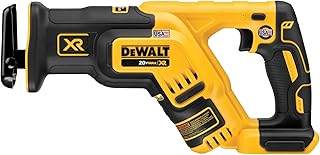
DeWalt DCS380B 20V MAX Reciprocating Saw Review

The DCS380B is the full-size option in DeWalt’s cordless reciprocating saw range, and it’s built for people who need to move serious volume without dragging a cord behind them. It has the longest stroke length of the three cordless models at 1-1/8 inches with a variable stroke rate up to 3,000 SPM, but the real story here is the 4-position blade clamp.
That 4-position clamp lets you rotate the blade to flush-cut, get into corners, or angle the saw for awkward demolition cuts without repositioning your whole body — a genuinely useful feature once you’ve used it on a job where standard blade orientation just doesn’t work with the space you’ve got.
Power and Runtime Trade-offs
Because this is a brushed motor rather than brushless, you’ll see somewhat shorter runtime per charge compared to the DCS367B at equivalent battery capacity, and the saw runs a little hotter under sustained load. For occasional heavy cutting — tearing out framing over a weekend project — that’s a non-issue. For contractors running the saw eight hours a day, it’s worth factoring in extra batteries or considering the corded DWE305 instead.
Pros
- Longest stroke in the cordless lineup, fastest material removal
- 4-position blade clamp adds real versatility
- Handles thick lumber and metal demolition confidently
- Rubber overmold grip reduces vibration fatigue
Cons
- Brushed motor means shorter runtime than brushless siblings
- Heavier and bulkier than the compact models
- Runs warmer under continuous heavy use
Handling Thick Material and Demolition Work
Where the DCS380B separates itself from its compact siblings is in sustained cuts through thick material — 4×4 posts, doubled-up 2x lumber in older framing, or landscape timbers that would bog down a shorter-stroke saw. The longer stroke keeps the cutting edge moving through more material per cycle, which shows up as a noticeably faster finish time on anything thicker than standard 2×4 stock.
During demolition — tearing out an old deck ledger board, cutting through a mix of wood and embedded fasteners, or opening up a wall with unknown framing behind it — the extra mass of the DCS380B actually works in its favor. The saw’s added weight helps drive the blade through resistant material with less need to lean into the cut yourself, which reduces arm fatigue on jobs that stretch over hours rather than minutes.
Trigger Feel and Control
The variable-speed trigger on the DCS380B has a longer travel than the compact models, giving you a wider band of control between a slow, precise starting cut and full-speed material removal. That range is genuinely useful when you’re starting a plunge cut into an unfamiliar wall cavity and want to ease the blade in before committing to full power.

DeWalt DWE305 12-Amp Corded Reciprocating Saw Review
Batteries eventually run out, and on some job sites that’s simply not an acceptable interruption. The DWE305 solves that problem entirely by running on a 12-amp corded motor that never needs a recharge, never loses power as a charge depletes, and never leaves you standing around waiting for a battery to top off.
With a 1-1/8 inch stroke length and up to 2,900 strokes per minute, the DWE305 keeps pace with DeWalt’s strongest cordless models while adding the consistency that only a corded tool can offer. The counterbalance mechanism inside the saw is worth calling out specifically — it actively reduces vibration during operation, which matters enormously if you’re running this saw for hours during a full demolition job rather than a few quick cuts.
Who Actually Needs a Corded Saw in an Era of Better Batteries
It’s a fair question, since cordless battery technology has improved dramatically. The honest answer: anyone doing sustained, all-day demolition work where downtime for battery swaps adds up to real lost hours, and anyone working in a shop or fixed location where a cord isn’t a limitation. Roofers stripping shingles, contractors gutting a kitchen, or anyone cutting through metal studs in volume will appreciate never having to think about battery percentage.
Pros
- Unlimited runtime — no battery to manage
- Counterbalance design meaningfully reduces vibration
- Consistent power output regardless of charge state
- Lower upfront cost since no battery or charger required
Cons
- Cord limits mobility and access in tight areas
- Requires a nearby power source or extension cord
- Less convenient for quick, occasional tasks
Job-Site Considerations
The obvious limitation of any corded tool is the cord itself, and on a real job site that means planning your work around outlet locations or running extension cords through the same space you’re trying to demolish. For interior renovation work where power is readily available at multiple points, this is a minor inconvenience. For outdoor or remote work — cutting into a fence line or working on a structure without active power — it becomes a genuine constraint that the cordless models simply don’t have.
Weight-wise, the DWE305 is the heaviest saw in this lineup at roughly 7.4 pounds, though without a battery pack adding mass at the rear, that weight is distributed differently than on the cordless models. Most users find the balance point comfortable for horizontal cuts but slightly more demanding during extended overhead work compared to the lighter DCS387B.

Beyond This Review: FlexVolt 60V and Atomic One-Handed Models
The four saws reviewed above cover the vast majority of home and job-site needs, but DeWalt’s reciprocating saw catalog extends further in two directions worth knowing about, even if we’re not naming them a top pick here.
DeWalt FlexVolt 60V MAX Reciprocating Saw (DCS389B)
For anyone who has outgrown the 20V MAX platform entirely, DeWalt’s FlexVolt 60V MAX reciprocating saw steps into territory that starts to rival corded power in a cordless package. It runs on FlexVolt batteries that automatically switch voltage depending on the tool they’re inserted into, and DeWalt rates this saw at roughly 19% more power than its predecessor. In practical terms, that extra power shows up most clearly on dense, thick material — cast iron pipe, structural steel, and heavy timber — where the 20V MAX lineup, including the DCS380B, starts to work noticeably harder. The trade-off is weight: the FlexVolt saw runs a couple of pounds heavier than the standard 20V models, which is more noticeable during overhead work than it is cutting at waist height.
If your work regularly involves industrial-grade demolition — cutting through rebar-reinforced material, structural beams, or heavy commercial teardown — the FlexVolt 60V saw is worth researching as a step up from everything covered in our main review. For the majority of residential and light-commercial work, though, the 20V MAX lineup remains the more practical and more affordable choice.
DeWalt Atomic One-Handed Reciprocating Saw (DCS369B)
DeWalt’s Atomic line takes the compact concept of the DCS387B even further. The one-handed Atomic reciprocating saw is built specifically for users who need true single-hand operation — holding a ladder or bracing themselves with the other hand while making a cut, for example — and its shorter body and lighter weight make that possible in situations where even the DCS387B feels like it needs two hands for full control. It’s a niche tool compared to the all-around DCS367B, but for electricians, HVAC technicians, and anyone working from a ladder regularly, it solves a specific problem the rest of the lineup doesn’t fully address.
Where the Atomic one-handed saw falls short is raw cutting power and stroke length, both of which are reduced compared to the standard compact models in exchange for that smaller footprint. It’s a specialist’s tool rather than a general-purpose recommendation, which is why it sits outside our core four-saw comparison rather than replacing any of them.
Orbital Action: Why DeWalt’s Core Reciprocating Saws Don’t Have It
If you’ve shopped reciprocating saws from other brands, you may have come across the term “orbital action” and wondered why it isn’t listed as a feature on the DCS387B, DCS367B, DCS380B, or DWE305. It’s a fair question, since orbital action is a genuinely useful feature on saws that offer it.
What Orbital Action Actually Does
Orbital action adds a slight elliptical, scooping motion to the blade’s return stroke instead of a purely straight push-pull cycle. That extra motion lifts the teeth clear of the material on the way back, clearing sawdust faster and allowing significantly quicker cuts through soft material like framing lumber — some manufacturers cite cutting speed improvements of up to 40% in wood when orbital mode is engaged.
Why It’s Not on These DeWalt Models
None of the four saws in this review — the DCS387B, DCS367B, DCS380B, or DWE305 — include an orbital action switch. DeWalt has historically prioritized straight-line stroke control on its mainstream reciprocating saw lineup, favoring predictable, controlled cuts across mixed materials over the added speed orbital action offers specifically in wood. This is a genuine trade-off worth knowing before you buy: if the bulk of your work is fast, rough demolition cuts through clean lumber, a competitor’s orbital-equipped saw may out-cut these DeWalt models in that narrow scenario. For mixed-material work — cutting through nail-embedded framing, metal, and pipe in the same session — the straight-stroke design across this DeWalt lineup tends to deliver more consistent results, since orbital action is generally recommended against when cutting metal or hard pipe anyway, as the added motion can dull teeth quickly and increase vibration chatter.
If orbital action is a priority for your specific workflow, it’s worth cross-shopping DeWalt’s FlexVolt and newer XR PowerPack-compatible models against competitors before settling on a saw, since feature availability shifts across DeWalt’s broader catalog beyond the four core models covered in this review.
Real-World Use Cases: How Each Saw Performs on Actual Projects
Spec comparisons only tell part of the story. Here’s how these four saws map onto the projects people actually search for a reciprocating saw to complete.
Cutting Through a Wall for a New Doorway
This job mixes drywall, insulation, framing lumber, and the occasional surprise — an electrical line or plumbing stub you didn’t know was there. The DCS367B is the strongest all-around choice here, since its longer stroke handles the framing lumber efficiently while its compact size still lets you work close to the wall surface. If the opening spans a load-bearing area with doubled studs, the DCS380B’s extra power becomes worth the added bulk.
Trimming Tree Branches and Yard Cleanup
For occasional outdoor cutting — removing storm-damaged branches or clearing brush — a cordless model wins outright since running an extension cord across a yard is impractical. The DCS387B is more than capable here, especially fitted with a wood-pruning blade, and its lighter weight makes repeated overhead cuts through branches far less fatiguing than a full-size saw would be.
Full Kitchen or Bathroom Demolition
Gutting a kitchen means hours of continuous cutting through cabinetry, subflooring, and old framing, often with nails and screws hidden throughout. This is the DWE305’s home turf — unlimited runtime means you’re never stopping mid-project to recharge, and the counterbalance system keeps vibration manageable across a long session. If you’d rather stay cordless, the DCS380B is the next best option, provided you have at least two batteries in rotation.
Plumbing Rough-In Work
Cutting PVC, copper, and occasionally cast iron pipe in cramped crawlspaces and wall cavities is precision work more than power work, which plays directly to the DCS387B’s strengths. Its compact nose fits into joist bays that would force a full-size saw into an unworkable angle, and the moderate power output is more than sufficient for pipe-diameter cuts.
Metal Stud Framing and Commercial Buildout
Cutting light-gauge metal studs in volume rewards a saw with a longer stroke and consistent power delivery, making the DWE305 or DCS380B the better fit over a full workday. Pair either with a high-TPI metal blade and expect clean, fast cuts through standard 20 to 25 gauge metal framing.
Emergency and Rescue Cutting
First responders and property maintenance crews sometimes need a reciprocating saw for emergency access — cutting through a door, a fence, or debris after a storm. In these situations, a charged cordless saw that’s immediately ready without hunting for an outlet is invaluable, making the DCS367B or DCS380B the more practical choice to keep staged and ready.
DeWalt Reciprocating Saw Comparison Table
Here’s how all four models stack up side by side. Use this table to quickly narrow your choice based on the specs that matter most for your work.
| Model | Power Source | Motor Type | Stroke Length | Strokes Per Minute | Weight | Best For |
|---|---|---|---|---|---|---|
| DCS387B | 20V MAX Cordless | Brushed | 7/8 in | Up to 3,000 | ~6.1 lbs | Tight spaces, overhead work |
| DCS367B | 20V MAX Cordless | Brushless | 1-1/8 in | Up to 3,000 | ~6.4 lbs | All-around cordless use |
| DCS380B | 20V MAX Cordless | Brushed | 1-1/8 in | Up to 3,000 | ~6.9 lbs | Heavy cordless cutting |
| DWE305 | Corded (12 Amp) | Brushed | 1-1/8 in | Up to 2,900 | ~7.4 lbs | All-day demolition |
For a broader look at how these compare against other power saw categories entirely, our best power saws guide puts reciprocating saws side by side with circular and tile saws so you can decide what your project actually calls for.
DeWalt vs Other Reciprocating Saw Brands
DeWalt isn’t the only serious option in this category, and it’s worth understanding where it stands relative to the other brands you’ll see recommended alongside it.
DeWalt vs Milwaukee
Milwaukee’s reciprocating saws, particularly its SAWZALL line, are often cited as the benchmark for raw power and stroke length, and in side-by-side power comparisons Milwaukee sometimes edges ahead on maximum material removal rate. Where DeWalt tends to win is ergonomics and overall package weight — the DeWalt lineup, especially the compact DCS387B, is noticeably easier to manage during extended or overhead use. If you already own Milwaukee’s M18 battery platform from tools like a Milwaukee circular saw, that ecosystem lock-in matters more than a marginal power difference.
DeWalt vs Makita
Makita’s reciprocating saws are known for smooth power delivery and lower vibration, competing closely with the DCS367B’s brushless performance. The decision here usually comes down to battery platform loyalty rather than a clear performance gap — if you’re already running Makita’s circular saw lineup, staying within that ecosystem avoids the cost of a second battery platform.
DeWalt vs Ryobi
Ryobi’s reciprocating saws are positioned squarely at the homeowner and light-DIY market, with a noticeably lower price point than DeWalt’s professional-grade lineup. For occasional yard work or small repairs, a Ryobi tool can be perfectly adequate, but Ryobi’s saws generally can’t match DeWalt’s build durability or sustained power output for regular job-site use. If your projects are infrequent and light-duty, the cost savings may outweigh the performance gap; if you’re cutting weekly, DeWalt’s added durability tends to pay for itself.
What the Comparison Actually Tells You
Across all three comparisons, the pattern holds: DeWalt competes at or near the top of the professional-grade tier on power and stroke length, while offering a meaningfully better balance of weight and ergonomics than some competitors. The strongest reason to pick DeWalt specifically, though, remains battery ecosystem — if you already own DeWalt 20V MAX tools, buying a DeWalt reciprocating saw as a bare tool is almost always the most cost-effective path forward.
Key Features Explained: What Actually Matters When Buying
Spec sheets throw a lot of numbers at you, and not all of them affect your day-to-day experience equally. Here’s what to actually pay attention to.
Stroke Length
Stroke length is how far the blade travels on each push-pull cycle. A longer stroke — like the 1-1/8 inch stroke on the DCS367B, DCS380B, and DWE305 — removes more material per cycle, which means faster cuts through thick lumber, metal pipe, or nail-embedded framing. The shorter 7/8 inch stroke on the DCS387B trades that speed for a more compact gearcase.
Strokes Per Minute (SPM)
This is how many times the blade cycles per minute at full trigger pull. Higher SPM generally means faster cutting, but it also means more vibration transmitted to your hands, so variable-speed control matters just as much as the maximum number.
Brushed vs. Brushless Motors
Brushless motors run cooler, last longer without maintenance, and typically deliver more runtime per battery charge. They cost more upfront but pay that back in reduced downtime and fewer battery swaps if you’re using the saw regularly.
Blade Clamp Design
Every model in this review uses a tool-free blade clamp, which is now the standard across the industry. The DCS380B’s 4-position clamp goes a step further, letting you orient the blade for flush cuts or awkward angles without repositioning the whole saw.
Vibration Control
Extended use of any reciprocating saw causes hand fatigue, and DeWalt addresses this differently across models — rubber overmold grips on the cordless saws, and an internal counterbalance mechanism on the DWE305. If you’re cutting for more than a few minutes at a stretch, this is worth prioritizing over raw power.
Weight and Balance
A saw’s stated weight only tells part of the story — where that weight sits relative to your grip matters just as much. Tools with the battery mounted close to the handle, like the DCS387B, tend to feel more balanced during one-handed cuts than saws where extra mass sits further back, even at a similar total weight.
Shoe Design and Material Contact
The pivoting shoe at the front of the saw does more than set cutting depth — it also acts as a fulcrum that stabilizes the blade against the material, reducing wander and blade deflection. A well-designed shoe, like the ones across this DeWalt lineup, lets you rock the saw slightly during a cut to maintain a clean cutting angle without lifting the blade off the material entirely.
Blade Selection Guide: Matching the Blade to the Material
Even the best reciprocating saw underperforms with the wrong blade attached, so it’s worth spending as much thought on blade selection as you did on choosing the saw itself.
| Material | Recommended TPI | Blade Type | Notes |
|---|---|---|---|
| Framing lumber (clean) | 5–8 TPI | Wood-cutting blade | Aggressive tooth pattern for fast material removal |
| Demolition lumber (with nails) | 6–10 TPI | Nail-embedded wood blade | Thicker body resists bending against fasteners |
| PVC and plastic pipe | 10–14 TPI | Fine-tooth wood/plastic blade | Reduces melting and chipping at cut edge |
| Thin-gauge metal (conduit, studs) | 18–24 TPI | Bi-metal blade | Fine teeth prevent snagging on thin material |
| Thick metal / pipe | 14–18 TPI | Bi-metal or carbide-tipped blade | Slower feed rate improves blade life |
| Tree branches / green wood | 3–5 TPI | Pruning blade | Wide gullets clear wet sawdust efficiently |
Why TPI Matters More Than Most Buyers Realize
Teeth-per-inch (TPI) determines how aggressively a blade removes material and how clean the resulting cut is. Low-TPI blades cut fast but leave a rougher edge and can vibrate more in thin material; high-TPI blades cut slower but stay controlled on thin-walled pipe and sheet metal where a coarse blade would snag or bend the material. Using a low-TPI wood blade on metal, or vice versa, is one of the most common reasons a buyer blames the saw for a poor cut when the blade was actually the limiting factor.
Blade Length Considerations
Longer blades let you reach deeper into a cut or handle thicker material, but they also flex more under lateral pressure, which can cause wandering cuts in tasks needing precision. As a rule of thumb, choose the shortest blade that comfortably clears the material you’re cutting — a 6-inch blade for standard framing lumber, stepping up to 9- or 12-inch blades only when cutting thicker stock or when you need extra reach into a cavity.
Universal Shank Compatibility
All four DeWalt saws in this review use the industry-standard universal tang blade shank, meaning you’re not locked into DeWalt-branded blades specifically — most major blade manufacturers produce compatible options, giving you flexibility to shop by task-specific blade quality rather than brand matching.
Who Should Buy Which DeWalt Reciprocating Saw
Matching the tool to the task saves you money and frustration. Here’s our practical recommendation breakdown.
| If you are… | Get this model | Why |
|---|---|---|
| An electrician or plumber working in walls and cabinets | DCS387B | Compact size accesses tight cavities other saws can’t reach |
| A remodeler doing mixed daily tasks | DCS367B | Best balance of speed, runtime, and size |
| A framer or demo contractor cutting thick lumber | DCS380B | Longest cordless stroke and 4-position clamp for versatility |
| Doing full-day demolition with no downtime tolerance | DWE305 | Corded power means unlimited runtime and consistent output |
| Already invested in DeWalt 20V MAX batteries | DCS367B or DCS380B | No added battery cost, shares power with your other tools |
If your work also involves cutting sheet material or tile, it’s worth browsing our best tile saws guide or the Porter-Cable tile saw review to round out your toolkit beyond reciprocating cuts.
Buying Guide: What to Consider Before You Buy a Reciprocating Saw
1. Corded vs. Cordless
Cordless saws win on mobility and are more than powerful enough for the vast majority of home and light professional use. Corded saws win when you need unlimited runtime for sustained, heavy-duty work and don’t mind managing a cord.
2. Battery Platform Compatibility
If you already own 20V MAX batteries from another DeWalt tool — a drill, impact driver, or a DeWalt circular saw — buying the bare tool version of any of these reciprocating saws is significantly cheaper than starting a new battery ecosystem.
3. Stroke Length vs. Size Trade-off
Longer stroke length cuts faster but generally means a bulkier gearcase. If your work is dominated by access-limited spaces, prioritize the compact models even if it costs you some cutting speed.
4. Blade Selection
The saw itself is only half the equation — using the wrong blade for the material will slow you down and dull quickly regardless of which saw you buy. Match blade tooth-per-inch (TPI) to material: lower TPI (5–8) for fast, rough cuts in wood, higher TPI (14–24) for metal.
5. Grip and Vibration Comfort
If you’re cutting for more than a few minutes at a time, an overmolded grip and vibration-dampening design will matter more to your comfort than an extra few hundred SPM on the spec sheet.
Kit vs Bare Tool: Which Should You Buy?
Every model in this review is available as a bare tool, and most are also sold in kit form bundled with a battery, charger, and sometimes a carrying case. Choosing between the two comes down to what you already own.
When a Bare Tool Makes Sense
If you already own DeWalt 20V MAX batteries and a charger — from a drill, impact driver, or a DeWalt circular saw already in your collection — buying the bare tool is almost always the better financial move. You avoid paying for a battery and charger you don’t need, and you can put that savings toward a higher-capacity battery if your existing packs are on the smaller side.
When a Kit Makes Sense
If this is your first DeWalt 20V MAX tool, a kit is typically the more cost-effective starting point, since buying a battery and charger separately after the fact usually costs more than the incremental price of a bundled kit. Kits also remove the guesswork of matching battery amp-hour capacity to your saw — most kits pair a mid-size battery, commonly in the 4.0Ah to 5.0Ah range, that balances runtime and weight reasonably well for general use.
Watch for Battery Size in Kits
Not all kits are created equal — some bundle a smaller, lighter battery meant to keep the kit price down, which may leave you wanting more runtime once you start using the saw regularly. If a kit’s battery capacity isn’t clearly listed, it’s worth checking before buying, since a compact 2.0Ah pack will need far more frequent recharging than a 5.0Ah pack on any of these saws, particularly the brushed DCS380B and DWE305.
Common Mistakes to Avoid When Buying or Using a Reciprocating Saw
Buying Based on SPM Alone
Strokes per minute is the most heavily marketed number on any reciprocating saw box, but it’s only meaningful in combination with stroke length. A saw with a high SPM and short stroke can actually remove less material per minute than a slightly slower saw with a longer stroke — which is exactly why the DCS387B’s 3,000 SPM rating doesn’t tell the whole story compared to the DCS367B’s identical SPM paired with a longer stroke.
Ignoring Battery Ecosystem When Comparing Brands
It’s easy to compare saws purely on specs and price, but if you already own batteries from one platform, the true cost of switching brands includes replacing every battery and charger you own. Factor that into any cross-brand comparison, including the ones in this article.
Using the Wrong Blade for the Job
As covered in our blade guide above, a mismatched blade is one of the most common reasons people report disappointing performance from an otherwise capable saw. Before assuming the tool is underpowered, check whether the blade’s TPI actually matches the material.
Not Securing the Workpiece
Reciprocating saws generate substantial reactive force through their cutting stroke, and cutting unsecured material — a board resting loosely on a sawhorse, for example — significantly increases the risk of kickback and an inaccurate cut. Clamp or brace your material whenever possible.
Overworking a Brushed Motor
The DCS380B and DWE305 both use brushed motors, which generate more internal heat under sustained load than brushless designs. Running either saw continuously through thick material for extended periods without brief pauses can shorten motor life over time; give the tool a short break during long demolition sessions.
Buying the Smallest Saw to Save Money
The compact DCS387B is the least expensive cordless option in this lineup, which makes it tempting to default to for budget reasons even if your work regularly involves thicker material. If you find yourself frequently frustrated by slow cuts, the money saved upfront may not be worth the lost time on the job.
Maintenance and Safety Tips for Your Reciprocating Saw
A reciprocating saw is a low-maintenance tool by design, but a few habits will extend its life and keep you safer while using it.
- Clear the shoe of debris regularly. Sawdust and drywall dust build up around the pivoting shoe and can affect depth control over time.
- Inspect blades before each use. A dull or bent blade forces the motor to work harder and increases kickback risk.
- Let brushed motors cool during heavy use. If you’re running the DCS380B or DWE305 for extended demolition, brief pauses prevent heat soak and extend motor life.
- Store batteries at partial charge. For the cordless models, storing lithium-ion batteries fully depleted or fully charged for long periods shortens their lifespan.
- Always secure your material. Reciprocating saws generate significant back-and-forth force; unsecured material is one of the most common causes of kickback injuries.
- Wear eye and hearing protection. These saws throw debris and generate sustained noise well above comfortable levels during extended use.
Cleaning After Use
Wipe down the housing and shoe area after dusty jobs like drywall demolition, and periodically use compressed air to clear dust from the motor vents. Dust buildup inside the vents restricts airflow and can contribute to overheating on brushed models over time.
Blade Storage
Store blades flat or in a dedicated case rather than loose in a tool bag, where the teeth can dull against other metal tools or injure you when reaching in blindly. Labeling blades by TPI and material type saves time reaching for the right one mid-job.
Troubleshooting Guide: Common Reciprocating Saw Problems
The Saw Cuts Slower Than It Used To
This is almost always a blade issue rather than a motor issue. A dull blade forces the motor to work harder for less material removal, and the drop-off in performance can be dramatic even before the blade looks visibly worn. Replace the blade first before assuming the tool itself has lost power.
Excessive Vibration During Cuts
Check that the blade is fully seated and locked in the tool-free clamp, since a loose blade is the most common cause of sudden vibration increases. If the blade is secure, confirm the shoe is making full contact with the material — a shoe that’s lifted or angled away from the workpiece removes the stabilizing effect it’s designed to provide.
Cordless Saw Losing Power Mid-Cut
This is typically a battery state-of-charge issue rather than a tool fault, particularly on brushed models like the DCS380B, which can show a more noticeable power drop-off as the battery depletes compared to brushless saws. Keep a second battery charged and ready during longer sessions.
Blade Won’t Release From the Clamp
Built-up sawdust and debris inside the tool-free clamp mechanism is the most common cause. Use compressed air to clear the clamp area, and avoid forcing the release lever, which can damage the mechanism over time.
Saw Overheating During Extended Use
Brushed motors, present in the DCS387B, DCS380B, and DWE305, generate more heat under sustained load than the brushless DCS367B. If a saw feels excessively hot to the touch, pause and let it cool for several minutes rather than continuing to push through — sustained overheating shortens motor lifespan.
Uneven or Wandering Cuts
Wandering cuts usually trace back to blade selection or shoe contact rather than the saw itself. A blade that’s too long or too flexible for the material will deflect under lateral pressure; switching to a shorter, stiffer blade and keeping consistent shoe pressure against the material typically resolves the issue.
Cost and Long-Term Value: Is Paying More for DeWalt Worth It?
DeWalt’s reciprocating saws sit in the mid-to-upper price range compared to budget brands, and it’s fair to ask whether that premium is justified. A few factors are worth weighing beyond the sticker price.
Bare Tool Pricing and Battery Sharing
Because all four saws in this review are sold as bare tools, the effective cost drops significantly if you already own DeWalt 20V MAX batteries from other tools in your collection. Buyers starting from scratch should factor in the cost of at least one battery and a charger, which can add substantially to the total investment — something worth comparing against bundled kits if you’re building a DeWalt collection from the ground up.
Durability and Replacement Cycles
A well-maintained DeWalt reciprocating saw used for regular home or light professional work commonly lasts many years before needing replacement, particularly the brushless DCS367B, which has fewer wear components to fail over time. Measured against a cheaper saw that might need replacing every year or two under similar use, the higher upfront cost often evens out or comes out ahead over a multi-year ownership period.
Resale and Ecosystem Value
DeWalt tools generally hold resale value better than budget-tier alternatives, and because the 20V MAX battery platform is so widely adopted, a used DeWalt saw remains desirable to buyers who are also already invested in the ecosystem. That resale strength is a real, if often overlooked, part of the total cost-of-ownership equation.
When the Premium Isn’t Worth It
If your entire need is a single occasional-use tool with no existing battery investment and no plan to expand into other cordless tools, a budget brand may legitimately serve you just as well at a lower total cost. The DeWalt premium pays off most clearly for anyone who will use the saw regularly or who’s already building out a broader cordless tool collection.
Warranty Coverage
DeWalt backs its reciprocating saws with a standard limited warranty program that typically includes a multi-year limited warranty against manufacturing defects, along with a separate no-questions-asked satisfaction guarantee period shortly after purchase and a free service period covering routine maintenance items. Registering your tool with DeWalt shortly after purchase is worth doing, since it simplifies any future warranty claim and can extend coverage windows on certain models compared to relying on a receipt alone.
Where DeWalt Reciprocating Saws Are Manufactured
DeWalt, like most major power tool brands, sources components and assembles tools across a global supply chain rather than a single country of origin. Some DeWalt reciprocating saws are assembled in the United States using a mix of domestic and globally sourced parts, while others in the broader catalog are manufactured entirely overseas; the exact designation varies by model and can change between production runs. If country of origin is a deciding factor for you, checking the specific packaging and product listing for the model you’re considering is the most reliable way to confirm current sourcing, since blanket claims about the entire DeWalt lineup aren’t accurate in either direction.
Frequently Asked Questions
Is the DeWalt DCS367B worth the extra cost over the DCS387B?
If you use the saw regularly rather than occasionally, yes. The brushless motor on the DCS367B delivers meaningfully longer runtime and a longer stroke for faster cuts, which pays for itself over time in fewer battery swaps and reduced job time.
Can I use these DeWalt reciprocating saws to cut metal?
Yes, all four models can cut metal when fitted with an appropriate high-TPI metal-cutting blade. The DCS380B and DWE305, with their longer 1-1/8 inch stroke, tend to cut through thicker metal stock more efficiently.
Do these saws come with a battery and charger included?
No. All four models reviewed here are sold as bare tools, meaning you’ll need to purchase a compatible 20V MAX battery and charger separately if you don’t already own DeWalt 20V MAX equipment.
Which DeWalt reciprocating saw is best for demolition work?
For all-day, heavy demolition, the corded DWE305 is the strongest choice because it never loses power to a depleting battery. For cordless demolition, the DCS380B’s longer stroke and 4-position blade clamp make it the better cordless option.
Is a corded or cordless reciprocating saw better?
Cordless is better for mobility, access, and most home or light-duty professional use. Corded is better for sustained, high-volume cutting where you can’t afford downtime for battery swaps.
Can the DCS387B handle framing and stud cutting?
Yes, it handles standard 2x lumber and stud cutting comfortably. It’s simply slower on thick material than the longer-stroke models due to its shorter 7/8 inch stroke length.
How long do DeWalt 20V MAX batteries last on a reciprocating saw?
Runtime varies significantly based on material density and battery amp-hour rating, but a 5.0Ah battery typically supports 30 to 60 minutes of intermittent cutting on brushless models like the DCS367B, less on brushed models.
What blade should I use for general demolition work?
A general-purpose demolition blade with a low TPI (around 6–8) designed for wood with embedded nails is the standard choice for most demolition tasks across all four of these saws.
Are DeWalt reciprocating saws compatible with other brands’ batteries?
No. These saws are built exclusively for DeWalt’s 20V MAX battery platform and are not cross-compatible with other manufacturers’ battery systems.
Is the DCS380B too heavy for overhead cutting?
At roughly 6.9 pounds with a battery installed, it’s manageable for short overhead tasks but will fatigue your arms faster than the lighter DCS387B during extended overhead sessions.
How does the DWE305’s vibration control compare to the cordless models?
The DWE305’s internal counterbalance mechanism is specifically engineered to offset the blade’s reciprocating motion, generally resulting in noticeably less felt vibration than the cordless models during sustained cutting.
Which DeWalt reciprocating saw offers the best value for a homeowner?
For most homeowners doing occasional projects, the DCS387B offers the best value if compact size and one-handed use matter, while the DCS367B is worth the upgrade if you’ll use the saw often enough to benefit from the brushless motor’s longer runtime.
What size battery should I pair with a DeWalt reciprocating saw?
A 4.0Ah or 5.0Ah battery is generally the best balance of runtime and weight for regular use, while smaller 2.0Ah packs are fine for occasional, light-duty cutting where minimizing tool weight matters more than extended runtime.
Can I use a reciprocating saw to cut down small trees?
Yes, with a dedicated pruning blade, a reciprocating saw can handle branches and small-diameter trunks effectively, though a dedicated chainsaw is more efficient for anything beyond occasional yard cleanup.
How is DeWalt’s reciprocating saw lineup different from Milwaukee’s?
Milwaukee’s saws are often slightly ahead on raw stroke power in some model comparisons, while DeWalt’s lineup, particularly the compact DCS387B, tends to offer better ergonomics and lighter overall weight. The better choice usually comes down to which battery platform you already own.
Do reciprocating saw blades fit across different brands?
Yes. All four DeWalt saws in this review use the industry-standard universal tang blade shank, so blades from most major manufacturers will fit regardless of brand.
Why does my reciprocating saw cut slower than when it was new?
In the vast majority of cases, this is caused by a dull or damaged blade rather than a decline in the tool’s motor performance. Replacing the blade typically restores cutting speed immediately.
Is it safe to cut metal pipe with these DeWalt reciprocating saws?
Yes, provided you use an appropriate bi-metal or carbide-tipped blade matched to the pipe’s thickness, and you secure the pipe firmly to prevent it from spinning or shifting during the cut.
What’s the difference between the DCS380B’s 4-position blade clamp and standard clamps?
A standard blade clamp holds the blade in a single fixed orientation, while the DCS380B’s 4-position clamp lets you rotate the blade 90 degrees at a time, useful for flush cuts against a wall or awkward-angle demolition cuts without repositioning the entire saw.
Does DeWalt make a one-handed reciprocating saw?
Yes. The DeWalt Atomic 20V MAX One-Handed Reciprocating Saw is built for true single-hand operation, with a shorter body and lighter weight than even the compact DCS387B, making it a specialist option for ladder work and situations where your other hand is occupied.
Do DeWalt reciprocating saws have orbital action?
No, the DCS387B, DCS367B, DCS380B, and DWE305 covered in this review use a straight-line stroke rather than orbital action. DeWalt prioritizes consistent, controlled cutting across mixed materials on this lineup rather than the faster wood-cutting speed orbital action provides.
Is there a 60V FlexVolt DeWalt reciprocating saw?
Yes. DeWalt’s FlexVolt 60V MAX reciprocating saw (DCS389B) delivers more power than the 20V MAX lineup and is aimed at heavy industrial cutting, such as structural steel and cast iron pipe, though it’s heavier and priced higher than the 20V MAX models in this review.
What is DeWalt’s warranty on reciprocating saws?
DeWalt reciprocating saws are generally covered by a multi-year limited warranty against manufacturing defects, plus a separate short-term satisfaction guarantee and a limited free service period. Registering the tool after purchase helps streamline any future warranty claim.
Are DeWalt reciprocating saws made in the USA?
It varies by model. Some DeWalt reciprocating saws are assembled domestically using a mix of US and globally sourced components, while others in the broader catalog are manufactured overseas, so checking the specific product listing is the most reliable way to confirm sourcing for a given model.
Final Verdict: Our Recommendation
There’s no single “best” DeWalt reciprocating saw — there’s a best one for your specific work. For most homeowners and remodelers who want one saw that handles nearly everything well, the DCS367B is our overall pick thanks to its brushless motor, longer stroke, and manageable size. If you’re constantly working in tight cavities, the DCS387B is worth the trade-off in cutting speed. Heavy cordless demolition points to the DCS380B, and anyone running the saw all day without tolerance for battery downtime should go corded with the DWE305.
Whichever model fits your work, all four share the build quality and reliability that make DeWalt a dependable choice on the job site. Pair your new saw with the right blade for the material you’re cutting most, and it’ll outlast most projects you throw at it.

For more buying guides and comparisons across the DeWalt lineup and beyond, explore our best reciprocating saws roundup, our best power circular saws guide, or check out how DeWalt stacks up against Makita and Ryobi in our brand-by-brand reviews.