Best Bosch Drill: The Complete Buying Guide for DIYers and Pros
We compared Bosch’s brushless and brushed drill/driver lineup on power, run-time, chuck design, and real job-site value to help you pick the right one for your toolbox.
Why Trust Bosch Drills
Bosch has been building power tools since the early 1900s, and its drill lineup reflects that long engineering pedigree. Where a lot of budget brands chase a low price tag by trimming motor windings and gear quality, Bosch tends to protect the drivetrain first and let the accessories catch up later. That’s why you’ll see the same core chuck, clutch, and motor architecture repeated across a dozen SKUs, just tuned differently for weight, speed, and price.
If you’re comparing power tool ecosystems more broadly, it’s worth reading our breakdown of the best drills for DIY and pro use, which looks at Bosch alongside other major brands. Bosch’s specific strength is consistency: a 12V Bosch drill from one generation feels remarkably similar in balance and trigger response to the next, which matters if you’re building out a matched set of tools on one battery platform rather than mixing and matching.
In this guide we’re focused entirely on five current Bosch drill and drill/driver options, ranging from a compact 12V driver kit meant for cabinetry and trim work up to an 18V brushless hammer drill built for masonry and heavy framing. Whichever one you land on, you’re buying into a brand that treats the drill as core infrastructure, not a throwaway accessory.
Quick Picks at a Glance
If you don’t have time to read the full breakdown, here’s the short version. Each of these five Bosch drills earns its spot for a specific type of buyer.
| Model | Best For | Voltage | Motor |
|---|---|---|---|
| Bosch GSB18V-490B12 | Masonry & heavy-duty hammer drilling | 18V | Brushless |
| Bosch CLPK22-120 | Budget-friendly starter combo kit | 12V Max | Brushed |
| Bosch PS31-2A | Lightweight everyday driving/drilling | 12V Max | Brushed |
| Bosch GSR12V-140FCB22 | Compact jobs needing torque control | 12V Max | Brushed |
| Bosch GSR18V-400B12 | All-around brushless workhorse | 18V | Brushless |
Check Price on Amazon
How We Evaluated These Drills
We didn’t just read spec sheets. Each drill was scored across five practical categories that actually affect how a tool feels on a job: raw torque and speed range, chuck and bit-retention quality, battery run-time versus weight, ergonomics under sustained use, and price-to-capability ratio. A drill that wins on paper but tires your wrist out after twenty minutes isn’t actually the “best” drill for most people, so ergonomics carried real weight in our scoring.
We also paid attention to how each drill fits into a broader tool ecosystem. If you already own Bosch 12V Max batteries, a new 12V tool is effectively cheaper than its sticker price because you’re not buying batteries and a charger again. That context changes which drill is “best” depending on what’s already in your bag, so we’ve called out battery compatibility for every pick below.
For readers who want a wider lens on how Bosch stacks up against other major manufacturers, our comparisons of the best DeWalt drill, the best Milwaukee drill, and the best Makita drill are useful companion reads if you’re still brand-shopping rather than committed to Bosch.
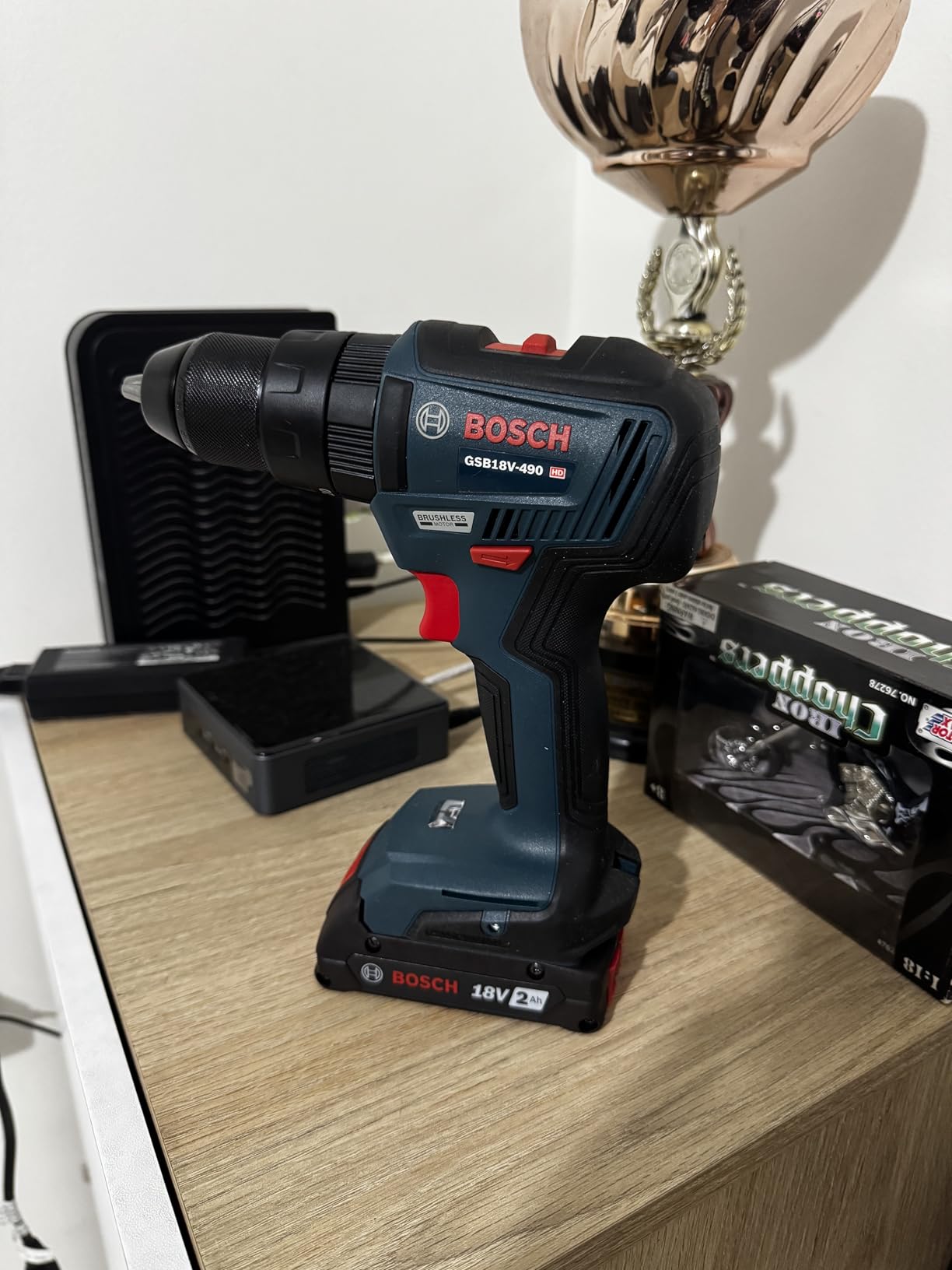
1. Bosch GSB18V-490B12 18V EC Brushless 1/2 In. Hammer Drill

The GSB18V-490B12 is the heaviest hitter in this lineup, and it’s the one to reach for if your work regularly involves masonry, concrete anchors, or dense framing lumber where a standard drill/driver starts to bog down. Bosch built this around its EC brushless motor platform, which trades the wear-prone carbon brushes of older motors for electronically commutated coils. In practice that means less heat build-up under load, longer motor life, and noticeably more torque per amp-hour pulled from the battery.
The hammer function is the headline feature. Flip the mode selector and the chuck adds a rapid hammering action on top of rotation, which is what actually lets a masonry bit chew through brick or block instead of just spinning uselessly against the surface. For wood and metal work you simply leave it in rotary-only mode, so this isn’t a specialty tool you’ll only use once a year — it covers everyday drilling duty just as well as dedicated drill/drivers do.
Standout Features
- 1/2-inch all-metal keyless chuck rated for larger masonry and spade bits
- Two-speed gearbox (0-600 / 0-2,000 RPM) for both high-torque driving and fast drilling
- Up to 620 in-lbs of max torque, among the strongest in Bosch’s compact 18V lineup
- LED work light with afterglow that stays lit briefly after the trigger is released
- Compatible across Bosch’s full 18V battery ecosystem, including higher-capacity packs
| Spec | Detail |
|---|---|
| Chuck Size | 1/2 in. |
| Max Torque | 620 in-lbs |
| No-Load Speed | 0-600 / 0-2,000 RPM |
| Weight (bare tool) | ~3.7 lbs |
| Motor | EC Brushless |
Pros
- Genuine hammer-drill capability for masonry work
- Brushless motor runs cooler on long sessions
- Strong torque ceiling for framing and large bits
Cons
- Heavier and bulkier than the 12V options here
- Overkill for light trim or cabinetry work
If you’re not sure whether you actually need hammer capability, our guide on the difference between a drill and an impact driver is worth a look — masonry work specifically calls for a hammer drill rather than an impact driver, and this model is one of the more affordable brushless hammer drills Bosch currently sells.
Check Price on Amazon
2. BOSCH 12V Max Cordless 2-Tool Combo Kit with Drill (CLPK22-120)

The CLPK22-120 is Bosch’s answer for someone building a starter kit rather than buying a single drill in isolation. It pairs a compact 12V Max drill/driver with an impact driver, two batteries, a charger, and a carrying case, which usually works out cheaper than buying each tool separately. If you’re setting up a garage workshop from scratch, this combo removes a lot of the guesswork around what to buy first.
The drill in this kit isn’t the most powerful thing Bosch makes, and it doesn’t need to be — 12V Max drivers are designed around control and maneuverability rather than raw torque. That makes this combo particularly well suited to furniture assembly, deck railing, shelving, and other tasks where precision matters more than muscle.
Standout Features
- Two-tool kit: drill/driver plus impact driver in one box
- Dual 12V Max batteries included, so one always stays charged
- Compact head length for tight cabinet and stud-bay work
- Single-sleeve, one-handed 3/8-inch chuck
Pros
- Excellent value for two tools plus accessories
- Lightweight enough for extended overhead work
- Great starter kit for new homeowners or hobbyists
Cons
- Brushed motor, so less efficient than brushless picks
- Not intended for heavy masonry or dense hardwood
Anyone weighing corded versus cordless setups before committing to a kit like this should also check our corded vs. cordless drill comparison, which explains why most home users are better served by a cordless combo kit like this one rather than a corded drill tied to an outlet.
Check Price on Amazon
3. BOSCH Cordless Drill PS31-2A 12V Max 3/8 In. Drill/Driver Kit

The PS31-2A is one of the most compact drills Bosch makes, and that compactness is really the entire pitch. At under 8 inches long, it slips into stud bays, cabinet interiors, and tight corners that a full-size 18V drill simply can’t reach. If your work is mostly interior — trim carpentry, cabinet installs, electrical box work — this is a genuinely different tool experience than a bulkier drill, not just a smaller version of one.
Bosch pairs the compact body with a two-speed transmission and a 20+1 clutch, giving you fine control over driving depth so you’re not stripping screw heads or blowing through drywall. It’s a driver-first tool that happens to drill competently, rather than a drilling powerhouse that also drives screws.
Standout Features
- Ultra-compact 7.6-inch length for tight-space access
- 20+1 clutch settings for precise torque control
- Two-speed gearbox: 0-350 / 0-1,300 RPM
- Integrated LED light with 20-second afterglow
Pros
- Best-in-class compactness for tight spaces
- Precise clutch control avoids over-driving screws
- Comfortable for one-handed, extended use
Cons
- Lower torque ceiling than 18V models
- 3/8-inch chuck limits max bit shank size
Check Price on Amazon
4. BOSCH GSR12V-140FCB22 12V Max Drill

The GSR12V-140FCB22 sits between the ultra-compact PS31-2A and the full-power 18V models, offering a FlexiClick-style modular head system on some kit variants that lets you swap between a standard chuck, a right-angle attachment, and an offset bit holder without changing tools. That modularity is genuinely useful if you regularly hit situations where a straight drill just can’t get the angle you need — behind pipes, inside cabinets, under sink basins.
Even without the FlexiClick attachments in play, this is a well-balanced 12V driver with a comfortable grip and predictable clutch behavior, making it a strong pick for anyone doing repetitive assembly work like flat-pack furniture, deck boards, or fence pickets.
Standout Features
- Compatible with Bosch FlexiClick attachment heads for angled access
- Two-speed gearbox for driving and drilling flexibility
- Compact, lightweight body reduces wrist fatigue over long sessions
- Bright LED work light for low-visibility work areas
Pros
- Modular head system adds real versatility
- Comfortable for repetitive, high-volume driving tasks
- Good middle-ground torque for a 12V tool
Cons
- FlexiClick heads sold separately on some kit versions
- Still a 12V ceiling on max torque output
Check Price on Amazon
5. Bosch GSR18V-400B12 18V Compact Brushless 1/2 In. Drill

The GSR18V-400B12 is the all-around workhorse of this lineup — an 18V brushless drill/driver without the added weight and complexity of hammer functionality. If you don’t need to drill into masonry but still want 18V power, a metal 1/2-inch chuck, and brushless efficiency, this is the model built specifically for that gap.
It splits the difference nicely between the compact 12V tools above and the heavier-duty hammer drill at the top of this list. You get real torque for framing lumber, deck posts, and larger spade or auger bits, while keeping a manageable weight that doesn’t wear out your wrist on a long day of overhead drilling.
Standout Features
- Brushless motor for extended run-time and reduced heat
- 1/2-inch metal chuck rated for larger bit shanks
- Two-speed gearbox (0-600 / 0-2,000 RPM)
- Compact form factor relative to other 18V drills
Pros
- Strong all-around torque without hammer-drill bulk
- Brushless efficiency extends battery life per charge
- Balanced weight for extended use
Cons
- No hammer function for masonry drilling
- Costs more than comparable 12V options
Check Price on Amazon
Full Side-by-Side Comparison
Here’s every spec that matters lined up in one place, so you can weigh trade-offs quickly instead of digging through five separate product pages.
| Model | Voltage | Motor | Chuck | Speed Range | Hammer Function |
|---|---|---|---|---|---|
| GSB18V-490B12 | 18V | Brushless | 1/2 in. | 0-600 / 0-2,000 RPM | Yes |
| CLPK22-120 | 12V Max | Brushed | 3/8 in. | Single/variable speed | No |
| PS31-2A | 12V Max | Brushed | 3/8 in. | 0-350 / 0-1,300 RPM | No |
| GSR12V-140FCB22 | 12V Max | Brushed | 3/8 in. (or FlexiClick) | Two-speed | No |
| GSR18V-400B12 | 18V | Brushless | 1/2 in. | 0-600 / 0-2,000 RPM | No |
Buying Guide: What Actually Matters When Choosing a Bosch Drill
Specs sheets throw a lot of numbers at you, but only a handful of them actually change how a drill performs in your hands. Here’s what we’d prioritize, roughly in order of real-world impact.
1. Task Type Before Brand Loyalty
Before you even compare Bosch models against each other, get honest about what you’re actually drilling into most often. Masonry and concrete require hammer capability — no amount of torque substitutes for that rapid hammering action. Wood framing and metalwork want a strong brushless motor and a 1/2-inch chuck. Trim, cabinetry, and furniture assembly want compactness and clutch precision far more than raw power.
2. Voltage Isn’t Everything
It’s tempting to assume 18V always beats 12V, but that’s only true for torque ceiling. A 12V Max drill like the PS31-2A is lighter, more maneuverable, and easier on your wrist for repetitive tasks. Unless you’re regularly pushing past 1-inch spade bits or drilling into hardwood joists all day, a 12V tool may honestly serve you better day to day.
3. Battery Ecosystem Compatibility
If you already own Bosch 12V or 18V batteries from another tool, buying within that same voltage platform effectively cuts your cost, since bare-tool options are usually available. Mixing voltage platforms means running two chargers and two sets of batteries, which adds clutter and cost over time.
4. Chuck Size and Bit Compatibility
A 1/2-inch chuck accepts larger-shank bits — spade bits, large auger bits, hole saws with bigger arbors — while a 3/8-inch chuck caps you at smaller accessories. If you do any deck-building, fence work, or large-hole drilling, the 1/2-inch chuck models in this list (the GSB18V-490B12 and GSR18V-400B12) will save you frustration.
5. Weight and Ergonomics
A drill that’s a joy to use for five minutes on a showroom floor can become miserable after an hour of overhead work. Compact 12V tools generally weigh 2 to 2.5 lbs, while full-size 18V hammer drills can push past 3.5 lbs with a battery attached. If you do a lot of overhead or one-handed work, that difference compounds fast.
Brushless vs. Brushed Motors: Why It Matters
Two of the five drills here — the GSB18V-490B12 and the GSR18V-400B12 — use Bosch’s EC brushless motor technology, while the three 12V models in this lineup use traditional brushed motors. The difference isn’t just marketing language.
A brushed motor uses physical carbon brushes that make contact with a spinning commutator to deliver current. That contact generates friction, heat, and gradual wear, which is why brushed motors eventually need brush replacement and tend to run hotter under sustained load. A brushless motor replaces that mechanical contact with electronic commutation, controlled by a small circuit board that switches current through the motor’s coils. The upshot: less wasted energy as heat, more torque delivered per amp-hour, less internal wear, and typically a smaller, lighter motor for the same power output.
In practice, that means brushless drills like the two 18V models here tend to run longer on a single charge, feel a little cooler in your hand during long sessions, and last longer before internal wear becomes noticeable. The trade-off is price — brushless tools generally carry a premium over comparable brushed models, which is part of why Bosch’s 12V lineup leans on brushed motors to hit a lower price point for casual users.
Understanding Bosch’s Battery Platforms
Bosch splits its cordless tools across two main voltage platforms relevant here: 12V Max and 18V. These aren’t interchangeable — a 12V Max battery only fits 12V Max tools, and 18V batteries only fit 18V tools. Before buying any drill on this list, it’s worth checking what battery platform you already own, since that context can make one otherwise-equal option meaningfully cheaper than another.
The 12V Max line prioritizes compact size and low weight, which is why the CLPK22-120, PS31-2A, and GSR12V-140FCB22 all sit in that category. The 18V line, home to the GSB18V-490B12 and GSR18V-400B12, prioritizes torque and run-time for heavier-duty work. If you’re building a full kit over time — drill, impact driver, oscillating tool, work light — sticking to one platform means every future tool purchase can be a bare tool rather than a full kit with batteries and a charger.
Do You Need a Drill or an Impact Driver?
None of the five tools reviewed here are impact drivers, but it’s a common point of confusion worth addressing directly. A drill/driver, like everything on this list, spins continuously and gives you a keyless chuck that accepts round or hex-shank bits along with a clutch for controlling drive depth. An impact driver adds rotational hammering blows on top of that spin, which delivers far more driving torque for long screws and lag bolts, at the cost of less finesse for precision drilling and driving.
If your work leans toward drilling clean, accurate holes — for hinges, dowels, shelf pins, or masonry with the GSB18V-490B12’s hammer function — a drill/driver like the ones covered here is the right category. If you’re regularly driving 3-inch deck screws or structural lag bolts, pairing one of these drills with a dedicated impact driver (like the one included in the CLPK22-120 combo kit) covers both bases. Our full drill vs. impact driver comparison goes deeper into when each tool actually earns its keep.
Maintenance and Longevity Tips
Even a well-built Bosch drill will underperform if it’s neglected. A few habits go a long way toward keeping any of these five models running like new for years.
- Keep the chuck clean: Dust and debris packed into the chuck jaws cause bits to slip or run off-center. A quick blast of compressed air after dusty jobs prevents most chuck issues.
- Don’t run the clutch too loose: Repeatedly stalling the motor against a high-resistance clutch setting generates unnecessary heat, especially on the brushed 12V models.
- Store batteries at partial charge: Lithium-ion packs, which all five of these tools use, degrade faster when stored fully charged or fully dead for long periods. Aim for roughly 40-60% charge for long-term storage.
- Avoid overheating on brushed models: If you notice unusual heat, reduced power, or a burning smell, stop and let the tool cool down. Our guide on why a drill might start smoking covers the warning signs and what to do if it happens.
- Learn proper technique early: If you’re newer to power tools, our how to use a drill guide covers grip, bit selection, and drilling technique that reduces wear on both the tool and your bits.
Who Should Buy Which Bosch Drill
Rather than crowning one single “best” drill, it’s more useful to match each of these five to the buyer it actually fits.
- Homeowners doing occasional masonry or heavy framing: the GSB18V-490B12 is worth the extra weight and cost for its hammer function and brushless torque.
- First-time tool buyers building a starter kit: the CLPK22-120 combo kit gives you a drill and impact driver together at a friendlier price point than buying separately.
- Trim carpenters and cabinet installers: the PS31-2A’s compact length is purpose-built for tight interior spaces.
- Buyers who need angled or offset access regularly: the GSR12V-140FCB22’s FlexiClick compatibility solves problems a straight drill can’t.
- Anyone wanting one capable all-purpose 18V drill without hammer bulk: the GSR18V-400B12 is the balanced, do-everything pick in this lineup.
If you’re still torn between brands rather than models, our roundups of the best Ryobi drill and the other brand comparisons linked earlier in this guide can help you decide whether Bosch’s ecosystem is the right long-term investment for your toolbox.
Frequently Asked Questions
Which Bosch drill is best for a beginner DIYer?
The CLPK22-120 combo kit is the easiest entry point since it includes both a drill/driver and an impact driver, two batteries, and a charger in one box, covering most home projects without needing a second purchase right away.
Can any of these Bosch drills drill into concrete?
Only the GSB18V-490B12 has a hammer function, which is required for efficient masonry and concrete drilling. The other four models are standard drill/drivers and are not designed for concrete work.
Is an 18V Bosch drill always better than a 12V Max model?
Not necessarily. 18V models offer more torque and a larger chuck, but 12V Max tools are lighter, more compact, and easier to control for extended trim, cabinetry, or assembly work. The “better” choice depends on the task, not just the voltage number.
Are Bosch 12V Max batteries interchangeable with 18V tools?
No. Bosch’s 12V Max and 18V platforms use physically different battery packs that are not cross-compatible. Always match your battery purchases to the voltage platform of the tool.
What’s the difference between a brushless and brushed Bosch drill?
Brushless motors, used in the GSB18V-490B12 and GSR18V-400B12, run cooler, last longer, and deliver more torque per charge than the brushed motors used in Bosch’s 12V Max lineup, at a higher price point.
Do these Bosch drills come with a warranty?
Bosch power tools typically include a manufacturer’s limited warranty covering defects in materials and workmanship; check the specific listing for the exact coverage length and registration requirements at the time of purchase.
What size drill bits can I use with a 1/2-inch chuck?
A 1/2-inch chuck, found on the GSB18V-490B12 and GSR18V-400B12, accepts larger-shank bits including big spade bits, auger bits, and larger hole saw arbors that won’t fit in a smaller 3/8-inch chuck.
Is the FlexiClick system worth it on the GSR12V-140FCB22?
If you regularly need angled or offset access — behind pipes, inside cabinets, near obstructions — the FlexiClick attachment system solves problems a standard straight drill can’t, making it a worthwhile upgrade for that specific use case.
How long do Bosch drill batteries typically last per charge?
Run-time depends heavily on the task, bit size, and material, but brushless 18V models generally get more work done per charge than comparable brushed 12V tools due to more efficient power delivery.
Can I use these drills for both driving screws and drilling holes?
Yes, all five models function as combination drill/drivers with adjustable clutch settings, letting you switch between controlled screw-driving and full-power drilling on the same tool.
Which Bosch drill is the lightest in this lineup?
The PS31-2A is the most compact and lightweight option here, purpose-built for tight-space access and extended one-handed use.
Should I buy a Bosch drill as a bare tool or in a kit?
If you already own compatible Bosch batteries and a charger, a bare tool saves money. If you’re starting from scratch, a kit like the CLPK22-120 is usually more cost-effective than buying batteries and a charger separately.
Final Verdict
All five of these Bosch drills are well-built, but they’re not interchangeable — the right one depends entirely on what you’re actually building. For heavy-duty masonry and framing, the GSB18V-490B12’s brushless hammer-drill combo is the strongest overall performer. For a complete starter setup, the CLPK22-120 combo kit is hard to beat on value. And if you want one balanced, do-everything 18V drill without the added hammer-drill bulk, the GSR18V-400B12 is our pick for most everyday users.
See Current Prices on Amazon