
Why Trust This Guide
Milwaukee has spent more than two decades building a reputation as one of the most trusted names in professional power tools, both among tradespeople who rely on their gear daily and among serious DIYers who want tools that will still perform reliably years down the road, and the M18 platform sits at the center of that reputation. With dozens of drill/driver models spanning multiple generations, choosing the right one is not as simple as grabbing whatever is on the shelf at the hardware store. Chuck size, motor type, battery compatibility, torque output, and even the size of the grip all matter depending on whether you are hanging drywall, driving lag bolts into a deck, or drilling into concrete for an anchor point.
This guide breaks down seven of the most popular Milwaukee M18 drill/driver options on the market right now, comparing them side by side so you can quickly identify which one fits your budget, your skill level, and the type of work you actually do. Every recommendation here is based on real-world specifications, common usage patterns reported by tradespeople and DIYers, and how each tool stacks up against the rest of the Milwaukee lineup.
If you are shopping for a drill outside the Milwaukee ecosystem, or you want to see how these tools compare to other major brands, our best drills for DIY and pro use roundup covers a wider range of options across every major manufacturer.
Throughout this guide, we focused on models that consistently show up as top sellers and consistently earn strong feedback from real users across a wide range of applications, from light household repairs to daily commercial use. Rather than simply listing specs pulled from a manufacturer’s datasheet, each entry considers how the tool actually performs in practice: how it feels during extended use, how it handles under load, and where it genuinely stands out from the rest of Milwaukee’s own lineup.
Quick Comparison Table
Before diving into the individual reviews, here is a fast side-by-side look at how these seven Milwaukee drills compare on the specs that matter most: motor type, chuck size, hammer function, and overall best use case.
| Model | Motor | Chuck | Hammer Function | Best For |
|---|---|---|---|---|
| M18 FUEL Hammer Drill/Driver | Brushless | 1/2″ | Yes | Pros needing masonry + wood/metal |
| M18 Compact Kit 2606-21CT | Brushed | 1/2″ | No | Budget-conscious DIYers |
| M18 FUEL 2903-20 | Brushless | 1/2″ | No | Daily driving/drilling workhorse |
| M18 Compact Brushless Drill/Driver | Brushless | 1/2″ | No | Tight-space work, overhead tasks |
| M18 FUEL 2804-20 Hammer Drill | Brushless | 1/2″ | Yes | Concrete/masonry anchoring |
| M18 2691-22 Combo Kit | Brushed | 1/2″ | No | Beginners wanting drill + impact |
| M18 FUEL 2-Tool Combo Kit | Brushless | 1/2″ | Yes (drill) | Pro-grade two-tool starter set |
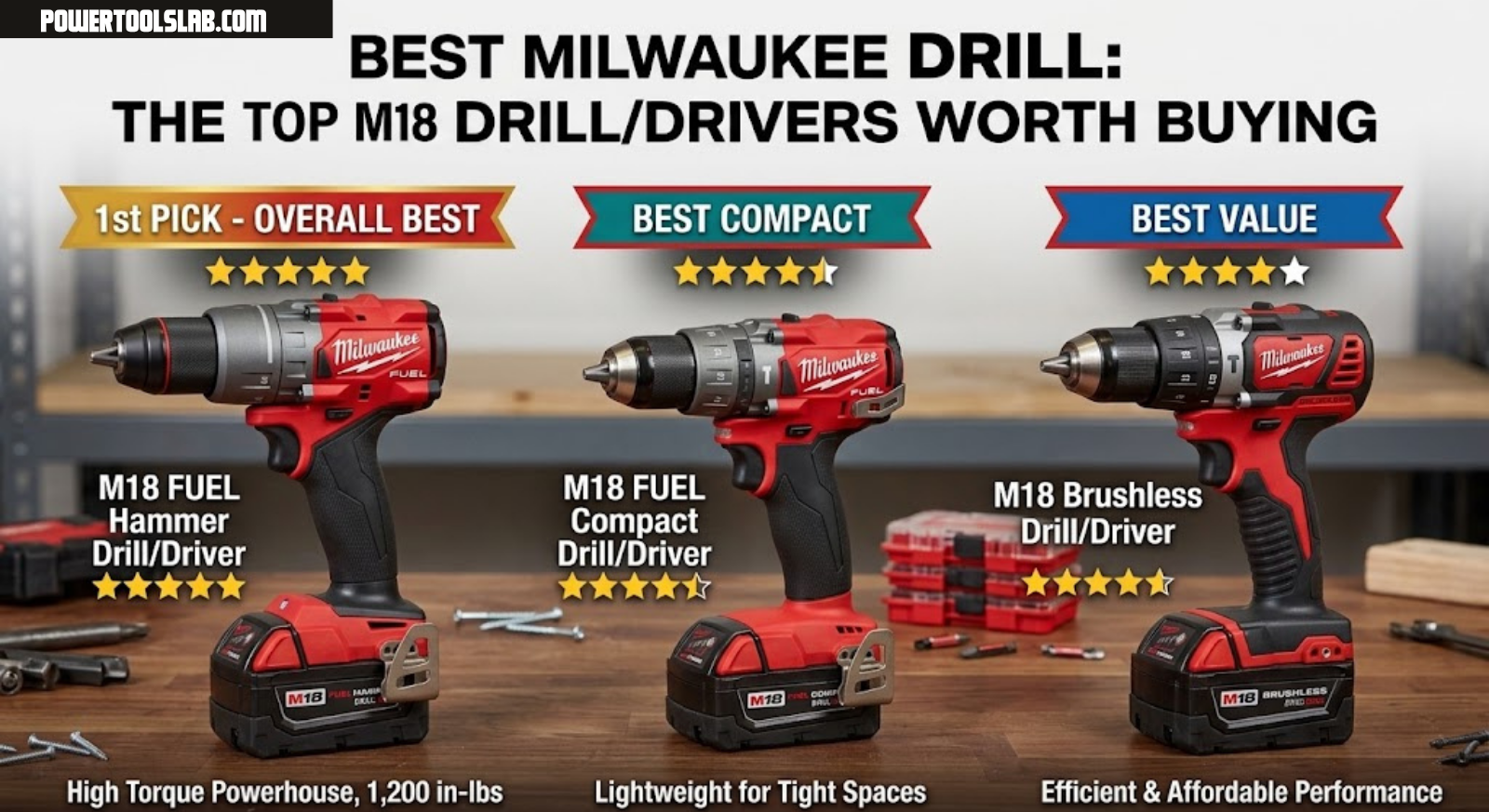
1. Milwaukee M18 FUEL 1/2″ Hammer Drill/Driver

Milwaukee Electric M18 Fuel 1/2″ Hammer Drill/Driver
The flagship of the lineup, built for pros who need one tool to handle wood, metal, and masonry without switching drills mid-job.
If you only buy one Milwaukee drill, this is the one most professionals point to first. The M18 FUEL Hammer Drill/Driver pairs Milwaukee’s brushless POWERSTATE motor with a REDLINK PLUS intelligence system that constantly monitors temperature, current, and load to protect both the tool and the battery from damage. The result is a drill that pulls hard through dense hardwood, drives long lag screws without bogging down, and switches into hammer mode for light masonry work like anchoring a ledger board into a block wall.
What separates this model from a standard drill/driver is the all-metal, four-pole hammer mechanism. Instead of a plastic hammer mechanism that wears out after a season of heavy use, Milwaukee built this one to survive years of daily use on active jobsites. The two-speed all-metal transmission gives you a low-speed, high-torque range for driving large fasteners and a high-speed range for fast hole drilling.
Key Features
- POWERSTATE brushless motor for extended run time and more power per charge
- REDLINK PLUS intelligence for overload protection
- All-metal four-pole hammer mechanism
- LED work light with three-mode delay for illuminating dark work areas
- All-metal, two-speed transmission
Pros
- Handles masonry, wood, and metal without swapping tools
- Excellent runtime thanks to brushless efficiency
- Durable metal gearbox and hammer mechanism
Cons
- Higher price point than non-hammer models
- Slightly heavier due to added hammer mechanism
2. Milwaukee M18 Compact Kit 2606-21CT

Milwaukee M18 18V Lithium-Ion Compact Kit 2606-21CT
An affordable entry point into the M18 ecosystem without sacrificing Milwaukee’s build quality.
Not everyone needs a brushless, hammer-capable drill for weekend projects around the house. The 2606-21CT is Milwaukee’s answer for homeowners and light-duty users who still want the reliability of the M18 platform without paying for features they will rarely use. This compact kit typically bundles a battery, charger, and carrying case, making it an easy first purchase for anyone starting a Milwaukee tool collection.
The compact form factor makes this drill noticeably easier to handle in tight spaces like cabinet interiors, closets, or under sinks. While it uses a brushed motor rather than brushless, it still delivers enough torque for general household tasks: hanging shelves, assembling furniture, driving deck screws, and drilling pilot holes.
Key Features
- Compact, lightweight design for one-handed operation
- All-metal chuck for secure bit retention
- Two-speed gearbox for versatility
- Includes battery, charger, and case in most kit configurations
Pros
- Budget-friendly entry into the M18 platform
- Lightweight and easy to maneuver
- Great starter kit with included accessories
Cons
- Brushed motor means shorter runtime than FUEL models
- Not designed for heavy daily commercial use
3. Milwaukee M18 FUEL 2903-20 Brushless Drill

Milwaukee 2903-20 M18 FUEL 18V Brushless Cordless 1/2″ Drill
A pure drill/driver without the hammer function, built for tradespeople who prioritize speed, comfort, and all-day battery efficiency.
Not every job needs hammer capability, and if you already have a dedicated hammer drill or rotary hammer for masonry, the 2903-20 makes a lot of sense. This model keeps everything that made the FUEL line popular — the POWERSTATE brushless motor, REDLINK PLUS protection, and durable metal transmission — while trimming the extra weight and bulk of the hammer mechanism.
Electricians, cabinet installers, and finish carpenters tend to gravitate toward this model because it is noticeably lighter and more compact than the hammer drill variant, which matters when you are holding the tool overhead or working in awkward positions for hours at a time. It still delivers enough torque to handle spade bits, hole saws, and mixing paddles for smaller batches of joint compound or thinset.
Key Features
- POWERSTATE brushless motor with REDLINK PLUS intelligence
- Lighter and more compact than the hammer drill version
- LED light ring for illuminating the work surface
- All-metal ratcheting chuck
Pros
- Excellent power-to-weight ratio for extended overhead use
- Long runtime thanks to efficient brushless motor
- Comfortable grip for all-day trade work
Cons
- No hammer function for masonry drilling
- Bare tool only in most listings — battery sold separately
4. Milwaukee M18 Compact Brushless Drill/Driver

Milwaukee Electric M18 Compact Brushless 1/2″ Drill/Driver
Pairs brushless efficiency with a smaller footprint, ideal for installers working in cabinets, crawlspaces, and other confined areas.
This model splits the difference between the compact 2606 kit and the full-size FUEL hammer drill. You get brushless motor efficiency — meaning longer runtime per charge and less heat buildup during extended use — packed into a shorter, more compact housing that fits into tight cabinets and between wall studs more easily than the larger hammer drill models.
Installers who spend their day working inside cabinetry, running low-voltage wiring, or assembling furniture in confined spaces tend to prefer this size class because it reduces wrist strain and makes it easier to keep the bit aligned in awkward positions. It is not a replacement for a full hammer drill on a job site that involves concrete, but for everyday wood and metal fastening, it more than holds its own.
Key Features
- Compact brushless motor for longer runtime in a smaller housing
- Reduced length compared to full-size FUEL models
- All-metal chuck and gearbox
- LED work light
Pros
- Great balance of power and compact size
- Comfortable for one-handed use in tight spots
- Brushless motor extends battery life
Cons
- No hammer function
- Slightly less torque than full-size FUEL hammer drill
5. Milwaukee M18 FUEL 2804-20 Hammer Drill
Milwaukee 2804-20 M18 FUEL 1/2″ Hammer Drill
A dedicated hammer drill built for concrete anchoring, masonry, and other high-impact drilling tasks.
If your work regularly involves setting anchors into concrete block, brick, or poured concrete, the 2804-20 is purpose-built for that demand. It shares the same POWERSTATE brushless motor family as the rest of the FUEL lineup but is tuned with the hammer mechanism front and center, delivering strong impact energy per blow so you spend less time leaning into the tool and more time moving to the next hole.
Electricians running conduit into masonry walls, HVAC techs anchoring equipment, and remodelers installing ledger boards on masonry foundations all benefit from having a dedicated hammer drill like this one, rather than relying on the hammer setting of a general-purpose drill/driver, which is typically less aggressive.
Another advantage of committing to a dedicated hammer drill rather than splitting time between a general-purpose model is consistency. When a tool is engineered from the ground up around its hammer mechanism, the gearing, motor tuning, and internal bearings are all matched to handle the vibration and shock loads that come with repeated masonry drilling. General-purpose hammer drills can technically get the job done occasionally, but they tend to show wear faster if masonry work becomes a regular part of the workload rather than an occasional task.
Key Features
- All-metal four-pole hammer mechanism for aggressive masonry drilling
- POWERSTATE brushless motor
- REDLINK PLUS intelligence for overload and overheat protection
- Two-speed all-metal transmission
Pros
- Strong, consistent hammer performance in masonry
- Durable metal internals built for daily commercial use
- Efficient brushless motor extends runtime
Cons
- Overkill for light household drilling and driving tasks
- Bare tool listings require a separate battery purchase
6. Milwaukee M18 2691-22 Drill & Impact Driver Combo Kit

Milwaukee 2691-22 18-Volt Compact Drill and Impact Driver Combo Kit
A practical two-tool bundle that gives new Milwaukee owners both a drill and an impact driver in one purchase.
Many first-time buyers quickly realize they need both a drill/driver and an impact driver, since each tool handles different tasks more efficiently: the drill for drilling clean holes and light driving, and the impact driver for driving long screws and lag bolts without stripping heads or straining your wrist. The 2691-22 combo kit solves that problem in a single purchase, bundling a compact drill and impact driver that share the same M18 battery platform.
This is a particularly good choice for homeowners tackling a range of projects, from deck building to furniture assembly, who want the flexibility of two tools without buying them separately at a higher combined cost. Because both tools run on the same M18 battery, you only need to manage one charging system.
Combo kits like this one also tend to offer better overall value than piecing together the same two tools individually, since manufacturers typically price bundles below the combined cost of separate purchases. For anyone still deciding between individual tools and a bundle, checking whether a combo kit already covers both needs is usually worth doing before buying anything separately.
Key Features
- Includes compact drill/driver and impact driver
- Shared M18 battery platform between both tools
- Typically bundled with two batteries, charger, and case
- Compact design for comfortable everyday use
Pros
- Great value for buyers who need two tools
- Shared battery platform simplifies charging
- Beginner-friendly with straightforward controls
Cons
- Brushed motors instead of brushless
- Not built for heavy commercial daily use
7. Milwaukee M18 FUEL 2-Tool Combo Kit

Milwaukee Electric M18 Fuel 2-Tool Combo Kit
A premium two-tool bundle pairing a FUEL hammer drill with a FUEL impact driver for professionals who want brushless power in both tools.
For tradespeople who want to skip the entry-level tier entirely and start with professional-grade equipment, the M18 FUEL 2-Tool Combo Kit is the strongest bundle on this list. It pairs the same POWERSTATE brushless hammer drill discussed earlier in this guide with a brushless FUEL impact driver, giving you two of Milwaukee’s top-tier tools in a single kit, usually with two batteries and a charger included.
This combo makes the most sense for contractors outfitting a new crew member, remodelers building out a full toolkit from scratch, or serious DIYers who have decided to commit fully to the Milwaukee ecosystem rather than mixing brands. Because both tools share the same brushless technology and REDLINK PLUS protection, they perform consistently well together on demanding job sites.
Key Features
- Brushless FUEL hammer drill and brushless FUEL impact driver
- REDLINK PLUS intelligence on both tools
- Typically includes two batteries, charger, and case
- Professional-grade durability across both tools
Pros
- Two premium brushless tools in one purchase
- Excellent long-term value for pros
- Consistent build quality across both tools
Cons
- Highest price point on this list
- More than most casual DIYers need
Buying Guide: What to Look For in a Milwaukee Drill
With so many M18 models on the market, narrowing down the right one comes down to a handful of decision points. Understanding these factors before you buy will save you from either overspending on features you will never use, or underbuying a tool that cannot keep up with your workload.
Brushed vs. Brushless Motors
Brushless motors, found in Milwaukee’s FUEL lineup, use electronic commutation instead of physical carbon brushes to control the motor. This results in less friction, less heat, longer tool life, and noticeably better runtime per battery charge. Brushed motors are generally less expensive but wear out faster under heavy use and lose some efficiency over time as the brushes degrade. For occasional home use, brushed is often perfectly fine. For daily professional use, brushless pays for itself in reduced downtime and battery costs.
Hammer Function
Not every drill needs hammer capability. If your work is limited to wood, drywall, and metal, a standard drill/driver like the 2903-20 will serve you well and save weight. If you regularly anchor into concrete, brick, or block, a hammer drill like the 2804-20 or the M18 FUEL Hammer Drill/Driver is worth the extra investment.
Chuck Size and Type
All seven models in this guide use a 1/2″ all-metal ratcheting chuck, which is the standard for full-size drill/drivers and accepts the widest range of bit shank sizes. Smaller 3/8″ chucks exist on some compact drivers but are less common in Milwaukee’s mainstream lineup.
Weight and Ergonomics
A drill that feels great for a five-minute task can become fatiguing after an hour of overhead work. Compact and brushless models tend to be lighter and better balanced, which matters significantly for installers, electricians, and anyone working in awkward positions for extended periods.
Kit vs. Bare Tool
Many Milwaukee drills are sold as bare tools without a battery or charger, which is a smart way to save money if you already own M18 batteries. If this is your first Milwaukee tool, a kit that includes a battery, charger, and case will be far more cost-effective than buying components separately.
LED Lighting and Work Visibility
Nearly every drill covered in this guide includes some form of integrated LED lighting near the chuck, and while it might seem like a minor feature, it makes a real difference when working inside cabinets, crawlspaces, or on early-morning and late-evening job sites. Look for models with a delayed shut-off feature, which keeps the light on for a few seconds after the trigger is released so you can reposition the tool without losing visibility mid-task.
Grip Design and Trigger Feel
Comfort often gets overlooked in favor of raw specs, but the shape of the grip and the responsiveness of the variable-speed trigger both affect control, especially during precision tasks like driving cabinet hardware screws or starting a hole at an angle. Milwaukee’s ergonomic grips are generally well regarded across the M18 lineup, but compact models tend to fit smaller hands more comfortably, which is worth considering if you plan to hand the tool off to multiple users on a job site.
Understanding Torque, Speed, and Clutch Settings
One of the most overlooked specs when shopping for a drill is torque, measured in inch-pounds. Torque determines how much rotational force the tool can apply before stalling, and it directly affects how large a spade bit or hole saw you can spin through hardwood, or how long a lag screw you can drive without the motor bogging down. Milwaukee’s FUEL drills generally deliver noticeably higher max torque than their brushed counterparts, which is one of the biggest practical differences buyers notice once they upgrade.
Speed, measured in RPM, works alongside torque rather than against it. Most M18 drills offer at least two gear ranges: a low-speed, high-torque setting for driving large fasteners or drilling with big bits, and a high-speed setting for quickly drilling smaller pilot holes or driving screws into softer material. Selecting the wrong gear range is a common beginner mistake — trying to drive a three-inch deck screw on the high-speed setting often strips the screw head or stalls the motor, while drilling a small pilot hole on the low-speed setting simply wastes time.
The clutch ring, typically numbered from one to the highest setting plus a drill icon, controls how much torque is applied before the clutch slips and stops driving the fastener. Lower numbers apply less torque, which is ideal for delicate work like driving screws into thin trim or cabinet hardware where overdriving could crack the material. Higher numbers, and the drill-only setting that disengages the clutch entirely, are reserved for actual drilling tasks where you want maximum, uninterrupted power. Learning to dial in the right clutch setting for each task is one of the fastest ways to get more consistent, professional-looking results and avoid stripped screws or split wood.
Accessories Worth Pairing With Your Milwaukee Drill
A great drill is only half the equation — the right bits and accessories make a noticeable difference in both results and how long the tool lasts. A quality set of impact-rated driver bits resists snapping under high torque far better than cheap, generic bits that often shatter after only a handful of uses. Titanium-coated or cobalt drill bits hold an edge longer than standard black oxide bits, especially when drilling through metal or hardwood repeatedly throughout the day.
For anyone using the hammer drill models in this guide for masonry work, carbide-tipped masonry bits are essential; standard twist bits will dull almost immediately against brick or concrete and can damage the hammer mechanism if used incorrectly. A dedicated bit organizer or quick-change chuck adapter also speeds up job transitions significantly, letting you switch between drilling and driving without constantly swapping bits by hand.
Finally, if you are investing in one of the bare-tool listings on this page, budget for at least one spare battery. Having a second battery charging while the first is in use all but eliminates downtime, which matters a lot more on a paid job than it does for the occasional weekend project.
A sturdy tool bag or rolling case is another accessory that pays for itself quickly, particularly for anyone transporting tools between job sites or storing them in a garage exposed to temperature swings. Keeping batteries, chargers, and bits organized in one place also reduces the amount of time wasted searching for the right accessory mid-task, which adds up significantly over the course of a busy week.
Who Should Buy Which Milwaukee Drill
With seven strong options covered in this guide, it helps to think in terms of your actual work rather than simply chasing the highest spec sheet. Full-time contractors and remodelers who need one tool to handle almost anything thrown at them on a given day should lean toward the M18 FUEL Hammer Drill/Driver, since its combination of brushless power and hammer capability minimizes the number of tools you need to carry between trucks and job sites.
Electricians, low-voltage installers, and finish carpenters who spend more time drilling and driving in wood, drywall, and metal than in masonry will likely get more day-to-day value out of the lighter, non-hammer 2903-20 or the even more compact M18 Compact Brushless Drill/Driver, both of which reduce fatigue during long days of overhead or awkward-angle work.
Homeowners tackling occasional projects — hanging shelves, assembling furniture, building a small deck, or general household repairs — rarely need brushless performance or hammer capability, making the 2606-21CT compact kit or the 2691-22 combo kit far more sensible purchases both in terms of price and in terms of not paying for capability that will sit unused.
Finally, anyone starting fresh with no existing cordless tools and a serious commitment to the Milwaukee ecosystem should strongly consider the M18 FUEL 2-Tool Combo Kit. Buying a drill and impact driver together as a matched, professional-grade set is almost always more cost-effective than purchasing each tool separately down the road, and it ensures both tools share the same battery platform and performance tier from day one.
Understanding the M18 Battery Platform
One of the biggest advantages of buying into the Milwaukee M18 system is battery interchangeability. Every tool covered in this guide runs on the same 18-volt M18 battery platform, which means a single battery can power your drill, impact driver, reciprocating saw, grinder, and dozens of other M18 tools. This cross-compatibility is a major reason so many tradespeople standardize on one brand rather than mixing tools from multiple manufacturers.
Milwaukee’s REDLITHIUM battery technology, paired with the REDLINK PLUS intelligence built into FUEL tools, communicates constantly between the battery and the tool to prevent damage from overloading, overheating, or over-discharging. This communication is part of why FUEL tools tend to outlast cheaper alternatives, since the system actively protects the battery cells from the kind of abuse that shortens battery lifespan.
When shopping for a bare tool, always check what battery amp-hour rating fits your workload. Higher amp-hour batteries provide longer runtime but add weight, while compact batteries keep the tool lighter for overhead or one-handed work at the cost of shorter runtime between charges.
It is also worth noting that Milwaukee maintains backward and forward compatibility across most of its M18 battery generations, meaning an older battery will typically still work in a newer tool, and a newer battery will typically work in an older tool. This long-term compatibility is a significant reason contractors continue reinvesting in the M18 platform rather than switching brands, since tools purchased years apart can still share the same charging station and battery pool without any adapters or workarounds.
Charging speed is another factor worth considering, particularly for anyone running a small crew off a shared battery pool. Milwaukee’s rapid chargers can bring a depleted battery back to a usable charge significantly faster than standard chargers, which matters when downtime directly affects billable hours on a job site.
Battery storage habits also affect long-term performance more than most users realize. Leaving a lithium-ion battery fully depleted for extended periods, or storing it in extreme heat such as a closed vehicle in summer, can permanently reduce its capacity over time. Storing batteries at a partial charge in a temperature-controlled space between uses is a simple habit that meaningfully extends the usable life of the entire battery pool.
Drill vs. Hammer Drill vs. Impact Driver
New tool buyers often confuse these three categories, and understanding the difference will help you avoid buying the wrong tool for the job. A standard drill/driver is designed for drilling clean, controlled holes and driving small to medium fasteners with adjustable clutch settings to prevent overdriving screws. A hammer drill adds a rapid, forward-and-back hammering action layered on top of the rotation, which is essential for drilling into masonry, brick, and concrete. An impact driver, by contrast, delivers rotational hammering — quick bursts of rotational force — which makes it exceptionally good at driving long screws and lag bolts without stalling or stripping the fastener head.
For a deeper breakdown of when to reach for each tool, our dedicated comparison on drill vs. impact driver walks through specific use cases and torque differences in more detail.
A helpful way to think about the distinction is by picturing the type of connection you are making. Drilling a clean hole for a dowel, hinge, or pilot hole calls for the smooth, controlled rotation of a standard drill/driver, since a hammering or impacting action would only make the hole rougher and less precise. Driving a three-inch structural screw into a deck ledger, on the other hand, benefits from the rapid rotational bursts of an impact driver, which prevent the fastener from camming out or stripping under sustained torque. Masonry work sits in its own category entirely, requiring the forward-and-back hammering action that only a hammer drill or rotary hammer can provide.
Maintenance & Troubleshooting Common Issues
Even a well-built Milwaukee drill needs basic maintenance to perform reliably over years of use. Keeping the chuck free of dust and debris, avoiding prolonged use in extreme heat, and storing batteries at partial charge when not in regular use all extend the life of both the tool and its battery pack.
If you notice unusual heat, smoke, or a burning smell coming from your drill during use, stop immediately and let the tool cool down before inspecting it further. This is often a sign of motor strain from an overloaded bit, a failing battery cell, or ventilation blockage. Our detailed troubleshooting article on why is my drill smoking walks through the most common causes and how to address each one safely.
How to Use a Drill Safely
Whether you are a first-time buyer or simply brushing up on best practices, using a drill correctly reduces wear on the tool and lowers your risk of injury. Proper bit selection, correct clutch settings, steady pressure without forcing the bit, and wearing eye protection are all fundamentals worth reviewing regardless of experience level. Our full walkthrough on how to use a drill covers proper technique for both drilling and driving tasks, along with common mistakes beginners make.
Corded vs. Cordless Considerations
All seven models in this guide are cordless, which is the direction the vast majority of the market has moved for good reason: freedom of movement, no tripping hazards from cords, and battery platforms that now rival corded tools in raw power. That said, corded drills still have a place in certain fixed-location, high-duty-cycle applications where constant power without battery swaps is a priority. If you are weighing which format fits your workflow better, our breakdown of corded vs. cordless drill options covers the trade-offs in more depth.
Milwaukee vs. DeWalt, Makita, Bosch, and Ryobi
Milwaukee is far from the only serious player in the cordless drill market, and depending on what tools you already own, another brand’s ecosystem might make more sense for your situation. DeWalt remains one of Milwaukee’s closest competitors in terms of professional-grade durability and battery platform breadth; our best DeWalt drill guide covers their top-performing models in detail.
Makita has built a loyal following among finish carpenters and cabinet installers who prioritize compact size and smooth, refined ergonomics, which you can explore further in our best Makita drill roundup. Bosch, meanwhile, tends to appeal to buyers who want a balance of precision engineering and value, covered in our best Bosch drill guide.
For homeowners and casual DIYers on a tighter budget, Ryobi’s ONE+ platform remains one of the most affordable ways to build out a full cordless tool collection without the premium pricing of professional-tier brands, which we break down in our best Ryobi drill guide.
Ultimately, brand loyalty in the power tool world usually comes down to whichever battery platform you invest in first, since switching brands later means starting a new battery collection from scratch. If you are already several tools deep into the Milwaukee M18 ecosystem, sticking with Milwaukee for your next drill purchase almost always makes more practical and financial sense than chasing a marginally cheaper option from a competing brand. On the other hand, if you are starting completely fresh with no existing cordless tools, it is worth comparing torque specs, warranty terms, and battery pricing across all five brands before committing, since each has genuine strengths depending on your specific trade and budget.
Frequently Asked Questions
What is the best overall Milwaukee drill for most people?
For most buyers who want a single drill capable of handling wood, metal, and light masonry, the M18 FUEL 1/2″ Hammer Drill/Driver is the strongest all-around choice thanks to its brushless motor and durable metal hammer mechanism.
Do I need a hammer drill, or is a regular drill/driver enough?
If your projects rarely involve drilling into brick, block, or concrete, a standard drill/driver like the 2903-20 is lighter, more comfortable for extended use, and perfectly capable for wood and metal work.
Are Milwaukee M18 batteries interchangeable across tools?
Yes. Every tool on the M18 platform, including all seven drills covered in this guide, uses the same battery system, so a single battery can power drills, impact drivers, saws, and dozens of other M18 tools.
What does “FUEL” mean on Milwaukee tools?
FUEL is Milwaukee’s branding for tools that combine a brushless POWERSTATE motor with REDLINK PLUS intelligence, resulting in more power, longer runtime, and better protection against overload compared to standard brushed models.
Is it worth buying a bare tool instead of a kit?
If you already own M18 batteries and a charger, buying a bare tool is usually the more cost-effective option. First-time Milwaukee buyers are generally better off starting with a kit that includes a battery and charger.
How long does a Milwaukee M18 battery last on a single charge?
Runtime depends heavily on the task and the battery’s amp-hour rating, but brushless FUEL tools paired with higher-capacity batteries can typically handle several hours of intermittent drilling and driving before needing a recharge.
Can I use a Milwaukee hammer drill on concrete regularly?
Yes, though for very frequent or heavy-duty concrete drilling, a dedicated rotary hammer will outperform a standard hammer drill. For occasional anchoring and light masonry work, models like the 2804-20 are well suited.
What is the difference between the compact and full-size M18 drills?
Compact models are shorter and lighter, making them easier to use in tight spaces or overhead, while full-size models generally offer more torque and, in the case of hammer drills, a more robust hammer mechanism.
Which Milwaukee drill is best for a beginner DIYer?
The M18 Compact Kit 2606-21CT or the 2691-22 combo kit are both excellent starting points, offering reliable performance and included accessories at a more approachable price point than professional-grade FUEL models.
Do Milwaukee drills come with a warranty?
Milwaukee power tools typically include a manufacturer’s limited warranty covering defects in materials and workmanship; specific terms can vary by product line, so check the listing or Milwaukee’s official documentation for exact coverage details.
Is brushless really worth the extra cost?
For anyone using their drill regularly or professionally, brushless motors generally justify the added cost through longer tool life, better runtime, and reduced heat buildup during extended use.
Common Mistakes to Avoid When Buying a Cordless Drill
One of the most frequent mistakes new buyers make is focusing entirely on voltage as a proxy for power. While all seven tools in this guide sit on the 18-volt M18 platform, real-world performance depends far more on motor type, gearing, and battery amp-hour rating than on the voltage number alone. Two 18-volt drills from different tiers of the same lineup can perform very differently depending on whether they use a brushed or brushless motor.
Another common misstep is buying a hammer drill for tasks that never actually require hammer function, adding unnecessary weight and cost. On the flip side, buyers who skip the hammer function entirely and later find themselves needing to anchor into concrete often end up purchasing a second, dedicated tool rather than budgeting for the right one upfront. Thinking honestly about the next twelve months of projects, not just the task in front of you today, leads to a much better long-term purchase.
Finally, many first-time cordless buyers underestimate how much a second battery changes the day-to-day experience of owning a tool. A single battery means downtime every time it runs low, while a second battery charging in rotation keeps work moving continuously — something worth factoring into your budget from the start rather than as an afterthought.
It is also easy to overlook noise and vibration when comparing tools purely on paper. Hammer drills, by their nature, produce more vibration and a louder operating sound than standard drill/drivers, which can matter if you are working in a shared space, an occupied home, or for extended stretches where hand fatigue becomes a real concern. Testing a tool in person, or at minimum reading feedback from users who describe comfort during extended use rather than just raw power figures, can save you from a purchase that looks great on a spec sheet but feels uncomfortable in daily practice.
Final Verdict
Milwaukee’s M18 lineup covers nearly every use case, from casual weekend projects to full-time professional jobsite work. If you want a single do-it-all tool, the M18 FUEL Hammer Drill/Driver is the safest recommendation on this list. If you already have masonry drilling covered and want a lighter, more efficient daily driver, the 2903-20 is hard to beat. Budget-focused buyers will find excellent value in the 2606-21CT or the 2691-22 combo kit, while pros ready to invest in a matched brushless set should look closely at the M18 FUEL 2-Tool Combo Kit.
Whichever model fits your needs, buying into the M18 platform means every future tool purchase shares the same battery system, making it one of the most practical long-term investments you can make in your toolkit. Take stock of the tasks you actually do on a regular basis, weigh that against your budget, and choose the model from this list that matches your real workload rather than the one with the longest spec sheet. A well-matched tool will serve you reliably for years, while an overbuilt or underpowered choice tends to either sit unused or wear out faster than it should.
Pingback: How to Organize Power Tools in Your Garage: 8 Steps