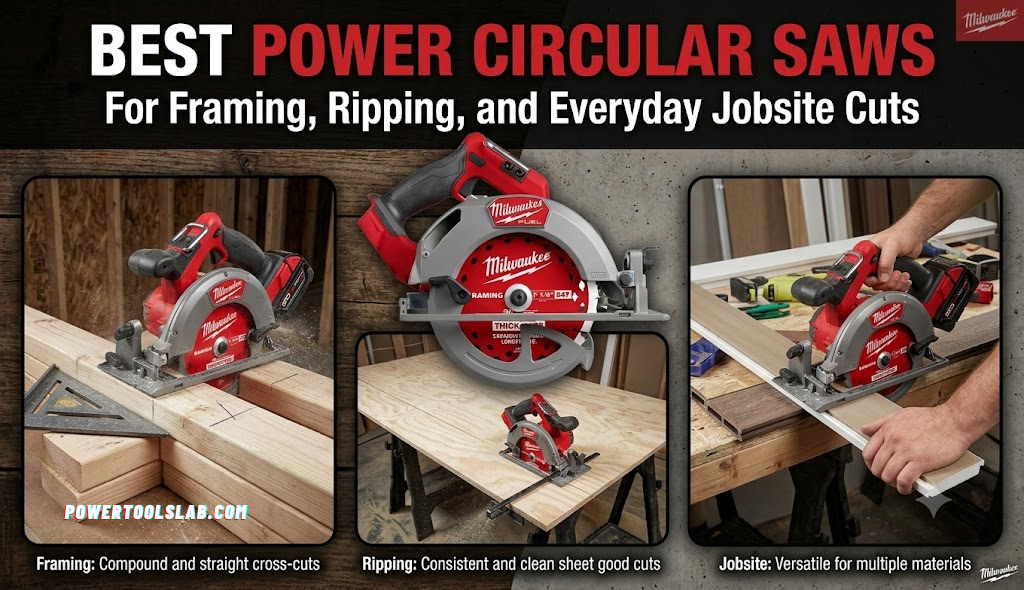
Best Power Circular Saws for Framing, Ripping, and Everyday Jobsite Cuts
Seven corded and cordless circular saws, compared on real cutting power, depth of cut, and control — so you can match the saw to the work instead of the other way around.
Cordless platforms have closed most of the gap with corded saws — but the right choice still depends on the cut you’re making.
A circular saw is the one tool almost every builder, remodeler, and serious DIYer reaches for first. It breaks down sheet goods, frames walls, trims doors, and rips deck boards, often all in the same afternoon. But “circular saw” covers an enormous range of tools, from featherweight cordless trim saws to gear-driven hypoid saws built for wet lumber and daily abuse. Picking the wrong one means fighting your tool instead of the material.
We put together this guide after spending time with seven of the most relevant power circular saws on the market right now, spanning corded sidewinders, a hypoid framing saw, and several cordless options across two major battery platforms. Below you’ll find full breakdowns of each saw, a side-by-side comparison table, and a buying guide that explains the specs that actually matter. If you’re still deciding between saw types entirely, our guide to types of power saws is a useful starting point, and our best power saws hub rounds up every saw category we’ve tested.
The market for circular saws has spread out in two directions at once. On one end, corded saws keep getting more refined, with better sightlines, dust management, and bevel range packed into designs that haven’t fundamentally changed in decades. On the other end, cordless platforms have matured to the point where a well-built brushless saw can genuinely stand in for a corded one on most jobs, not just light-duty trim work. That split means the “best” saw really does depend on how and where you work, not just which brand name is stamped on the shoe.
Think about the jobs you actually do before you shop by spec sheet. Someone framing additions five days a week has different priorities than a homeowner who pulls a saw out twice a year to build a raised garden bed or trim a door. We’ve tried to keep that distinction front and center throughout this guide rather than crowning a single universal winner, because a saw that’s perfect for a framing crew can be genuinely frustrating for an occasional user, and vice versa.
Quick Picks at a Glance
If you already know roughly what kind of saw you need, start here. Each of these seven saws earned its spot for a specific reason, and we’ve paired each one with the type of user it fits best.
- Best budget corded saw: SKIL 5280-01 — a 15-amp saw with a laser guide for a fraction of the cost of premium brands.
- Best hypoid saw for daily framing: Makita 5377MG — a magnesium-bodied worm-drive-style saw built for torque-heavy ripping.
- Best compact cordless saw: DEWALT DCS391B — a lightweight 20V MAX sidewinder for remodels and punch-list work.
- Best overall cordless saw: Milwaukee M18 FUEL 7-1/4″ — the closest a battery saw gets to matching corded output.
- Best sightline and visibility: Bosch CS10 — a blade-right design that keeps the cut line in clear view.
- Best for homeowners and light DIY: RYOBI ONE+ P505 — an affordable 18V saw that shares batteries with the rest of the ONE+ lineup.
- Best brushless value cordless saw: Makita XSH03Z — an 18V LXT sidewinder with Automatic Speed Change technology.
If none of those quick descriptions immediately settles it, don’t worry — that’s what the rest of this guide is for. Keep reading for full breakdowns of each saw’s strengths and trade-offs, a side-by-side spec table, and a buying guide that walks through exactly what terms like “hypoid,” “brushless,” and “bevel capacity” mean in practical, on-the-job terms rather than marketing language.
Full Comparison Table
Here’s how the seven saws stack up on the specs that matter most: power source, blade size, no-load speed, bevel range, and weight.
A quick note on reading a table like this one: no-load speed is measured with the blade spinning freely, not under cutting load, so it’s most useful for comparing saws within the same power source category rather than treating it as an absolute predictor of real-world cutting speed. A brushless cordless saw with a lower listed RPM can still out-cut a brushed saw with a higher number once both are working through actual material, because brushless motors are far better at holding their speed under load.
| Saw | Power Source | Blade Size | No-Load Speed | Bevel Range | Weight |
|---|---|---|---|---|---|
| SKIL 5280-01 | Corded, 15A | 7-1/4″ | 5,300 RPM | 0-51° | ~8.9 lbs |
| Makita 5377MG | Corded, 15A | 7-1/4″ | 4,500 RPM | 0-51.5° | 13.2 lbs |
| DEWALT DCS391B | Cordless, 20V MAX | 6-1/2″ | 5,150 RPM | 0-50° | ~7.3 lbs (bare) |
| Milwaukee M18 FUEL | Cordless, 18V (M18) | 7-1/4″ | Brushless, variable | 0-56° | ~8.4 lbs (bare) |
| Bosch CS10 | Corded, 15A | 7-1/4″ | 5,600 RPM | 0-56° | 10.2 lbs |
| RYOBI ONE+ P505 | Cordless, 18V ONE+ | 5-1/2″ | 4,700 RPM | 0-50° | ~6 lbs (bare) |
| Makita XSH03Z | Cordless, 18V LXT | 6-1/2″ | Brushless, variable | 0-50° | ~7.6 lbs (bare) |
Every cordless model above is sold as a bare tool, meaning the battery and charger are purchased separately. That’s normal for the category and often cheaper if you already own batteries on that platform. For a broader look at how circular saws stack up against other cutting tools, see our comparison of a power saw vs. chainsaw.
Weight numbers are also worth reading with a bit of context. A saw’s listed weight for corded models typically includes the full tool as sold, while cordless bare-tool weights exclude the battery, which usually adds another 1 to 2 pounds depending on capacity. That means the real, in-hand weight difference between a corded saw and a cordless one running a large battery is often smaller than the spec sheets alone suggest — another reason to prioritize how a saw actually feels in your hands over any single number in isolation.
How We Evaluated These Saws
We looked at each saw across five practical categories rather than chasing a single “winner.” Raw power and no-load speed matter, but they only tell part of the story — depth of cut, bevel range, blade visibility, and how the saw feels after twenty minutes of continuous ripping all factor into whether a saw earns a permanent spot in your truck.
We also weighed value against the realistic buyer for each saw. A homeowner building a deck once a year has different needs than a framing crew running a saw eight hours a day, so a “best” pick in this guide always comes with the context of who it’s best for.
Specifically, we looked at motor performance under load rather than just no-load RPM figures, since a saw that spins fast with nothing to cut can still bog down the moment it meets dense engineered lumber. We also paid attention to how each saw handled dust management, since a clear line of sight to the cut mark matters just as much as raw cutting power once you’re trying to hold a straight line across an eight-foot rip. Ergonomics factored in too — grip shape, balance point, and how the saw felt after repeated bevel adjustments all influence whether a tool becomes a daily favorite or ends up sitting in the bottom of a tool bag.
Finally, we considered the ecosystem each saw belongs to. A cordless saw is rarely purchased in isolation; it usually needs to fit into an existing collection of batteries and chargers. Where a saw shares a platform with a wide range of other tools, that’s a real, practical advantage that shows up in this guide’s recommendations even when the saw itself is only a modest step ahead of the competition on paper.
None of this means chasing the single highest number on any one spec. A saw with the fastest RPM on paper isn’t automatically the best choice if its handle design fatigues your grip after twenty minutes, and a saw with the widest bevel range isn’t a smart pick if you never cut anything beyond 45 degrees. The goal throughout this guide is matching a saw’s actual strengths to how you’ll actually use it, not ranking tools purely by whichever number happens to be largest.

Check Price on Amazon
1. SKIL 5280-01 — 15 Amp 7-1/4″ Circular Saw with Laser Guide
The SKIL 5280-01 is proof that a solid corded circular saw doesn’t need a premium price tag. It’s built around a 15-amp motor that spins the 7-1/4″ blade at 5,300 RPM, which is plenty for everyday framing, deck building, and general shop cutting. The single-beam laser guide is a genuinely useful add-on for anyone still building confidence with freehand cuts, and the integrated dust blower keeps your cut line visible without a shop vac attached.
- Motor15 Amp
- Blade7-1/4″ carbide-tipped, included
- Bevel0-51°, positive stop at 45°
- ExtrasLaser guide, spindle lock
Where this saw shines is value: you get a full-size, high-amp motor, a real bevel range, and tool-free-ish blade changes via the built-in spindle lock and on-tool wrench storage, all at a price that undercuts most name-brand corded saws. It won’t feel as refined in the hand as a premium sidewinder, and the cord is on the shorter side at six feet, but for weekend projects, light remodeling, or a backup saw kept in the truck, it earns its keep.
Who it’s for: First-time saw buyers, weekend woodworkers, and anyone who wants a full-power corded saw without paying for features they won’t use. It’s also a smart second saw to keep dedicated to rougher cutting tasks, like breaking down reclaimed lumber, so your primary saw stays out of harm’s way.
Cutting notes: In doubled 2x framing lumber, the 15-amp motor holds its RPM well and doesn’t bog down the way some budget saws do when the blade meets a knot or a nail-adjacent section of wood. The laser guide is bright enough to see in normal shop lighting, though it washes out somewhat in direct sunlight, so it’s more of a confidence aid than a precision tool for outdoor jobsite cuts. Blade changes are quick thanks to the spindle lock, and the on-tool wrench storage means you’re not hunting through a bag for the right hex key mid-project.
PROS
- Strong 15-amp motor for the price
- Laser guide improves accuracy for freehand cuts
- Dust blower keeps the cut line visible
- Spindle lock speeds up blade changes
CONS
- Shorter 6-foot cord than some competitors
- Build quality trails premium corded saws
Check Price on Amazon
2. Makita 5377MG — 7-1/4″ Magnesium Hypoid Saw
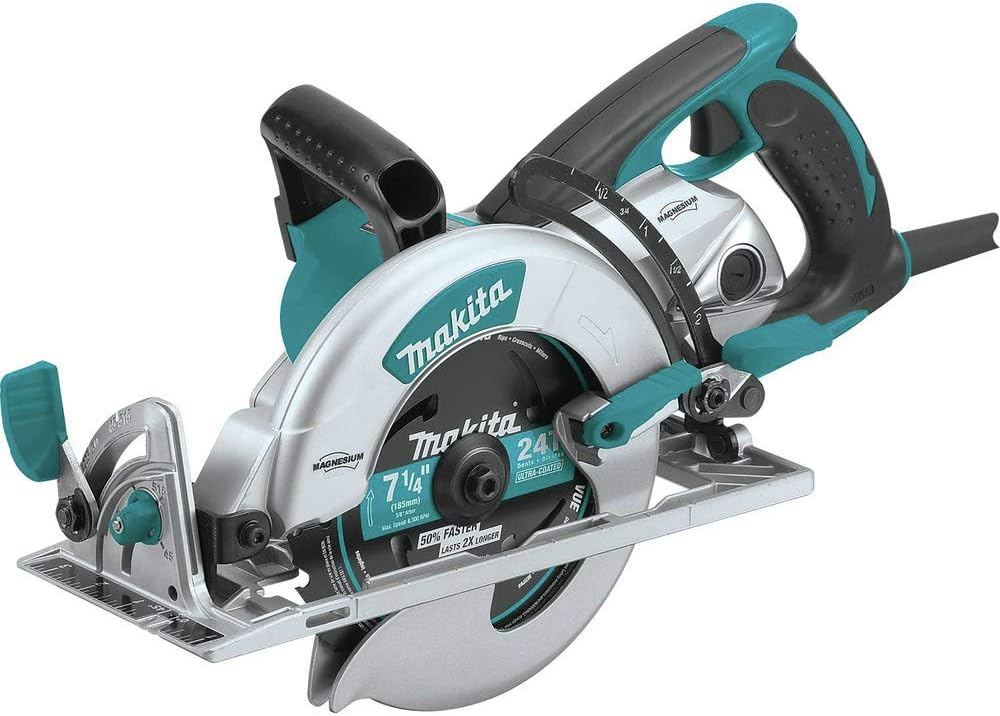
The Makita 5377MG is built for people who cut lumber all day, every day. Instead of a standard sidewinder layout, it uses hypoid gearing — the motor sits parallel to the blade and drives it through heat-treated gears running in an oil bath. That design trades a bit of top-end speed (4,500 RPM) for significantly more torque, which shows up the moment you push this saw through wet, dense, or engineered lumber that would bog down a lighter saw.
- Motor15 Amp hypoid drive
- Weight13.2 lbs (magnesium body)
- Bevel0-51.5°, stops at 22.5° & 45°
- ExtrasOil-bath gearing, sky hook
Magnesium components keep the weight manageable for a saw in this class, and the extra clearance between the rear handle and blade case is a small but appreciated detail for anyone running the saw with gloves on. This isn’t the saw to grab for quick trim cuts — it’s heavier and more purpose-built than that — but for framing crews and anyone who values durability and torque over finesse, it’s one of the most respected saws in its category. For more on how Makita’s saws compare across the lineup, our Makita circular saw review goes deeper.
Who it’s for: Framing crews, deck builders, and anyone regularly cutting pressure-treated or engineered lumber that tends to bog down lighter saws. The added weight is a fair trade for the torque if you’re running the saw for hours at a stretch rather than the occasional quick cut.
Cutting notes: The difference in torque becomes obvious the moment you push this saw into pressure-treated 2x material or wet lumber straight off a delivery truck — where a lighter sidewinder can stall or slow noticeably, the hypoid gearing keeps the blade driving through at a consistent rate. The extra weight is felt most during overhead or awkward-angle cuts, but for standard framing work at waist height, the saw’s balance keeps that weight from becoming fatiguing over a full day.
PROS
- Hypoid gearing delivers exceptional torque
- Oil-bath system reduces maintenance needs
- Magnesium body balances durability and weight
- Built for daily jobsite abuse
CONS
- Heavier than sidewinder-style saws
- Lower top-end RPM than lighter saws
- Overkill for occasional or light-duty use
Check Price on Amazon
3. DEWALT DCS391B — 20V MAX 6-1/2″ Cordless Circular Saw

The DEWALT DCS391B is a sidewinder-style cordless saw built around DEWALT’s 20V MAX battery platform, and it’s aimed squarely at anyone who already owns DEWALT batteries and wants a light, portable saw for remodeling, punch-list work, or quick site cuts. The 6-1/2″ blade and 5,150 RPM motor deliver a 2-1/8″ depth of cut at 90°, which covers the vast majority of framing and sheet-good cutting without the bulk of a full 7-1/4″ saw.
- Motor20V MAX, brushed
- Blade6-1/2″, 18-tooth carbide included
- Bevel0-50°
- Weight~7.3 lbs (bare tool)
The rubber-overmolded grip and magnesium shoe make this a comfortable saw to run one-handed for extended stretches, and the lighter blade size means less battery draw per cut compared to a 7-1/4″ cordless saw. It’s sold as a bare tool, so budget for a battery and charger if you’re starting from scratch. For a closer look at how this saw fits into the broader DEWALT lineup, check our DEWALT circular saw review.
Who it’s for: Remodelers, trim carpenters, and DIYers already invested in the DEWALT 20V MAX ecosystem who want a light, grab-and-go saw for quick cuts without hauling out a heavier framing saw for every task.
Cutting notes: On a 5.0Ah battery, this saw comfortably handles a full afternoon of intermittent cutting — cross-cuts on 2x stock, plywood sheets, and trim material — without needing a battery swap. Where it shows its limits is in back-to-back full-depth bevel rips through thick material, where the smaller 6-1/2″ blade and brushed motor combination will draw down a battery noticeably faster than the brushless options in this guide.
PROS
- Lightweight and easy to control one-handed
- Shares batteries with the full 20V MAX lineup
- Magnesium shoe adds durability without much weight
- Good runtime-per-charge thanks to the smaller blade
CONS
- Brushed motor, not brushless
- Sold as bare tool — battery and charger cost extra
- Smaller blade means less depth of cut than 7-1/4″ saws
Check Price on Amazon
4. Milwaukee M18 FUEL — 7-1/4″ Circular Saw
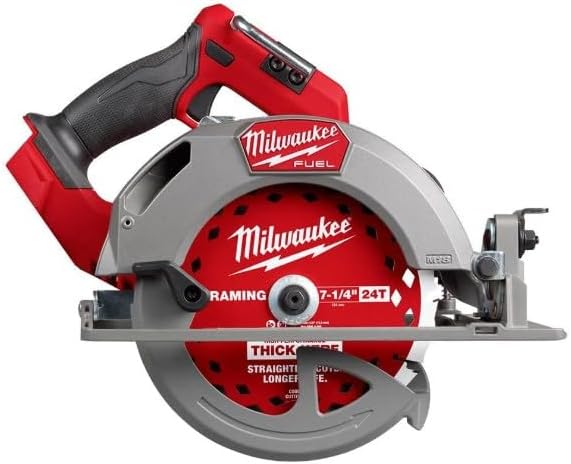
The Milwaukee M18 FUEL 7-1/4″ is the saw we’d point to for anyone who wants to leave the cord behind without giving up much cutting performance. Milwaukee’s FUEL branding pairs a brushless motor with the company’s REDLINK PLUS electronics, and the combination is noticeable the moment the blade meets material — this saw pushes through 2x framing lumber and sheet goods with authority that used to be the exclusive domain of corded saws.
- MotorM18 FUEL brushless
- Blade7-1/4″, full-depth cutting
- Bevel0-56°
- Weight~8.4 lbs (bare tool)
Beyond raw power, the bevel range extends to a generous 56 degrees, and the electric brake stops the blade almost immediately after the trigger is released, which is a meaningful safety upgrade over older brushed saws. As a bare tool, it’s built to run on Milwaukee’s higher-capacity M18 batteries for full performance, and it slots neatly into an existing M18 battery collection. For a deeper dive into how it compares against the rest of the lineup, see our full Milwaukee circular saw review.
Who it’s for: Professionals and serious DIYers who want to go fully cordless without a noticeable drop in cutting performance. It’s also a strong pick for anyone already running Milwaukee’s M18 system who wants their circular saw to match the output of their other high-demand tools.
Cutting notes: Ripping full sheets of 3/4″ plywood, this saw maintains its blade speed under load in a way that genuinely feels closer to a corded saw than a typical cordless one — there’s very little of the RPM sag you notice on lower-end brushless saws when the blade meets resistance. The electric brake is one of the fastest-stopping in this lineup, which matters most when you’re making a string of short repetitive cuts and setting the saw down between each one.
PROS
- Brushless motor rivals corded cutting power
- Wide 56° bevel range
- Fast-stopping electric brake improves safety
- Full 7-1/4″ blade for maximum depth of cut
CONS
- Best performance requires higher-capacity M18 batteries
- Sold as bare tool
- Premium price relative to entry-level cordless saws
Check Price on Amazon
5. Bosch CS10 — 7-1/4″ Circular Saw

The Bosch CS10 is a corded 7-1/4″ saw built around a blade-right layout designed to give you an unobstructed view of the cut line — a detail that matters more than it sounds like on long rip cuts where a fraction of an inch of drift can throw off an entire board. A 15-amp motor spins the blade at 5,600 RPM, among the fastest no-load speeds in this lineup, and cuts up to 2-7/16″ deep at 90°.
- Motor15 Amp
- Weight10.2 lbs
- Bevel0-56°, stops at 22.5° & 45°
- ExtrasDie-cast magnesium footplate
The die-cast magnesium footplate keeps the base flat over time, which helps maintain accurate cuts even after months of jobsite use, and Bosch’s bevel louvers direct dust away from the cut line for better visibility without a separate blower system. Between the sightline advantage, the wide bevel range, and the fast motor, this is a strong pick for anyone doing detailed ripping and cross-cutting who wants a corded saw without a premium-brand price tag.
Who it’s for: Finish carpenters, cabinet installers, and anyone whose work depends on tracking a cut line precisely over long, straight rips. The blade-right visibility makes a real difference on detail-sensitive projects like built-ins and trim work.
Cutting notes: The blade-right layout takes a short adjustment period if you’ve spent years on a blade-left sidewinder, but once it clicks, the difference in how easily you can track a pencil line becomes obvious, especially on long rips where small drift compounds over distance. The bevel louvers do a genuinely good job clearing dust from the cut line compared to saws relying solely on a rear-mounted blower.
PROS
- Excellent cut-line visibility from blade-right design
- Fast 5,600 RPM motor
- Wide 56° bevel capacity
- Durable magnesium footplate
CONS
- Corded only — no cordless version in this lineup
- Heavier than some competing sidewinders
Check Price on Amazon
6. RYOBI ONE+ P505 — 18V 5-1/2″ Cordless Circular Saw

If you already own tools on RYOBI’s ONE+ platform, the P505 is one of the easiest additions you can make. It runs on the same 18V batteries as everything else in the ONE+ ecosystem, which now spans hundreds of tools, so there’s no need to add another charger or battery type to your shelf. The 5-1/2″ blade and 4,700 RPM motor are sized for cross-cutting 2x lumber and general DIY project work rather than heavy daily framing.
- Motor18V ONE+, brushed
- Blade5-1/2″, 18-tooth carbide included
- Bevel0-50°
- Weight~6 lbs (bare tool)
Cut depth tops out at 1-11/16″ at 90°, which is enough for most 2-by material but worth noting if you’re regularly cutting thicker stock. The lighter weight makes it an easy saw to hand off to a less experienced user, and the ONE+ battery compatibility is genuinely one of the platform’s biggest advantages for anyone building out a home tool collection over time. See our complete RYOBI circular saw review for more on how it performs across different materials.
Who it’s for: Homeowners, renters, and occasional DIYers who want an affordable, lightweight saw for shelving, small furniture builds, and basic home repairs, especially if they already own other ONE+ tools.
Cutting notes: This saw is genuinely comfortable to use one-handed for extended stretches thanks to its light weight, and it handles cross-cuts on 2x lumber and plywood without hesitation. Ripping thicker or denser hardwood stock is where the lower RPM and smaller blade show their limits, so it’s best matched to the lighter side of DIY projects rather than treated as a full framing replacement.
PROS
- Shares batteries with the huge RYOBI ONE+ lineup
- Lightweight and easy to control
- Affordable entry point for cordless cutting
- 3-year manufacturer warranty
CONS
- Smaller 5-1/2″ blade limits depth of cut
- Brushed motor with lower RPM than premium saws
- Not intended for heavy daily framing use
Check Price on Amazon
7. Makita XSH03Z — 18V LXT Brushless 6-1/2″ Circular Saw

The Makita XSH03Z brings a brushless motor and Automatic Speed Change technology to Makita’s 18V LXT platform, and the result is a saw that intelligently adjusts speed and torque based on the load it senses during a cut. That means it holds power through tougher material without you having to manually manage feed rate as carefully, while conserving battery in lighter cuts.
- Motor18V LXT brushless
- Blade6-1/2″
- TechAutomatic Speed Change, Star Protection
- Weight~7.6 lbs (bare tool)
Makita’s Star Protection Computer Controls add another layer of value here: the tool and a compatible battery communicate in real time to guard against overloading, over-discharging, and overheating, which extends the working life of both. For anyone already invested in Makita’s LXT battery ecosystem, this saw is an easy way to add serious cutting capability without starting a new battery platform. It pairs well with Makita’s guide rail accessories if you want track-saw-like precision on sheet goods without buying a dedicated track saw.
Who it’s for: Makita LXT owners who want to add a genuinely capable brushless saw to their kit, plus anyone who values the extra protection Star Protection Computer Controls offer for both tool and battery longevity.
Cutting notes: The Automatic Speed Change technology is noticeable in mixed-material cutting sessions — the saw seems to sense when it’s cruising through soft pine versus grinding through a knot or denser hardwood, and adjusts torque accordingly rather than running at one fixed output regardless of load. That translates into a smoother feel in the cut and, anecdotally, less strain on the battery during lighter passes.
PROS
- Brushless motor with Automatic Speed Change
- Star Protection guards battery and tool longevity
- Compatible with Makita guide rail accessories
- Balanced weight for extended use
CONS
- Sold as bare tool
- 6-1/2″ blade caps depth of cut versus 7-1/4″ saws
Check Price on Amazon
Buying Guide: What the Specs Actually Mean
Every circular saw listing is packed with numbers — amps, volts, RPM, bevel degrees — and it’s easy to fixate on the wrong ones. Here’s what actually affects how a saw performs in your hands.
Manufacturers know that spec sheets get compared side by side, which means numbers are sometimes chosen more for how they look on a chart than for how much they’ll matter on your actual project. Understanding which figures translate directly into real-world performance, and which are closer to marketing flourishes, will save you from overpaying for a spec you’ll never notice and underpaying for one you actually need.
Corded vs. Cordless
Corded saws draw continuous power from the outlet, so they don’t lose performance as a charge depletes, and they’re generally the better choice for shop work, long ripping sessions, and anyone who wants to avoid managing batteries. Cordless saws sacrifice a little top-end power for freedom of movement, which matters enormously on roofs, scaffolding, or any job site without convenient outlets. Modern brushless cordless saws, like the Milwaukee M18 FUEL and Makita XSH03Z in this guide, have narrowed the performance gap significantly.
Blade Size and Depth of Cut
Blade size determines maximum depth of cut more than any other spec. A 7-1/4″ blade is the standard for framing because it cleanly gets through doubled 2x material at 90 degrees. Smaller 6-1/2″ and 5-1/2″ blades trade some depth of cut for a lighter, more maneuverable saw — a reasonable trade for remodeling, trim work, and general DIY projects where you’re rarely cutting through doubled dimensional lumber.
It’s worth running the numbers on your own most common cut before deciding blade size matters less than it seems. A single layer of 3/4″ plywood or a single 2x board is well within reach of even the smallest saw in this guide. Where blade size actually shows up is in bevel cuts and doubled material — tilt a 5-1/2″ saw to 45 degrees and its effective depth of cut drops enough that it may no longer clear a single 2x board, while a 7-1/4″ saw still has margin to spare at the same angle.
Amps and Voltage
For corded saws, amperage is the best rough indicator of motor power — 15 amps is the benchmark for a saw built to run all day without bogging down. For cordless saws, voltage (18V, 20V MAX) matters less on its own than the combination of voltage, battery amp-hour rating, and whether the motor is brushed or brushless. A brushless 18V saw on a high-capacity battery will often outperform a brushed saw on a higher nominal voltage.
It also helps to think about amp-hour rating separately from voltage when shopping for batteries. A 2.0Ah battery will get you through light trim work but will drain quickly under continuous ripping, while a 5.0Ah or larger battery adds weight but roughly doubles or triples your working time between charges. If you’re buying a bare-tool cordless saw and starting a battery collection from scratch, it’s often worth spending slightly more on a higher-capacity battery pack up front rather than settling for the smallest option just to save a few dollars.
Bevel Capacity
Bevel range determines the maximum angle you can tilt the blade for angled cuts. A 45 to 50-degree range covers standard framing and trim needs. Saws with 56 to 57-degree capacity, like the Bosch CS10 and Milwaukee M18 FUEL in this guide, offer more flexibility for specialty cuts, though most users will spend the majority of their time at 0 or 45 degrees regardless of the saw’s maximum range.
Sidewinder vs. Hypoid (Worm Drive)
Sidewinder saws mount the motor directly beside the blade in-line with the gearing, which keeps the saw lighter and the motor spinning faster. Hypoid and worm-drive-style saws, like the Makita 5377MG, mount the motor parallel to the blade and use gearing to trade speed for torque, which is why they excel in dense or wet lumber where a lighter saw might bog down.
Blade Tooth Count and Material
The blade that comes with a saw is rarely the only blade you’ll ever use, but it’s worth understanding what tooth count does before you swap one out. Lower tooth counts, typically 18 to 24 teeth on a 7-1/4″ blade, remove material faster and are the standard choice for framing and general ripping. Higher tooth counts, 40 teeth and up, leave a cleaner edge but cut more slowly and are better suited to plywood, veneered panels, or trim work where finish quality matters more than speed. Carbide-tipped blades hold an edge far longer than steel blades and are the default on every saw in this guide.
Ergonomics and Handle Design
Specs on paper don’t tell you how a saw feels after the fortieth cut of the day. Handle shape, trigger placement, and where the saw’s weight sits relative to your grip all affect fatigue over a long shift. Saws with rubber overmolded grips, like the DEWALT DCS391B, tend to reduce vibration transfer into your hand and wrist. Front auxiliary handles or dedicated grip zones near the shoe, common on hypoid saws, give you more control when guiding the saw through a long rip cut with two hands. If you can, handle a saw in person before buying, since balance point is one of the few specs that’s genuinely hard to judge from a listing alone.
Balance point in particular is worth paying attention to on cordless saws, where the battery sits at the rear of the tool and shifts the center of gravity noticeably compared to a corded saw of similar blade size. A saw that feels front-heavy when the battery is removed can feel nicely balanced once a full battery is seated, so it’s worth testing a cordless saw with the battery you actually plan to run rather than judging balance from the bare tool alone.
Demolition and Rough Cutting
Circular saws are built for controlled, straight cuts in dimensional lumber and sheet goods — they’re not the right tool for freehand demolition or cutting through nail-embedded framing. Running a circular saw into embedded fasteners can chip carbide teeth, kick the saw back toward you, or simply ruin an otherwise good blade in a single pass. For that kind of work, a dedicated reciprocating saw is a better match, since its blade is designed to flex and cut through mixed materials without the same kickback risk; our best reciprocating saws guide and DEWALT reciprocating saw review cover that category in depth.
Corded vs. Cordless: A Closer Look
The corded-versus-cordless question comes up in nearly every power tool category, but it plays out a little differently for circular saws than it does for, say, a drill or an impact driver. A circular saw draws heavily on its power source in short, intense bursts rather than steady, moderate draw, which is exactly the kind of load that used to separate corded and cordless performance most sharply — and exactly where cordless technology has made its biggest gains in recent years.
Where Corded Still Wins
A corded saw plugged into a standard 15-amp household circuit has, for practical purposes, unlimited runtime and a completely flat power curve — the tenth cut of the day performs identically to the first. That consistency matters most in high-volume production settings: a framing crew cutting hundreds of studs, a shop breaking down sheet after sheet of plywood, or anyone doing repetitive ripping where a dip in power partway through a board would be more than just an inconvenience. Corded saws also tend to run a few pounds lighter than their cordless counterparts once you subtract the weight of a battery pack, since they don’t need to carry their power source on board.
Where Cordless Has Closed the Gap
The rise of brushless motors is the single biggest reason cordless saws now compete seriously with corded ones. A brushless motor is more electrically efficient than a brushed motor, meaning more of the battery’s stored energy converts directly into cutting power rather than being lost as heat and friction at the brushes. Saws like the Milwaukee M18 FUEL and Makita XSH03Z in this guide are direct beneficiaries of that shift, and it shows in how they hold RPM under load compared to older brushed cordless saws.
The other major advantage cordless saws bring is one that’s easy to underweight until you’re actually standing on a roof, working from a ladder, or cutting somewhere far from an outlet: freedom from the cord itself. No tripping over a cord stretched across a jobsite, no extension cord voltage drop robbing power from a saw already working hard, and no risk of cutting through your own power cord mid-project — a mistake nearly every tradesperson has a story about.
A Practical Way to Decide
If most of your cutting happens in one place — a shop, a driveway, a single job site with reliable power — a corded saw is hard to argue against on pure value and consistency. If your work moves around, involves awkward positions, or happens somewhere power isn’t guaranteed, a cordless saw’s mobility advantage usually outweighs its modest power trade-off, especially once you factor in a brushless motor and a reasonably sized battery. Plenty of tradespeople end up owning one of each and reaching for whichever fits the specific task at hand.
Circular Saw Blade Guide
The saw does the work of spinning the blade, but the blade does the actual cutting — and swapping to the right blade for the job often matters more than which saw you’re using. Here’s a closer look at the variables that actually affect cut quality and speed.
Tooth Count
Tooth count is the first spec most people notice on a blade, and it’s a reasonably good shorthand for what the blade is built to do. Fewer, larger teeth — commonly 18 to 24 on a 7-1/4″ blade — clear material quickly and are the default choice for framing, ripping, and general construction cutting where speed matters more than a glass-smooth edge. More, smaller teeth, in the 40 to 60 range, take smaller bites per rotation, which produces a cleaner edge at the cost of cutting speed. Plywood, veneered panels, and any cut destined to be visible in a finished project benefit from the higher tooth count.
Blade Material and Coatings
Nearly every blade worth buying today is carbide-tipped, meaning individual carbide teeth are brazed onto a steel body. Carbide holds a sharp edge dramatically longer than a fully steel blade, especially in engineered lumber and dense hardwoods that dull a soft edge quickly. Some blades add a non-stick coating to the body, which reduces friction, heat buildup, and resin buildup from sappy or treated lumber — a small feature that makes a noticeable difference in how smoothly a blade tracks through a long rip cut.
Kerf Width
Kerf refers to the width of the slot a blade cuts as it passes through material. Thin-kerf blades remove less material and put less strain on a saw’s motor, which is especially useful on cordless saws where every bit of efficiency extends runtime. Full-kerf blades are typically stiffer and less prone to wandering in a long cut, which is why they remain popular on high-powered corded and hypoid saws where motor strain is less of a concern.
Matching Blades to Material
Beyond wood-cutting blades, specialty blades exist for cutting metal, masonry, and plastic on a standard circular saw, provided the saw’s RPM and arbor size are compatible. Swapping to a metal-cutting or abrasive blade for the occasional off-material cut is usually more practical than buying a dedicated tool, as long as you follow the blade manufacturer’s speed rating and never exceed it.
It’s also worth building the habit of inspecting a blade before every use, not just when it starts cutting poorly. Look for missing or chipped carbide teeth, a warped or bent body, and resin or pitch buildup along the plate — any of these can throw off cut quality or create a safety hazard well before the blade seems obviously dull. A quick wipe-down with a blade cleaner after cutting resinous or treated lumber keeps a blade performing closer to new for far longer than letting buildup accumulate cut after cut.
Getting Straight, Accurate Cuts Every Time
A capable saw still depends on solid technique to produce a clean, accurate cut. A few fundamentals separate a wandering, splintered cut from a crisp one.
Mark Once, Check Twice
A single pencil line is easy to lose track of once sawdust starts flying. Marking both the cut line and a clear reference point for where the blade guide or shoe edge should ride gives you a second visual anchor to check against as you cut, especially useful on saws without a laser guide.
Let the Saw Set the Pace
Forcing a saw through material faster than the motor and blade are designed to handle is one of the most common causes of a wandering or burned cut. A saw with adequate power for the material, like the higher-amp corded saws in this guide, should be allowed to cut at its own pace — pushing harder rarely speeds things up and often makes the cut less accurate.
Support the Work Properly
Cutting a board that’s only supported at both ends, with the cut falling in the unsupported middle section, is a recipe for the material pinching the blade as it flexes downward mid-cut. Supporting material on both sides of the cut line, or using sawhorses positioned so the offcut can fall freely, keeps the blade running smoothly and reduces kickback risk substantially.
Use a Guide for Long Rips
Freehand accuracy degrades noticeably over long distances, even for experienced users. Clamping a straightedge parallel to your intended cut line, offset by the distance from your saw’s blade to the edge of its shoe, turns a long rip into a controlled, repeatable cut rather than a test of steady hands.
Check Bevel and Depth Before Every Cut Type Change
It’s easy to leave a saw set to a bevel angle from a previous cut and forget to reset it to 0 degrees for the next square cut. A quick glance at the bevel indicator before starting a new cut avoids a mistake that’s frustrating to catch only after the cut is already made.
Common Circular Saw Mistakes to Avoid
Even experienced users fall into a few recurring habits that quietly hurt cut quality, blade life, or safety. Here are the ones worth watching for.
Setting the Blade Too Deep
It’s tempting to crank the depth adjustment as far as it goes “just in case,” but a blade extending far below the material exposes more spinning teeth than necessary, increases kickback risk, and doesn’t improve cut quality. Setting depth to roughly a quarter-inch past the material’s bottom face keeps more of the blade shrouded by the guard while still cutting cleanly through.
Ignoring Blade Wobble or Runout
A blade that isn’t seated flush against the arbor flange, even slightly, will wobble as it spins, producing a rough cut and excess vibration. Always make sure the blade sits flat against the inner flange, with any debris cleared away, before tightening the arbor nut back down.
Cutting With a Dull Blade “Because It Still Works”
A dulling blade doesn’t fail outright, so it’s easy to keep using one well past its useful life. But a dull blade forces the motor to work harder, generates more heat, increases the chance of burning the material, and raises kickback risk since the blade is more likely to bind rather than cut cleanly through resistance.
Overreaching or Cutting at an Awkward Angle
Circular saws are meant to be cut with the tool close to the body and the material positioned so you’re not stretching or cutting across your own centerline. Reaching too far or cutting in a twisted stance both reduces control and makes it harder to react if the saw binds or kicks.
Skipping the Test Cut on a New Blade or Setting
Whenever you swap to a new blade type, change bevel angle significantly, or start cutting an unfamiliar material, a quick test cut on scrap material catches problems — wrong tooth count, incorrect depth, or a bevel setting that’s off from what you intended — before they show up in your actual project piece.
Safety & Maintenance Tips
A circular saw is one of the most useful tools on a job site and also one of the least forgiving of carelessness. Unlike a miter saw or table saw, a circular saw is a handheld tool moving through material that isn’t clamped or fenced, which means most of the responsibility for a safe cut rests on how the tool is set up and handled rather than on built-in guarding alone. A few habits go a long way toward keeping both you and the saw in good working order.
- Check the lower guard before every session. The spring-loaded retracting guard should snap back into place freely. If it hangs up or moves sluggishly, clear out built-up sawdust before cutting.
- Set blade depth correctly. Set the blade to extend only slightly below the material you’re cutting — roughly a quarter-inch past the bottom face. This reduces kickback risk and keeps more of the blade guarded.
- Support the material on both sides of the cut. Unsupported offcuts can pinch the blade mid-cut, which is one of the most common causes of kickback.
- Keep blades sharp and matched to the material. A dull or wrong-tooth-count blade forces the motor to work harder and increases the chance of binding.
- Let the blade fully stop before setting the saw down. Saws with an electric brake, like the Milwaukee M18 FUEL, shorten this window significantly, but the habit still matters on any saw.
- Clean vents and guards regularly. Sawdust buildup around motor vents and the lower guard is one of the most common causes of premature saw failure.
- Wear appropriate eye and hearing protection. Circular saws throw debris and generate enough noise over extended use to warrant both, even for quick cuts that feel too short to bother.
- Disconnect the power source before adjustments. Unplug corded saws or remove the battery from cordless saws before changing blades, adjusting depth, or clearing a jam — never rely on the trigger lock alone.
Maintenance matters just as much between projects as it does mid-cut. Wipe down the shoe after use to prevent rust or resin buildup, especially if you’re cutting treated lumber, and store cordless saws with batteries removed if the tool will sit unused for more than a few weeks. A quick visual check of the cord on corded saws, or the battery contacts on cordless models, before each use catches most problems before they become dangerous ones.
Accessories Worth Adding to Your Kit
A circular saw’s out-of-box performance only tells part of the story. A handful of inexpensive accessories can noticeably improve accuracy and safety without much added cost, and most of them cost far less than the saw itself.
Straightedge or Track Guide
Freehand rip cuts are hard to keep perfectly straight over long distances, even with a laser guide. Clamping a straightedge to your material, or using a dedicated track system on saws designed to accept one, turns a circular saw into something much closer to a track saw for sheet good breakdown.
Extra and Specialty Blades
Keeping a second blade on hand — a higher tooth-count option for clean cross-cuts, alongside the standard framing blade — means you’re never stuck making a finish cut with a blade optimized for rough ripping. Swapping blades takes only a couple of minutes on any saw with a spindle lock.
Dust Collection Adapter
Where available, a dust port adapter connecting to a shop vac dramatically cuts down on airborne dust during extended cutting sessions, which matters both for visibility and for long-term respiratory health on dusty job sites.
Extra Batteries (Cordless Saws)
For any of the cordless saws in this guide, a second battery removes the single biggest limitation of going cordless: running out of charge mid-project. Rotating a spare battery on the charger while you work keeps a cordless saw functionally as available as a corded one.
A Dedicated Carrying Case
A hard case or padded bag does more than keep a saw organized in a truck bed — it protects the base plate and bevel mechanism from getting knocked out of true, which is a slow, easy-to-miss way a saw’s accuracy degrades over time. It’s a small investment that helps preserve the precision you paid for.
Frequently Asked Questions
What size circular saw do most professionals use?
Most framing and general construction work is done with a 7-1/4 inch circular saw. That blade size gives enough depth of cut to get through 2x material at a full 90-degree angle and still has room for common bevel cuts, which is why it remains the standard size on job sites.
Is a corded or cordless circular saw better?
Corded saws generally deliver more consistent power for long cutting sessions and never run out of charge, which suits shop work and heavy framing. Cordless saws trade a bit of raw power for mobility, making them better for remodels, roofing, and any job where dragging a cord is impractical.
How many amps should a corded circular saw have?
For a corded 7-1/4 inch saw, look for at least 13 amps, with 15 amps being the standard for saws built to handle daily framing and ripping without bogging down in dense lumber.
What voltage is best for a cordless circular saw?
18V and 20V MAX platforms cover the vast majority of cordless circular saws and are plenty for typical framing and remodeling tasks, especially when paired with a brushless motor. Higher-capacity batteries close the gap with corded saws for heavy ripping and full sheet breakdown.
What does a hypoid or worm drive saw do differently than a sidewinder?
Hypoid and worm drive saws place the motor parallel to the blade and use gearing to deliver more torque at lower RPM, which helps in thick or wet lumber. Sidewinder saws mount the motor directly beside the blade, making them lighter and better suited to faster, lighter cutting.
What bevel capacity do I actually need?
A 45 to 50-degree bevel range covers nearly every framing and trim application. Saws with 56 to 57-degree bevel capacity add flexibility for specialty angle cuts, but that extra range rarely gets used outside of niche projects.
Do I need a brushless motor?
Brushless motors run cooler, last longer, and pull more runtime from each battery charge than brushed motors, which makes them worth the added cost for anyone using a cordless saw regularly. Occasional users can still get good service from a brushed saw at a lower price.
How deep can a 7-1/4 inch circular saw cut?
Most 7-1/4 inch circular saws cut a little over 2-3/8 inches deep at a 90-degree angle, which is enough to get through two layers of standard 2x lumber in a single pass.
Can a circular saw replace a table saw for ripping sheet goods?
A circular saw paired with a straightedge or track can rip full sheets of plywood accurately and is far more portable than a table saw, though it will not match a table saw’s repeatability for high-volume production cuts.
What safety features should I look for on a circular saw?
Prioritize a spring-loaded retracting lower blade guard, an electric brake that stops the blade quickly after the trigger is released, and a spindle lock that keeps your hands away from the blade during changes.
How often should I replace a circular saw blade?
A carbide-tipped blade used for general framing can often be sharpened once or twice before it needs replacing, but signs like burning, excessive splintering, or noticeably slower cutting despite adequate motor power usually mean it’s time for a fresh blade rather than another sharpening.
Can I use a smaller blade size than my saw came with?
Most circular saws are designed around a specific blade diameter and arbor size, so it’s best to stick with the blade size the saw shipped with rather than trying to fit a smaller blade, which can affect guard clearance and depth-of-cut calibration.
Which Circular Saw Should You Buy?
If you want the closest thing to corded power without a cord, the Milwaukee M18 FUEL is the strongest all-around pick in this guide. Budget-conscious buyers get real value from the SKIL 5280-01, framing crews should look hard at the Makita 5377MG’s hypoid torque, and anyone already invested in a specific battery platform will get the most mileage from staying within it — DEWALT, RYOBI ONE+, or Makita LXT alike.
There’s no single spec sheet that settles this decision for everyone, and that’s really the point of comparing all seven saws side by side rather than chasing one universal “best.” Match the saw to the cutting you actually do most often — daily framing, occasional remodeling, or light homeowner projects — and the right pick tends to become obvious fairly quickly. If you’re still torn between two options, lean toward whichever platform already has a foothold in your tool collection, since shared batteries and chargers add real value that doesn’t show up on a spec sheet.
As a last gut-check: if you’re building a deck, framing a wall, or doing anything that involves repeated cuts through doubled 2x lumber, prioritize the saws with 7-1/4″ blades and 15-amp or brushless motors — the Makita 5377MG, Milwaukee M18 FUEL, Bosch CS10, or SKIL 5280-01. If your work leans toward trim, remodeling, and lighter material, the more compact 6-1/2″ and 5-1/2″ cordless options — the DEWALT DCS391B, Makita XSH03Z, or RYOBI ONE+ P505 — will feel easier to live with day to day without giving up meaningful capability for that kind of work.
Whichever saw you choose, it’s worth browsing our complete best power saws hub for comparisons across every saw category, from tile saws to reciprocating saws, so the rest of your cutting toolkit gets the same level of scrutiny as the saw you land on here.
Shop Circular Saws on Amazon