What Type of Tool Is a Porta Power? A Complete Guide to Hydraulic Push-Pull Kits
It looks like a small hydraulic jack that took a wrong turn, and it does things a jack can’t. Here’s what a porta power really is, how it works, what it’s used for, and how to pick and use one safely.
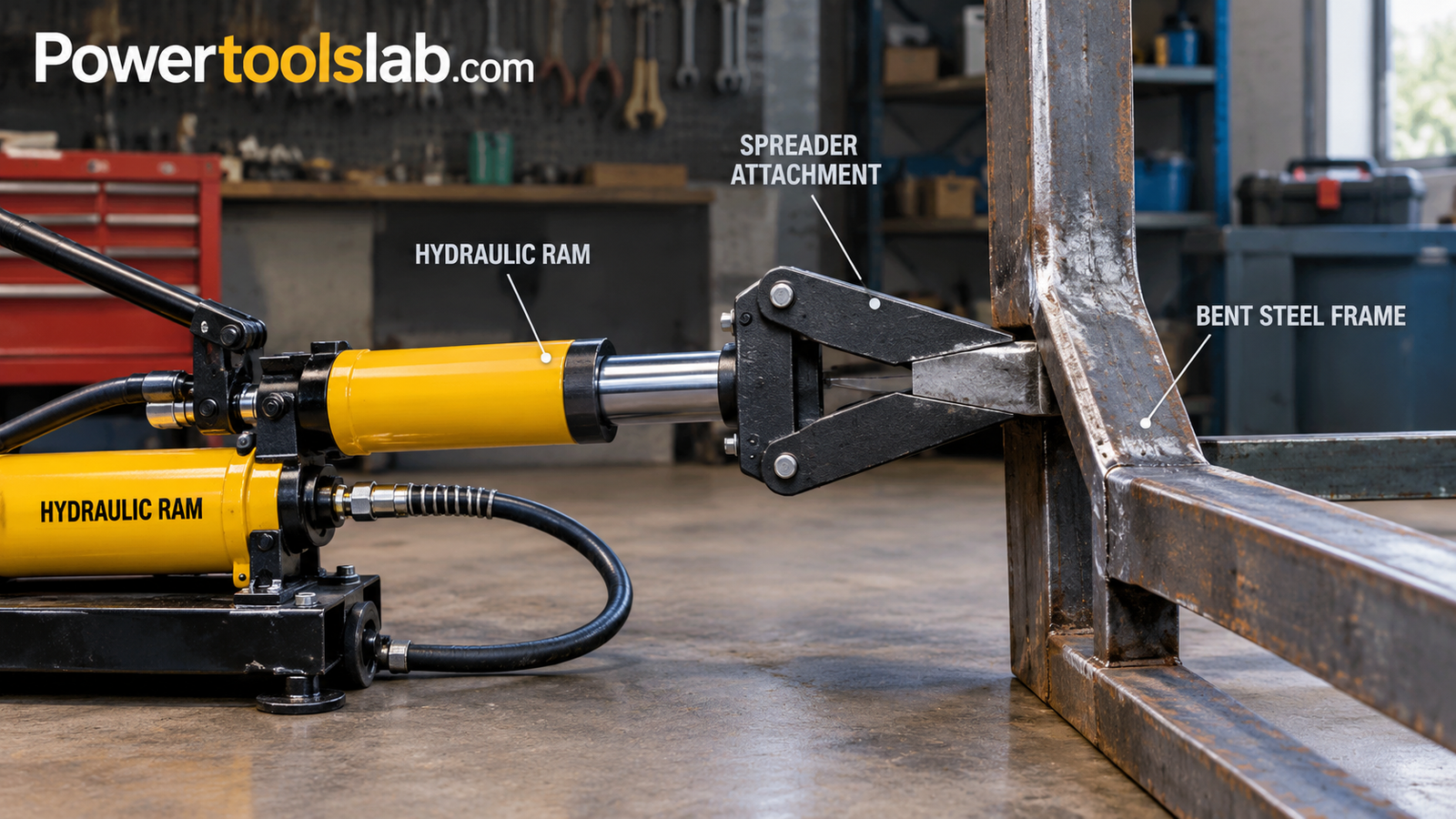
Short answer: A porta power is a portable hydraulic tool that pushes, pulls, spreads, and presses. It’s built around a hand-operated pump, a flexible high-pressure hose, and a hydraulic ram that accepts a range of interchangeable attachments. It’s a force tool, not a lifting tool, and it’s most closely associated with auto body and frame repair.
1. What Type of Tool Is a Porta Power?
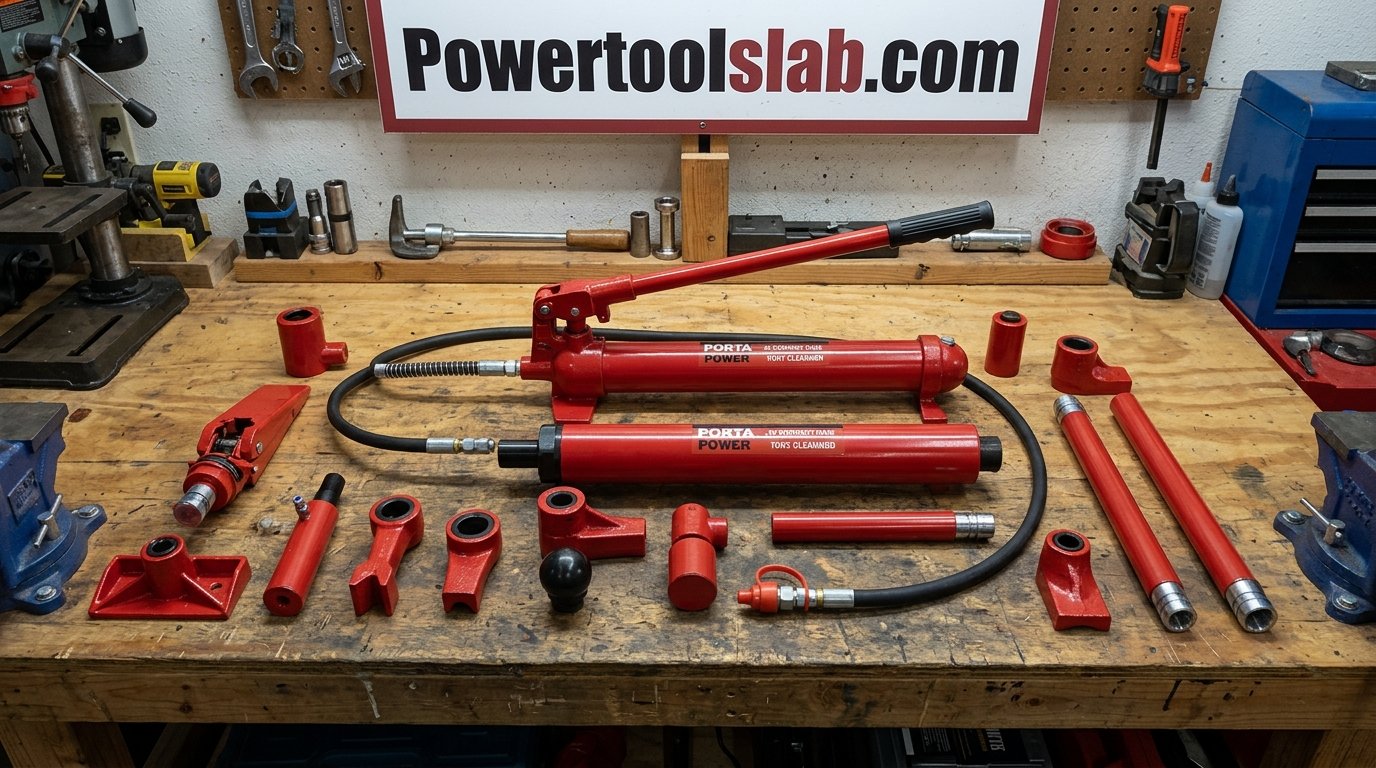
If you’ve never held one, the easiest way to picture a porta power is to imagine a hydraulic bottle jack split into two pieces. The pump handle and oil reservoir sit at one end. The piston that actually moves sits at the other end, connected by a hose. Because the ram is separated from the pump, you can put the working end in places a regular jack could never reach, such as inside a door opening, between two frame rails, or across a bent bracket, while you stand comfortably outside the tight space and pump.
That design gives the tool its character. A porta power is technically a hydraulic ram kit, sometimes called a hydraulic body and frame repair kit or a push-pull kit. It converts the small effort you put into a hand pump into a very large, controlled linear force at the ram. That force can push two objects apart, pull them together (with the right attachments), press a part into or out of a housing, or slowly straighten metal that has been bent out of position.
In workshop terms, it belongs to the family of manual hydraulic tools alongside bottle jacks, floor jacks, hydraulic presses, and hydraulic pullers. It isn’t a power tool in the sense of needing electricity, and it doesn’t use compressed air unless you pair it with an air-over-hydraulic pump. Most kits are 100 percent hand powered, which is a big part of their appeal: no cords, no batteries, no compressor, and no way to lose power in the middle of a job.
This guide covers the full picture. You’ll learn where the name comes from, how the hydraulics work, what each part does, which attachments matter, and where a porta power is genuinely the right tool. We’ll also compare it with other tools that get mistaken for it and go through the safety rules that keep a lot of force from turning into an accident.
Want to see what a complete kit looks like before you read on?
Browse Porta Power Kits on Amazon2. Where the Name Comes From
“Porta Power” is one of those product names that escaped its brand and became a common noun. The tool was popularized by a company that sold hydraulic repair kits to collision shops decades ago, and the name stuck so firmly that many people now use it for any similar kit, whatever logo is on the case. The same thing happened with other tool names, where one manufacturer’s product became the word everybody uses for the whole category.
You’ll see the tool spelled and named a few different ways. Porta Power, Porto Power, Porto-Power, and Port-a-Power all point at the same basic idea. Manufacturers and retailers also use more descriptive labels such as hydraulic ram kit, body repair kit, frame repair kit, push-pull hydraulic kit, and spreader kit. If you’re shopping, searching all of those terms will bring up more options than a single spelling.
The “porta” part is a nod to portability. Before this style of tool existed, straightening a bent vehicle frame meant bolting the car to a massive floor-anchored rig or a heavy chain-and-post machine. A portable hand-pumped ram that fit in a carrying case changed that. Small shops, farm garages, and home mechanics could suddenly apply serious straightening force without a huge investment in floor equipment.
It’s worth knowing this history because it explains how the tool is meant to be used. It was never designed to be a general lifting device or a substitute for a jack stand. It was designed to apply directed, adjustable force to a specific point, and everything about the kit, from the short ram stroke to the attachment set, reflects that job.
If you’re curious about how the big manufacturers compare across categories, our overview of power tool brands is a helpful starting point, since several of the well-known names in hand tools also sell hydraulic kits under their own labels.
3. How a Porta Power Works
The physics behind a porta power is Pascal’s principle. When pressure is applied to a confined liquid, that pressure is transmitted equally in every direction through the fluid. Hydraulic oil is nearly incompressible, so the pressure you create at the pump piston shows up undiminished at the ram piston at the other end of the hose.
The trick is that the two pistons have very different sizes. The pump piston is small. The ram piston is much larger. Pressure equals force divided by area, so the same pressure acting on a larger area produces a proportionally larger force. If the ram piston has ten times the surface area of the pump piston, the ram pushes ten times harder than your hand pushes on the pump, minus a little for friction.
The trade-off: force for distance
Nothing about this is free. Energy is conserved, so what you gain in force you pay for in distance. To move the ram one inch, the pump has to displace enough oil to fill that extra volume, which takes many strokes of the handle. That’s why a porta power feels slow and deliberate. You’ll pump a good number of times to extend the ram a few inches. In return, you get force you could never generate with muscle alone, and you get it in a smooth, controllable way.
The pumping cycle
- Lifting the handle draws oil from the reservoir into the pump chamber through an inlet check valve.
- Pushing the handle down forces that oil through an outlet check valve, down the hose, and into the ram cylinder.
- The oil pushes the ram piston outward against the load. A check valve holds the oil in place between strokes, so the ram doesn’t creep backward.
- When you’re finished, opening the release valve lets oil flow back to the reservoir, and the return spring pulls the ram back.
That last valve is worth respecting. Releasing it slowly gives you controlled retraction. Cranking it open all at once can drop a heavily loaded ram suddenly, which is exactly the type of moment that causes accidents in the shop.
Good to know: Some kits use a two-speed pump that moves a lot of oil on the first part of the stroke to close the gap quickly, then shifts to a high-pressure stage once the ram meets resistance. It doesn’t change what the tool is, but it saves a lot of pumping on long extensions.
Compare hand pumps and ram sets built for shop use.
See Hydraulic Ram Kits on Amazon4. Anatomy of a Porta Power Kit
Open a typical case and you’ll find three core components plus a pile of attachments. Knowing what each one does makes it much easier to buy the right kit and to diagnose problems later.
The hand pump
The pump is the control center. It includes the handle, the oil reservoir, the pump piston, the check valves, the release valve, and usually a coupler for the hose. Better pumps have longer handles for more leverage, a filler plug that’s easy to reach, and a release valve that opens smoothly instead of all at once. Some pumps have a built-in pressure relief valve that limits the maximum pressure so you can’t accidentally overload the ram.
The high-pressure hose
The hose carries oil between pump and ram. It’s reinforced to handle thousands of pounds per square inch and it ends in quick-connect couplers, so you can swap rams or hoses without dripping oil across the floor. Hose length matters more than most beginners expect. A longer hose lets you stand well clear of the load, and it makes it possible to position the ram in awkward locations. Damaged or kinked hose is one of the most common failure points, so it deserves a regular inspection.
The ram
The ram is where the work happens. It’s a cylinder with a piston and a return spring, threaded or fitted at the tip to accept attachments. Rams are rated by tonnage and by stroke length. A typical kit ram has a stroke of roughly a few inches to about six inches, and a working capacity of anywhere from a few tons to ten tons for standard body shop sets. The ram may be single acting, meaning oil pushes it out and a spring pulls it back, which is the standard arrangement in these kits.
The carrying case
It sounds trivial, but the case matters. A blow-molded or steel case keeps attachments organized and keeps dirt out of the couplers. Dirt in a hydraulic system is the enemy, and a kit that’s tossed loose into a toolbox is a kit that will eventually leak or stick.
| Component | Main Job | What to Check |
|---|---|---|
| Hand pump | Builds pressure by moving oil | Smooth handle action, no leaks at the reservoir, working release valve |
| Hose | Carries pressurized oil to the ram | Cracks, kinks, bulges, damaged couplers |
| Ram | Turns pressure into linear force | Rust on the piston, weeping seals, smooth return |
| Couplers | Quick-connect joints | Clean, fully threaded, no oil seepage |
| Case | Storage and protection | Latches that hold, room for every attachment |
Need a replacement hose, coupler, or extension for your kit?
Shop Hoses and Couplers on Amazon5. Attachments and Accessories That Make It Useful
On its own, a ram just extends and retracts. The attachments are what turn a porta power into a real repair system. A full kit ships with a collection of heads, bases, extension tubes, and connectors that can be combined in dozens of arrangements.
Common attachments you’ll find in a kit
- Serrated saddle or head: a grooved cap that grips a bar or a rounded piece of metal so it doesn’t slip while under force.
- Flat base plate: spreads the load against a flat surface such as a fender, floor, or wall so the ram doesn’t dig in.
- Rubber head: protects finished surfaces when you’re pushing against something you don’t want to mark.
- Spreader or wedge attachment: a wedge-shaped tip that fits into a gap and forces two panels apart.
- Toe piece: a low-profile foot that fits into tight corners and along rails.
- Extension tubes: rigid pipes in several lengths that thread together to extend the reach of the ram.
- Pipe or U-shaped adaptors: support for curved surfaces or pipes.
- Chain and hook set: used in kits that support pulling as well as pushing.
- Coupler and connector pieces: allow the tubes and heads to be assembled in a chain.
Why the extension tubes matter most
Beginners often focus on the ram tonnage and overlook the extension tubes, yet those tubes decide how versatile the kit really is. A ram with a five-inch stroke can’t reach across a car’s engine bay or between two rails on its own. Screw a few tubes together and suddenly the same ram spans a foot or two. Just remember that a longer assembly is also a less stable one. The longer the column, the more it wants to buckle sideways under load, so extended setups deserve extra care and correct alignment.
Pulling attachments
A basic porta power pushes. Some kits include a set of chain, hooks, and a clamp that let it work in a pulling arrangement. This is done by anchoring one end of a chain, running it around the ram assembly, and using the outward push to draw the chain tight. It’s a clever way to get pulling force from a pushing tool, but it requires proper anchor points and a solid understanding of load direction.
Tip: Keep every attachment in its assigned slot in the case. If a piece is missing, you’ll know before you’re halfway through a job and can’t easily find a substitute.
Look for kits with a good spread of heads and extension tubes.
Find Attachment Sets on Amazon6. Auto Body and Frame Repair: The Classic Job
Collision repair is where the porta power built its reputation. When a vehicle takes an impact, panels crumple, door frames twist, and structural members bend. Restoring that damage isn’t about hammering. It’s about applying steady force in the opposite direction of the deformation until the metal returns to its original shape.
Typical body shop tasks
- Pushing out dents from inside: a ram braced against a solid point can push a caved-in panel back toward its original contour.
- Straightening door frames: when a door won’t close properly because the opening has racked, a ram spanning the opening can gradually restore the shape.
- Spreading pinched seams: spreader attachments can separate panels that have been crushed together.
- Correcting minor frame and rail misalignment: used carefully on small deviations, it can nudge components back into position.
- Pushing out crushed fenders and quarter panels: working from the inside with the right base plate spreads the force over a large area.
- Removing and installing stubborn components: pressing out worn parts held tightly in place.
Why it’s controllable
Metal has memory, and sudden force tends to tear or kink it. A hydraulic ram builds force gradually and lets you stop at any moment. You can apply a bit of pressure, check the result, adjust the angle of the ram, and continue. That’s a huge advantage compared with hammering, and it’s why experienced technicians often make several small pulls instead of one dramatic one.
The limits of the tool
A porta power isn’t a full frame machine. Modern vehicles use high-strength steels, aluminum, and unibody construction that require precise measurement and heat management. Serious structural damage should be measured against manufacturer specs and repaired on proper equipment by a qualified technician. For minor straightening, older vehicles, trailers, and farm equipment, the porta power is a fine tool. For structural safety components on a late-model car, it isn’t a substitute for a professional collision repair process.
Working on body panels or frame repair at home?
Shop Body Repair Kits on Amazon7. Uses Beyond the Body Shop
Once you understand that a porta power is a general-purpose push and spread tool, the range of jobs it can handle opens up considerably. Plenty of owners buy one for a single repair and then find themselves reaching for it again and again.
Mechanical and automotive tasks
- Pressing bushings and bearings in and out of housings when they’re too tight to tap out by hand.
- Pushing stuck pins, axle shafts, or seized components.
- Spreading a slightly pinched clamp or bracket.
- Providing steady force to hold parts in position while welding or bolting.
Farm, trailer, and equipment repair
Bent implements, twisted trailer frames, and warped gates are common in agricultural and rural settings. A portable ram lets you straighten these items in place, without hauling heavy equipment to a specialized shop. It’s also good for pushing stubborn pins out of hitch assemblies.
Carpentry and construction
Builders occasionally use spreaders to push framing members apart or to pull a sagging beam back into alignment. Pressing a tight door frame back into square is another good example. The key is remembering the tool applies enormous force, so it should be used only where the structure can safely take that force.
Industrial maintenance
Maintenance crews use hydraulic ram kits to adjust machine bases, separate flanges, and push components apart during disassembly. Where a slow, controlled push is needed and a pry bar would be too crude, a porta power fits nicely.
If you’re setting up a workshop where hydraulic tools share space with air tools, it helps to understand how the other side of the shop works too. Our guide on how air compressors work covers the fundamentals of compressed-air power, which is a useful contrast to the fluid-based power inside a porta power.
A versatile kit pays for itself across many repair jobs.
Explore 10-Ton Kits on Amazon8. Tonnage Ratings and Kit Sizes Explained
Kits are labeled by their rated capacity, most often four tons or ten tons. That number describes the maximum force the ram is designed to deliver at its rated pressure. It doesn’t mean the kit lifts four or ten tons like a jack. It means the ram can push with that much force against a resisting object.
| Kit Size | Typical Use | Best For | Considerations |
|---|---|---|---|
| Around 4 ton | Light body panel work, spreading, small pressing jobs | Home garages and hobby repair | Lighter, cheaper, less capacity for heavy frame work |
| Around 8 ton | Mixed body work and general repair | Serious hobbyists and small shops | Good balance of force and portability |
| Around 10 ton | Heavier straightening, frame components, farm equipment | Professional shops and heavy DIY | Heavier ram and stronger attachments needed |
| Heavier industrial sets | Maintenance, machinery, industrial use | Industrial maintenance crews | Much higher cost and a strong need for training |
Why more tons isn’t always better
It’s tempting to buy the highest rating available. But a bigger ram is heavier, has a larger body that may not fit into tight spaces, and can easily apply more force than a thin panel can handle. For sheet metal, a modest ram with a well-spread base is usually more useful than a big one that risks crushing what you’re trying to fix. Match the tonnage to the material and the job.
Stroke length
Stroke length is the distance the piston extends. A longer stroke means fewer tube changes, but a taller ram body. Short-stroke rams are compact and good for cramped areas, while long-stroke rams help when you need to move a component a significant distance. Many people are surprised by how little movement is required for most straightening jobs. A couple of inches applied in the right spot often does the trick.
Pressure ratings
Pressure is usually rated in psi, and hand pumps commonly operate up to roughly ten thousand psi. The maximum pressure and the ram’s piston area together give the tonnage. Always check that the pump, hose, and ram are rated for the same working pressure. A mismatched component becomes the weak link in the system.
Choose the right capacity for your kind of work.
Compare 4-Ton and 10-Ton Kits on Amazon9. Porta Power vs Other Hydraulic and Shop Tools
Because a porta power shares parts and principles with other hydraulic tools, people often confuse them. Here’s how they differ and where each one fits.
| Tool | Primary Function | Force Direction | Portability | Typical Job |
|---|---|---|---|---|
| Porta power | Push, spread, and press | Linear, remote ram | High, kit-based | Body straightening, pressing, spreading |
| Bottle jack | Lift heavy loads | Vertical lift | Moderate | Raising vehicles and equipment |
| Floor jack | Lift vehicles quickly | Vertical lift with wheels | Moderate, bulky | Raising a car for wheel and brake work |
| Hydraulic press | Press parts under controlled force | Vertical, in a frame | Low, stationary | Bearings, bushings, shafts |
| Hydraulic puller | Pull gears and bearings off shafts | Pulling | High | Removing pulleys and bearings |
| Come-along or winch | Pull with a cable or chain | Pulling only | High | Dragging and tensioning |
Porta power vs bottle jack
A bottle jack is built to lift. Its ram is integral with the pump, it has a base designed to sit on the ground, and its saddle is meant to carry a vehicle or load. A porta power ram is designed to push horizontally or at any angle, and it isn’t intended to be trusted as a lifting support. The two look similar, but their jobs are different, and using a porta power to hold up a car is a dangerous mistake.
Porta power vs hydraulic press
A shop press is a fixed frame with a ram that pushes straight down. It gives you rigid alignment and is ideal for pressing bearings and bushings accurately. A porta power lets you do similar pressing, but on parts that are already installed in a vehicle or machine, where you can’t bring the part to a press. It trades some precision for enormous flexibility.
Hand pump vs air-over-hydraulic
Some setups replace the manual pump with an air-driven hydraulic pump. That saves your arm, but it adds the need for a compressor and air fittings. If you’re considering that route, our guides on how to choose an air compressor and what size air compressor you need can help you decide whether the extra equipment makes sense for your shop.
Pros of a Porta Power
- Huge force from a compact, hand-operated kit
- Remote ram fits into tight spaces
- Fine, controllable movement
- No electricity or air required
- Versatile attachment system
- Fairly affordable for the capability
Cons of a Porta Power
- Pumping is slow for long extensions
- Not a lifting or support device
- Requires skill to avoid overloading metal
- Long extension setups can buckle
- Seals and hoses need periodic care
- Not a replacement for a full frame machine
Not sure which hydraulic tool you need? Check the options side by side.
Compare Hydraulic Tools on Amazon10. Safety Rules for Using a Porta Power
The same feature that makes a porta power valuable, its huge force, makes it dangerous when it’s misused. A ram under load stores a great deal of energy. If a base plate slips or a tube buckles, that energy can release very quickly, sending pieces flying. Most accidents are preventable with a few disciplined habits.
Before you pump
- Wear protection. Safety glasses are mandatory, and heavy gloves and closed shoes are strongly recommended. A face shield isn’t a bad idea for high-force setups.
- Inspect the kit. Look for cracked hoses, leaking couplers, bent tubes, and damaged threads. Don’t use anything that looks compromised.
- Check ratings. Make sure the ram, hose, and pump are matched and that you aren’t going to exceed the working capacity.
- Secure the workpiece. A vehicle should be on proper stands or fixed in place. A ram pushing against a movable object can shove it away dangerously.
During the job
- Keep everything aligned. The ram should push straight along its axis. Side loading bends the piston and can cause failure.
- Use a solid anchor point. The base should press against something that can take the reaction force without deforming or slipping.
- Pump gradually. Add pressure in small increments and stop regularly to check how the metal or the setup is responding.
- Stay out of the line of fire. Use the hose length to stand to one side of the ram, not directly behind it.
- Never use it as a lift. A porta power isn’t rated to hold a load overhead. If you need to raise something, use jacks and stands designed for that purpose.
- Watch the extension length. Longer stacks of tubes are less stable, so keep them as short as the job allows.
After you’re finished
Release pressure slowly, and let the ram retract completely before removing the attachments. Never disconnect a coupler while there’s pressure in the hose. Wipe off the components, inspect them for damage, and store the kit clean and dry.
Shop safety goes beyond hydraulics. If your garage also runs pneumatic tools, it’s worth reviewing our guide to air compressor safety. Many of the same principles, such as respecting stored energy and never bypassing safety devices, apply to both kinds of equipment.
Gear up before you start pumping.
Shop Safety Gear on Amazon11. Buying Guide: What to Look For in a Porta Power
The market ranges from inexpensive import kits to premium professional sets. The right pick depends on how often you’ll use it, how heavy your jobs are, and how much you’re willing to spend. Here are the features that actually make a difference.
1. Match the capacity to your work
For occasional garage repair and light body work, a smaller kit is often enough. If you handle heavier frames, farm implements, or trailers, a ten-ton set gives you headroom. Buying above your needs adds weight and cost, while buying below them risks straining the tool.
2. Inspect build quality
Look for forged or thick-walled steel attachments, machined threads, and a ram with a smooth, clean finish. Cheap kits sometimes use soft metal that deforms under load. Reading owner reviews for reports of bent tubes, leaking seals, and weak couplers will tell you far more than a spec sheet.
3. Consider the pump design
A long, comfortable handle reduces effort. A two-stage pump reduces pumping time. A smooth, progressive release valve gives you control on the way down. A built-in relief valve adds a layer of protection against overload.
4. Check the hose length and quality
A longer hose gives you flexibility to position the ram and stand back. It should be rated for the same pressure as the pump, with crimped or swaged fittings rather than a cheap, loose connection.
5. Count the attachments
More attachments aren’t automatically better, but a good set should include a flat base, a serrated head, a rubber head, a spreader, a toe, and several extension tubes. Kits that add a chain set for pulling deserve extra points if you need that function.
6. Look at the case and the warranty
A sturdy case protects your investment. A meaningful warranty, and a brand with a track record of supplying replacement parts, saves headaches later. Many well-known manufacturers appear in our roundup of power tool brands, which can help you judge who stands behind their products.
| Buyer Type | Suggested Capacity | Key Priorities |
|---|---|---|
| Weekend DIYer | Around 4 ton | Price, compact case, basic attachments |
| Serious hobbyist | Around 8 to 10 ton | Build quality, extension tubes, pump comfort |
| Small repair shop | 10 ton and up | Durability, warranty, parts availability |
| Farm or fleet maintenance | 10 ton with pulling accessories | Rugged case, long hose, replacement parts |
Ready to choose? Read owner reviews before you buy.
See Top-Rated Kits on Amazon12. Maintenance, Storage, and Troubleshooting
A hydraulic kit will last for many years if you treat it properly. Most failures come from dirt, neglect, and rust rather than from normal use.
Routine maintenance
- Check the oil level. With the ram fully retracted, the reservoir should be at the level shown in the manual. Top it up using the specified hydraulic oil, never brake fluid or motor oil.
- Keep couplers clean. Cap the ends when disconnected. A speck of grit in a coupler can score seals.
- Wipe the piston. Clean any exposed piston surface after use and apply a light coat of oil to keep rust away.
- Inspect the hose. Replace it at the first sign of cracking, bulging, or oil weeping at the crimps.
- Store correctly. Keep the kit in its case, in a dry place, with the ram fully retracted.
Common problems and fixes
| Symptom | Likely Cause | What to Try |
|---|---|---|
| Ram won’t extend | Low oil, closed-off air pocket, or release valve open | Close the release valve, check the oil level, and bleed the system |
| Ram extends but drifts back | Worn seal or leaking check valve | Inspect the pump valves, replace seals if needed |
| Spongy, weak feel | Air trapped in the system | Bleed the air from the pump and ram |
| Oil leaking at the coupler | Damaged threads or seal | Clean and reseat; replace the coupler if needed |
| Ram doesn’t fully retract | Weak return spring or trapped fluid | Open the release valve fully and check for a bent piston |
| Slow or uneven pumping | Dirty oil or a stuck check valve | Change the oil and service the pump |
Bleeding air from the system
Air in the hydraulic circuit compresses, unlike oil, so it makes the ram feel soft and unpredictable. To bleed the system, set the pump higher than the ram, open the release valve, and cycle the ram a few times, following the specific instructions in your manual. Since procedures differ slightly between pump designs, the manufacturer’s guidance always takes priority over general advice.
When to replace rather than repair
If the ram body is bent, the piston is scored or pitted, or the threads are damaged, replacement is safer than repair. Hydraulic components are pressure devices, and a compromised part isn’t worth the risk.
Keep your kit running with fresh hydraulic oil and spare parts.
Shop Oil and Spare Parts on AmazonFrequently Asked Questions About the Porta Power
What type of tool is a porta power?
A porta power is a portable, hand-pumped hydraulic ram kit. It uses a pump, a hose, and a remote ram with interchangeable attachments to push, spread, and press objects with very large force. It’s used mainly for auto body and frame straightening.
Is a porta power the same as a jack?
No. Jacks are designed to lift and support loads. A porta power is designed to apply force horizontally or at an angle for straightening, spreading, and pressing. It shouldn’t be used to hold up a vehicle or any overhead load.
Does a porta power need electricity or air?
Standard kits are entirely manual and require neither. You operate the pump by hand. Air-powered and electric pumps are available for ram systems, but they’re add-ons and not part of the classic kit.
How much force can a porta power produce?
It depends on the model. Common kits are rated at about four tons or ten tons, meaning the ram can push with roughly that much force at its rated pressure. The rating describes push force, not a lifting capacity.
Can a porta power straighten a car frame?
It can help with minor straightening on older vehicles, trailers, and equipment. Modern unibody vehicles and safety-critical structural components require precise measurement and proper equipment, and should be repaired by a qualified collision technician.
What can I use a porta power for besides body work?
Typical uses include pressing bearings and bushings, spreading pinched parts, pushing stuck pins, straightening farm equipment, adjusting machine bases, and holding parts in position during repairs.
What size porta power should I buy?
A smaller kit is enough for light garage jobs and panel work. A ten-ton kit is a better choice for heavy frame work, farm equipment, and professional use. Buy for the heaviest job you expect to do regularly, without going far above it.
What kind of oil does a porta power use?
Use hydraulic jack oil or the fluid recommended in your manual. Avoid brake fluid, motor oil, or other substitutes, since they can damage seals and lead to leaks or poor performance.
Why does my porta power feel spongy or lose pressure?
The usual cause is air trapped in the system, low oil, or a worn seal or check valve. Bleeding the air, topping up the oil, and inspecting the seals and couplers solves most cases.
Is a porta power safe for beginners?
It can be, with the right precautions. Wear eye protection, secure the workpiece, keep the ram aligned, pump slowly, and stay out of the line of force. Beginners should start with simple jobs and never exceed the kit’s rated capacity.
How long does a porta power last?
A quality kit that’s kept clean, stored properly, and serviced on time can last for many years. Hoses and seals are wear items and will need replacement eventually, but the ram and pump body often outlast them.
Can I use a porta power to pull as well as push?
Yes, if you use a kit that includes a chain and pulling accessories, and you set up solid anchor points. The ram itself always pushes, and the accessories redirect that force into a pull.
Conclusion: A Small Kit With a Big Job Description
So, what type of tool is a porta power? It’s a portable hydraulic push-pull system: a hand pump, a hose, and a remote ram that turn a few pounds of hand pressure into thousands of pounds of controlled force. It isn’t a jack and it isn’t a lift, and thinking of it that way keeps you safe. It’s a straightening, spreading, and pressing tool that shines in body repair, farm and trailer work, and general mechanical jobs where a controlled push does what a hammer can’t.
If you’re considering one, start by defining the work you actually do. Choose a capacity that fits, pay attention to build quality and attachment selection, and treat safety as part of the tool, not an afterthought. Look after the hoses and seals, keep the oil clean, and your kit will reward you with years of dependable service.
Whether you’re pushing out a dented fender, pressing a stubborn bushing, or straightening a bent gate, a porta power gives you the kind of controlled muscle that’s hard to get any other way.
Ready to add a porta power to your workshop?
Check Porta Power Prices on Amazon