Angle Grinders · Shop-Floor Picks
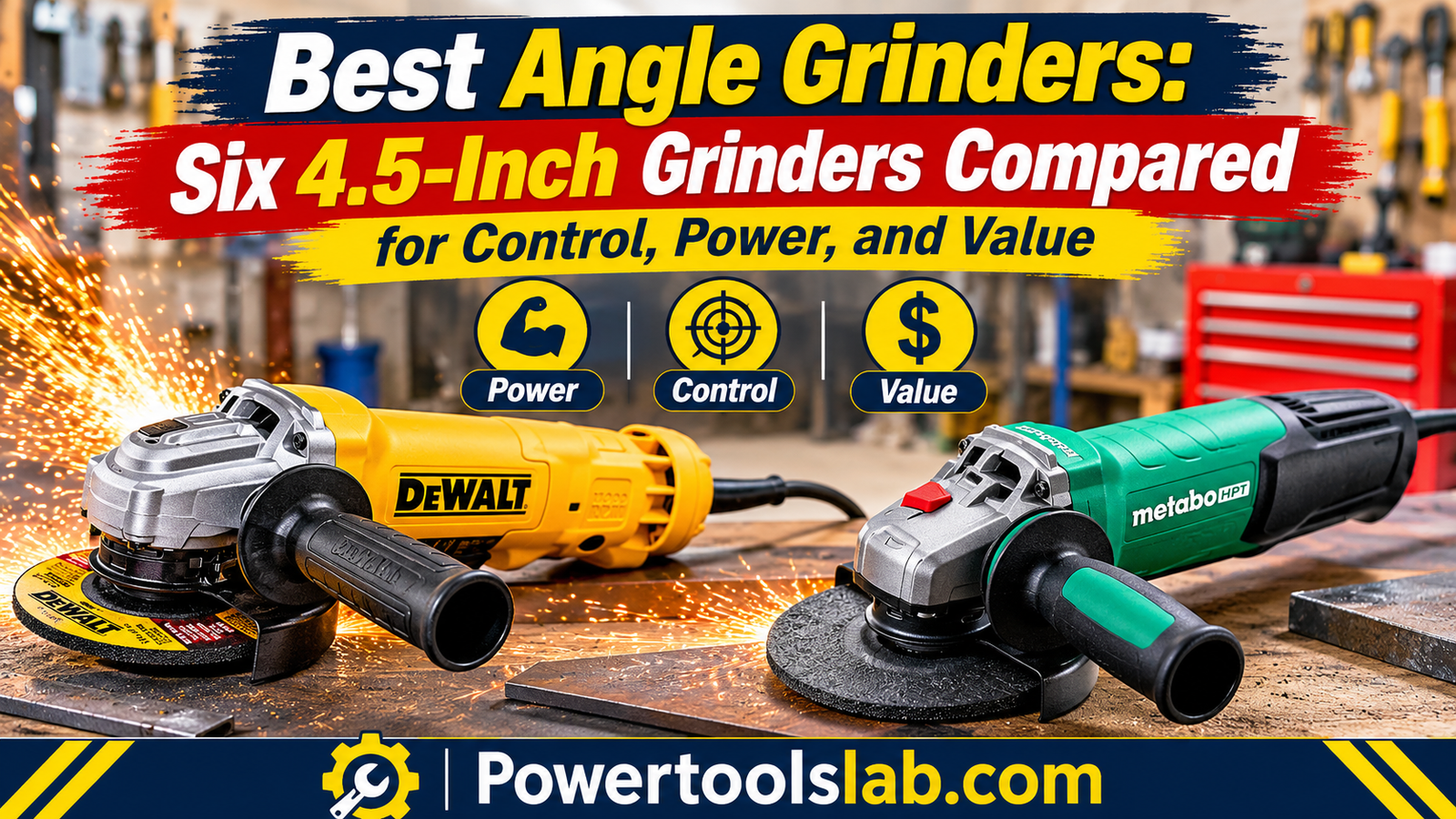
Best Angle Grinders: Six 4.5-Inch Grinders Compared for Control, Power, and Value
An angle grinder is the most versatile single tool you can put on a bench — but only if you buy one that fits your hands, your work, and your habits. We compared six popular 4.5-inch corded grinders from DEWALT, Bosch, Makita, Metabo HPT, AVID POWER, and PROMAKER to work out which one deserves the space in your kit.
- 4.5-inch wheel format
- Corded power
- Grinding · Cutting · Sanding
- Beginner to pro
The Short Version
Why This Guide Exists
Ask ten fabricators which tool they would refuse to give up, and an uncomfortable number of them will say the same thing: the angle grinder. It cuts, it grinds, it sands, it polishes, it strips paint, it sharpens, it scores masonry, and it cleans up the mess left behind by every other tool on the list. Nothing else in a home shop or a professional bay covers that much ground from one trigger.
That versatility is exactly why buying one is harder than it looks. Angle grinders all share the same silhouette — a body, a spinning disc, a guard — but the differences between them live in the things you cannot see on a product photo: how the housing sits in your palm, how the guard resists being bumped out of position, how the motor behaves when you lean into a weld, how much the tool fights you after forty minutes of continuous work.
We built this guide around six 4.5-inch corded grinders that show up repeatedly in real workshops: the DEWALT DWE402, the Bosch GWS8-45, the Makita 9557PBX1, the Metabo HPT 4.5-inch kit, the AVID POWER 7.5-Amp, and the PROMAKER 9 Amp. Between them, they cover the whole spread — professional workhorse, control-focused compact, accessory-loaded kit, and value-first entry points.
One note on how we write here: we do not publish invented numbers. Where a specification is not stated in a product’s name or confirmed on its listing, we describe the characteristic in plain language rather than guessing at a figure. Before you order, always confirm the current specification list on the Amazon product page, because manufacturers do quietly refresh tool bodies and bundles.
What is the best angle grinder for most people?
- Best overall: DEWALT DWE402 — a full-strength, pro-grade corded grinder with an 11-amp motor in a 4.5-inch body.
- Best for control: Bosch GWS8-45 — slim, light, and easy to hold steady on detail work.
- Best accessory kit: Makita 9557PBX1 — a trusted workhorse that arrives ready for multiple jobs.
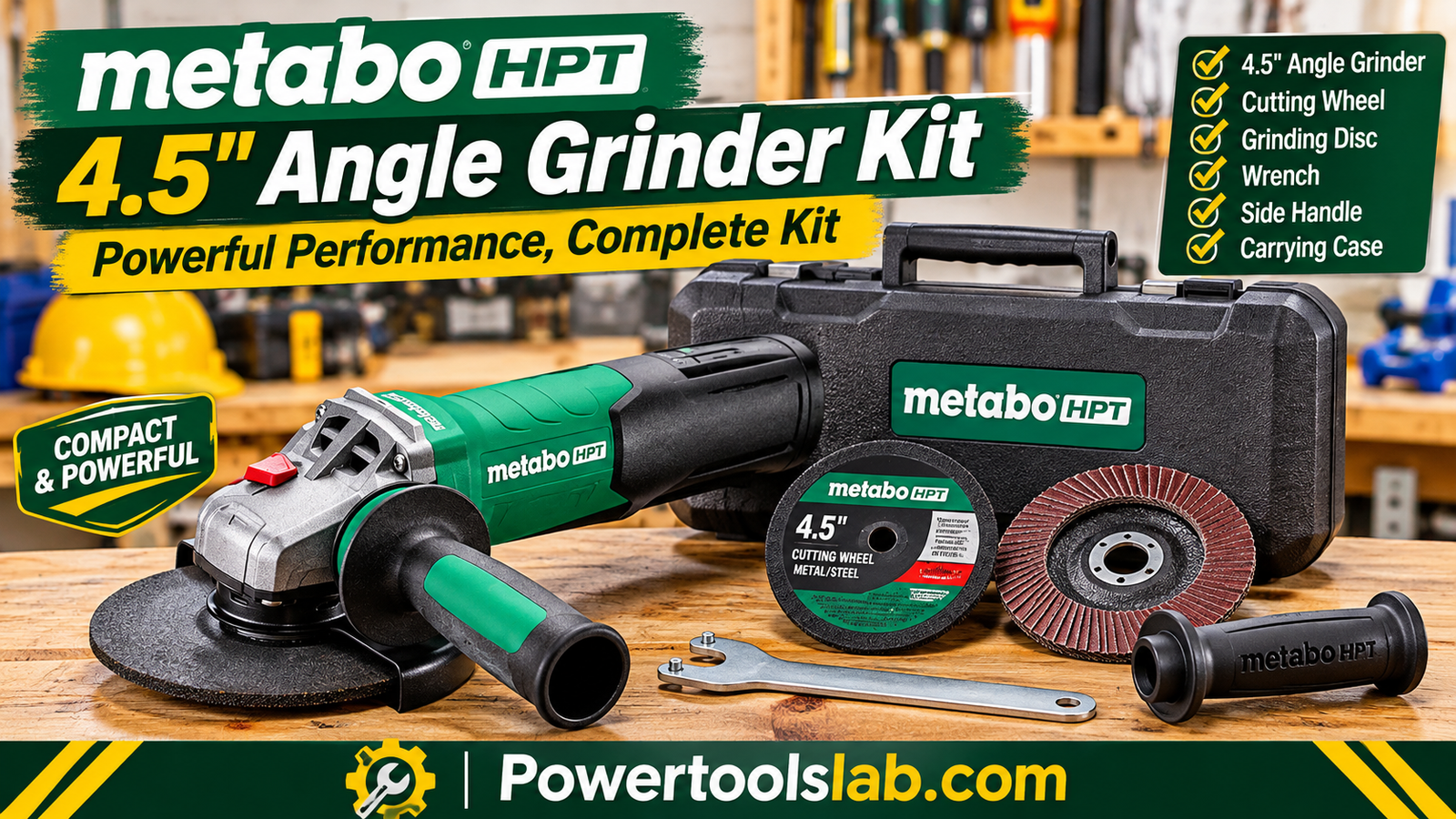
- Best complete package: Metabo HPT 4.5-Inch Kit — a sensible all-in-one bundle for a working shop.
- Best budget option: AVID POWER 7.5-Amp — approachable, capable, and beginner-friendly.
- Best for stock removal: PROMAKER 9 Amp — extra motor headroom for stubborn material on a budget.
Below you will find the full comparison table, individual reviews of every grinder on the list, a breakdown of the specification language that actually matters, a job-by-job matching guide, safety and accessory advice, and a maintenance section that will save you from the most common early failures. If you only read two things today, read the comparison table and the safety section.
Ready to see the full range?
Browse every 4.5-inch angle grinder in one place and compare current bundles.
Check Price on AmazonAt a Glance
Quick Comparison: Our Top Picks
Every grinder on this list appears below. Use the table to shortlist two or three candidates, then read the full review sections further down for the details that do not fit in a cell.
| # | Image | Product | Key Specs | Verdict | Check Price |
|---|---|---|---|---|---|
| Top Pick 1 |
 |
DEWALT DWE402 4.5″ 11 Amp Angle GrinderBest Overall |
|
Muscle and grip comfort in one tough package. | Check Price on Amazon |
| 2 |  |
Bosch GWS8-45 4.5″ Angle GrinderBest for Control |
|
Slim, light, and remarkably easy to control. | Check Price on Amazon |
| 3 |  |
Makita 9557PBX1 4.5″ Angle GrinderBest Value Kit |
|
Trusted workhorse with a genuinely useful kit. | Check Price on Amazon |
| 4 |  |
Metabo HPT 4.5″ Angle Grinder KitBest Complete Package |
|
Complete kit value for weekend warriors and pros. | Check Price on Amazon |
| 5 |  |
AVID POWER 7.5-Amp Angle GrinderBest Budget |
|
Approachable entry point for everyday grinding work. | Check Price on Amazon |
| 6 |  |
PROMAKER 9 Amp 4.5″ Angle GrinderBest for Stock Removal |
|
Extra amps for stubborn material without the premium. | Check Price on Amazon |
Short on time?
Open the full angle grinder listings and filter by the features you need.
Check Price on AmazonSection 01
Why an Angle Grinder Earns Its Keep
Most power tools are specialists. A circular saw wants to travel in a straight line. A drill wants to make round holes. An angle grinder wants to remove material as fast as you can push it, in whatever direction you choose. That single difference explains why it appears in welding shops, auto restorers’ garages, masonry crews, boatyards, and sculptors’ studios — and why it is usually the tool people reach for even when a more precise option exists.
What an angle grinder actually does
At its core, the tool is a motor driving a spindle at high speed, with a disc mounted at a right angle to the body. Change the disc and you change the tool entirely. A thick grinding wheel shapes steel. A thin cutting disc slices through bar stock, sheet, tile, and masonry. A flap disc blends a weld flush. A sanding backing pad with abrasive discs strips paint and rust. A wire cup brush chases corrosion out of pitted steel. A polishing pad and compound bring aluminium back to life. A diamond blade opens up stone and tile.
That swap-in, swap-out approach is why a grinder is such a good return on a single purchase. You are not buying one capability; you are buying a platform, and the consumables are cheap relative to the work they do.
Why the 4.5-inch format dominates
Grinders come in a range of wheel sizes, and larger machines are genuinely useful for heavy fabrication. But the 4.5-inch class is the sweet spot for one overwhelming reason: balance. The body is light enough to hold one-handed on vertical surfaces, compact enough to reach inside a wheel arch or a cabinet frame, and the discs are inexpensive and available everywhere in every abrasive grade imaginable.
A 4.5-inch grinder also behaves more forgivingly than a bigger machine. It has less rotating mass, so it spools up and stops quickly, and it is far less likely to snatch or kick back when you touch the edge of a disc to a corner. For a beginner, that margin matters enormously. For a professional, it simply means less fatigue over a long shift.
Who actually needs one
- Welders and fabricators: weld cleanup, beveling edges before a joint, cutting angle iron and tube to length, and grinding out a bad bead before re-welding.
- Auto restorers: rust removal, spot weld cutting, seam cleaning, panel trimming, and paint stripping in areas a sander cannot reach.
- Homeowners and DIYers: cutting bolts flush, trimming a steel shelf bracket, sharpening mower blades, removing old mortar, and prepping surfaces before painting.
- Masons and tilers: scoring and cutting tile, stone, and brick when a dedicated wet saw is impractical — though for serious tile work, a dedicated saw remains the better tool, as we explain in our best tile saws guide.
- Woodworkers, carefully: carving and texturing with dedicated carving discs, and removing old finish. Wood is where a grinder is most often misused, so the disc choice matters more than the tool.
Where a grinder is the wrong answer
An angle grinder is not a precision instrument. It will not give you a furniture-grade cut line, it is not a substitute for a mitre saw when accuracy matters, and it is a poor choice for anything where the workpiece can move or the operator cannot brace both hands. If your task is accurate dimensioning of timber, you want a proper saw — see our guides to the best power saws and the differences in types of power saws before you commit.
Understand the tool’s temperament and it rewards you. Push it into work it was never designed for and it will remind you, loudly, at the worst possible moment.
Start with the right grinder body
Compare 4.5-inch models from the brands fabricators actually use.
Check Price on AmazonSection 02
Reading the Spec Sheet: What Actually Matters
Grinder marketing copy is a wall of numbers, and half of them will not change how the tool performs in your hands. Here is how to sort the useful information from the decorative.
Motor amperage — useful, but not the whole story
Amperage tells you how much current the motor draws, and it is a reasonable shorthand for sustained muscle on a corded tool. A grinder with a higher amp rating generally holds its speed better when you press hard into a weld or drive a cutting disc through thick section. That is why the DEWALT DWE402 and its 11-amp motor feel so assertive, why the PROMAKER 9 Amp offers real headroom at its price, and why the AVID POWER 7.5-Amp is positioned for lighter everyday work.
But amps are only part of the equation. Cooling design, gear quality, and how the motor handles heat over a long cut matter just as much. A well-cooled mid-amp grinder that runs all afternoon will outwork a high-amp tool that bakes its own windings. For a wider discussion of amp draw across the tool family, our guide to how many amps a typical power tool uses puts these figures in context.
Wheel size and disc compatibility
Every grinder on this list runs the 4.5-inch format, which is the most common and most flexible size available. What matters beyond the headline number is the arbor configuration and whether the tool uses a standard mounting system that accepts the abrasive range you can actually buy locally. Before ordering discs, check the bore size stamped on the wheel and match it to your spindle.
Speed: no-load numbers versus what happens under load
Grinder speed is quoted as a no-load figure — the speed the disc spins with nothing touching it. The moment you engage the work, speed drops. A tool that maintains a larger share of its no-load speed under pressure is doing more work per second and producing less heat in the disc. This is why a strong motor feels smoother: it is not necessarily spinning the disc faster at rest, it is refusing to bog when you push.
Ergonomics, grip, and balance
Grinding is one of the few tool tasks where the human body becomes the weak link. Vibration travels straight into the wrists, and awkward grip angles turn a five-minute job into a day-long ache. The body diameter, the texture of the grip zones, the position of the switch, and the way the tool balances with a side handle fitted all matter more than an extra digit on the amp rating.
This is precisely where the Bosch GWS8-45 earns its reputation — a slim, compact body that stays controllable during detail work — and where the DEWALT’s grip shape makes long sessions more tolerable. Once you start comparing grinders side by side, notice how quickly the “best spec sheet” stops being the best tool.
Guard design, spindle locks, and wheel changes
The guard is not a formality. It is the difference between a spark shower that goes where you expect and a wheel fragment that does not. Look for a guard that adjusts without a separate tool and holds its position under vibration, plus a spindle lock that makes wheel changes quick and certain.
Dust, heat, and motor protection
Grinding produces fine abrasive dust that finds its way into everything. Better tools route airflow over the motor and away from the operator, and some use sealed or labyrinth-style inlets to keep particles out of the windings. If you work in a dusty environment — masonry, concrete, rust removal — this design detail determines tool life far more than raw power does. Motor design across the wider tool family is covered in our breakdown of brushless versus brushed motors, and brand-level tendencies are covered in our power tool brands guide.
Want the strongest motor on the list?
Start with the DEWALT DWE402 and compare its current bundle.
Check Price on AmazonSection 03
How We Selected These Six Grinders
There are dozens of 4.5-inch grinders on the market. These six earned their place on the list for specific reasons, and it is worth being transparent about what those reasons were.
Build quality and durability
We favoured tools from manufacturers with a service history — brands that stock brushes, guards, and replacement parts, and that have a real warranty process. A grinder that fails at the switch is not a bargain at any price. Brand heritage is one reason DEWALT, Bosch, Makita, and Metabo HPT appear here alongside the value-focused AVID POWER and PROMAKER.
Handling and control
Every grinder on this list had to be manageable with two hands and reasonable with one. Body diameter, grip texture, switch placement, and the balance point with a side handle installed were all considered. Tools that punish you during a fifteen-minute job were excluded.
Safety design
Guard adjustability, guard retention, spindle lock security, and the clarity of the operator manual all fed into the selection. A grinder should make the safe choice the easy choice.
Value, not just price
The cheapest tool is not automatically the best value, and the most expensive is not automatically the best tool. We looked at what you get in the box, how the tool will hold up over a few seasons of real use, and whether the purchase still makes sense when you add the discs and accessories you will inevitably need. If you are new to power tools entirely, our guide to the best power tools for beginners explains how to sequence your first purchases.
Versatility of the platform
Because a grinder is only as useful as the discs you can run on it, we favoured tools in the mainstream 4.5-inch format with widely available consumables. A grinder with an obscure mounting system is a tool you will stop using the moment the first pack of discs runs out.
Honest limitations
We are not going to pretend that a spreadsheet replaces time on the tools. Where we describe a characteristic, we describe it in the terms a working user would recognise rather than inventing figures to fill a table. And where a product’s bundle content changes between listings, the listing wins — always check what is included before you order.
Building your first toolkit?
Pair your grinder with a drill that suits the same kind of work.
Check Price on AmazonSection 04 · Best Overall
DEWALT DWE402 4.5″ 11 Amp Angle Grinder
The DEWALT DWE402 is the grinder we would choose if we could own exactly one. It pairs a full-strength 11-amp motor with a 4.5-inch wheel format that stays nimble in the hand, and it comes from a line of tools that has spent decades on job sites rather than in showrooms. For anyone who grinds regularly — weld cleanup, rust removal, bolt trimming, masonry scoring — this is the tool that stops being a compromise.
- 11-amp corded motor: meaningful headroom for sustained grinding and cutting without the tool feeling like it is struggling.
- 4.5-inch wheel format: the most widely supported disc size, available in every abrasive grade and price range.
- Tool-free guard adjustment: reposition the guard quickly as the work changes, without hunting for a spanner.
- Pro-grade body design: built for repeated use, with the grip shaping that long sessions demand.
- Quick wheel changes: a spindle-lock style setup that keeps consumable swaps fast and predictable.
What stands out
The first thing you notice is confidence under load. Where lighter grinders audibly change pitch the moment you press into a weld, the DWE402 holds its ground. That steadiness changes the way you work: you can feed more consistently, produce a flatter blend, and finish a seam in fewer passes. Feed consistency is the single biggest factor in clean grinding, and a tool that supports it is worth more than a slightly better price tag.
The second thing is the guard. Working on anything other than a flat bench means the spark direction changes constantly, and a guard you can adjust without tools becomes a habit rather than a chore. You end up using it correctly instead of leaving it in the wrong position because changing it was annoying.
Third, the balance. With a side handle fitted, the tool sits naturally between two hands, which keeps the force vector in line with the disc instead of twisting your wrists. It is one of those qualities you only appreciate after using a grinder that lacks it.
Pros
- Strong motor that resists bogging under pressure
- Tool-free guard repositioning on the fly
- Comfortable grip for extended sessions
- Runs the most common disc size available
- Pro-grade build with parts and service support
Cons
- Full-strength motor means more weight than a compact model
- Priced above entry-level grinders
- Overkill if you only cut a few bolts a year
Who it is best for
Anyone who grinds or cuts metal more than occasionally. Welders, fabricators, mechanics, restorers, and serious DIYers who would rather buy once than replace a tool every season. If you already own DEWALT cordless gear, the familiarity of the grip and switch will feel immediately natural — see how the brand compares against its main rival in our DEWALT versus Milwaukee comparison.
Section 05 · Best for Control
Bosch GWS8-45 4.5″ Angle Grinder
The Bosch GWS8-45 takes a different position on the spectrum. Where the DEWALT leads with muscle, the Bosch leads with finesse. Its slim, compact body is the standout characteristic, and it makes the tool genuinely pleasant to use on detail work, overhead work, and anything where you are guiding the disc rather than leaning on it.
- 4.5-inch wheel format: full compatibility with the standard abrasive and cutting disc range.
- Corded power delivery: no runtime anxiety, no battery to charge in the middle of a job.
- Slim, compact body: easier to hold precisely and easier to position in tight spaces.
- Side handle included: two-handed control whenever the work demands stability.
- Bosch engineering pedigree: a brand with deep roots in professional power tools.
What stands out
Control is the reason to buy this grinder. When you are blending a weld on visible sheet metal, or chasing a rust line along a curved panel, what matters is the ability to feather the disc gently and hold a consistent angle. A lighter, slimmer tool makes that easier, and it reduces the wrist fatigue that sets in on repetitive detail work.
It also excels in awkward positions. Overhead grinding, working inside a cabinet, reaching behind a roll cage — anywhere you cannot get both feet planted and both hands square to the work — a compact grinder is dramatically more manageable. The reduced bulk also helps you see what the disc is doing, which is a quiet but important advantage when accuracy matters.
For users with smaller hands especially, the body diameter makes a real difference. Many grinders are designed around a large grip, and if your hand does not wrap comfortably around the housing, you lose leverage and gain fatigue. The Bosch is one of the friendliest tools on this list in that regard.
Pros
- Excellent handling on detail and overhead work
- Compact body fits where larger grinders cannot
- Comfortable for smaller hands and long sessions
- Standard 4.5-inch disc compatibility
- Strong brand support and parts availability
Cons
- Less outright muscle than higher-amp models
- Not the pick for hours of heavy stock removal
- Bought as a bare tool rather than a full accessory bundle
Who it is best for
Detail-oriented users: auto body workers, metal artists, welders doing finish grinding, and anyone who values precision over raw removal rate. If your work involves visible surfaces and you care about how the finish looks, this is an easy recommendation. Bosch owners who want to stay inside one battery ecosystem for their other tools can see our best Bosch drill roundup.
Section 06 · Best Value Kit
Makita 9557PBX1 4.5″ Angle Grinder
The Makita 9557PBX1 is the grinder that turns up in the most workshops, and there is a straightforward reason why: it works, it lasts, and it arrives as a kit rather than a bare tool. Makita’s compact grinders have a long track record in metalworking and fabrication, and this package is designed for someone who wants to start grinding immediately rather than ordering accessories a week later.
- 4.5-inch wheel format: the standard size with the broadest consumable availability.
- Corded motor: continuous power for full-day projects.
- Accessory kit format: arrives ready for multiple job types rather than one.
- Compact barrel-style body: easy to position and easy to control with one or two hands.
- Storage case included: keeps the tool and its accessories together between jobs.
What stands out
The kit is the headline here. One of the most common frustrations with a new grinder is discovering that you still need a cutting disc, a grinding wheel, a flap disc, a wrench, and somewhere to keep them. Bundling those together removes the friction and means your first project is not delayed by a second order.
The tool body itself has the qualities that made Makita a fixture in fabrication shops: compact proportions, a straightforward switch, and a habit of surviving conditions that would retire lesser tools. There is a reason so many grinders of this shape are still running in shops years after purchase — the design is mature, and mature designs tend to be the ones that just work.
It also holds its value. Grinders in this class are easy to pass on, easy to get serviced, and easy to find consumables for, which matters more than people expect when a tool is part of a working kit rather than a weekend curiosity.
Pros
- Kit format means you can start work immediately
- Compact, well-proportioned body
- Proven design with a long service history
- Case keeps everything together
- Excellent consumable availability
Cons
- Kit accessories may overlap with discs you already own
- Not the most powerful motor on this list
- Case takes up bench or van space
Who it is best for
Anyone starting from zero who wants a complete, dependable setup in a single purchase. It is also a sensible second grinder for a shop that already owns a heavy-duty unit and wants something compact and ready to go. For more from the brand, see our Makita circular saw review, our best Makita drill guide, and how the brand stacks up in Makita versus DEWALT.
Section 07 · Best Complete Package
Metabo HPT 4.5″ Angle Grinder Kit
The Metabo HPT 4.5-inch grinder kit occupies a useful middle ground: professional-grade ambitions with a package that makes sense for a working garage. Metabo HPT tools carry engineering DNA from a long line of metalworking equipment, and that heritage shows in the details that matter on a grinder — guard behaviour, switch feel, and how the tool handles sustained use.
- 4.5-inch wheel format: compatible with the most common abrasive and cutting range.
- Kit format: bundled with the accessories that make the tool useful on day one.
- Corded power: unlimited runtime for projects that stretch across a weekend.
- Practical ergonomics: shaped for real work rather than showroom photos.
- Metalworking heritage: a brand lineage built around grinding and cutting.
What stands out
Metabo HPT grinders tend to feel purposeful. The controls are where you expect them, the guard stays where you set it, and the tool behaves predictably as the disc wears down. Predictability is underrated in a grinder — an unpredictable tool keeps you tense, and a tense operator produces worse work and gets tired faster.
The kit framing also makes this one of the smarter buys for a small shop. Rather than buying a bare tool and then assembling a collection of discs and accessories at retail prices, you get a working set in one decision. For a homeowner who has just bought a welder, or a restorer starting a project, that removes a whole category of friction.
There is also something to be said for buying into a brand with genuine metalworking credentials. Grinders are mechanically hard tools — high speed, high heat, constant dust — and manufacturers who have spent decades on that problem tend to build the right habits into their products.
Pros
- Complete kit for immediate, versatile use
- Predictable handling under load
- Metalworking-focused brand heritage
- Good balance of capability and price
- Sensible starter set for a new shop
Cons
- Less ubiquitous than the biggest tool brands
- Kit contents can vary between listings
- Not the lightest option for extended overhead work
Who it is best for
Homeowners, hobby fabricators, and small shops that want a capable, well-rounded package without assembling it piece by piece. If you are working out which brands deserve your loyalty across a whole tool set, our power tool brands guide is a useful companion read.
Section 08 · Best Budget
AVID POWER 7.5-Amp Angle Grinder
Not everyone needs a fabrication-grade grinder. If your work is occasional — a few bolts, a rust patch, a shelf bracket, an annual mower-blade sharpening — then buying the most powerful tool on the market is spending money you do not need to spend. The AVID POWER 7.5-Amp exists for exactly that user, and it does the job honestly.
- 7.5-amp corded motor: enough capability for everyday grinding, cutting, and cleanup.
- Light, approachable build: easy to handle for users who are not used to grinders.
- 4.5-inch compatible format: access to the standard, widely available disc range.
- Budget-friendly positioning: a sensible entry point before committing to a premium tool.
- Everyday versatility: handles the tasks most homeowners actually encounter.
What stands out
The value here is straightforward. This grinder covers the work that most non-professional users will ever ask of a grinder, and it does so without the intimidating price tag of a pro-grade machine. For a first grinder, that is a genuinely good trade.
It is also a useful learning tool. Grinders have real technique — the angle you hold the disc, the amount of pressure you apply, how you manage sparks and dust, how you move with the work rather than against it. Practising that technique on an affordable tool is much better than practising it on something you are afraid to scratch.
For lighter-duty use, the lower motor demand is not really a limitation. If you are not driving a cutting disc through thick steel section for hours at a time, a modest motor will handle the vast majority of jobs perfectly well. Where it will tell on itself is sustained heavy stock removal, and that is simply outside its intended territory.
Pros
- Lowest barrier to entry on this list
- Light and manageable for new users
- Covers everyday household and garage tasks
- Uses the standard disc size
- Good first grinder before a premium upgrade
Cons
- Less suited to sustained heavy grinding
- Fewer premium design refinements
- May be outgrown by serious fabricators
Who it is best for
First-time grinder owners, homeowners, renters, and DIYers with occasional needs. If you are building out a starter tool set, compare it against the entry-level options in our best drills for DIY and pro use guide, and consider how the budget tier compares across brands in our Ryobi versus Milwaukee comparison.
Section 09 · Best for Stock Removal
PROMAKER 9 Amp 4.5″ Angle Grinder
The PROMAKER 9 Amp sits in an appealing spot on the value curve. It offers meaningfully more motor than the entry-level options while staying well below the price of premium professional units, which makes it interesting for anyone doing heavier work on a budget — scrappers, farm and property maintenance, restoration projects, and busy home shops.
- 9-amp corded motor: extra headroom for stubborn material and longer working periods.
- 4.5-inch wheel format: full access to the standard cutting and grinding disc range.
- Value-focused build: capability prioritised over premium flourishes.
- Corded reliability: no runtime limits on multi-hour projects.
- Everyday serviceability: straightforward design that is easy to live with.
What stands out
Motor headroom is what you are paying for here. The difference between a modest grinder and one with real amp capacity shows up in the second hour of a project, not the first five minutes. When you are grinding out old welds, stripping a badly rusted panel, or cutting through multiple lengths of steel, a stronger motor keeps the disc spinning at a productive rate instead of dragging.
That makes the PROMAKER a sensible tool for work that is too demanding for a basic grinder but does not quite justify a top-tier purchase. Property maintenance is a perfect example: cutting fence hardware, trimming bolts, cleaning up implement parts, and prepping surfaces before painting. The jobs are real, they are rough, and they do not need showroom-level refinement.
It also makes sense as a dedicated second tool. Many experienced users keep one grinder set up with a grinding wheel and another with a cutting disc, because swapping discs constantly is the single biggest slowdown in grinding work. A value-priced grinder configured as your permanent cutter is a genuinely practical arrangement.
Pros
- Strong motor for the price
- Handles heavier stock removal comfortably
- Great as a dedicated second grinder
- Standard disc compatibility
- Good fit for property and restoration work
Cons
- Less brand ubiquity than the biggest names
- Design is function-first rather than refined
- Over-specified for light household tasks
Who it is best for
Budget-conscious users who still need real cutting and grinding muscle. Ideal for restoration projects, farm and property upkeep, scrapping, and shops that want a second grinder set up for a specific disc. If you are comparing motor specs across the whole tool family, read our note on typical power tool amp draw and our guide to what should never be engaged when using power tools.
Section 10
Matching the Grinder to the Job
Choosing a grinder is only half the decision. The other half is matching the tool and the disc to the work in front of you. Below we group the grinders on this list by the kind of user they suit, then walk through the common job types and what each one actually requires.
Corded workhorses for regular fabrication
If grinding is a weekly activity rather than an annual event, these are the four grinders to focus on. They share the 4.5-inch format and corded power delivery, and they differ mainly in motor output and kit content.
| # | Image | Product | Key Specs | Verdict | Check Price |
|---|---|---|---|---|---|
| Top Pick 1 |
|
DEWALT DWE402 4.5″ 11 Amp Angle GrinderBest Overall |
|
Muscle and grip comfort in one tough package. | Check Price on Amazon |
| 2 | |
Bosch GWS8-45 4.5″ Angle GrinderBest for Control |
|
Slim, light, and remarkably easy to control. | Check Price on Amazon |
| 3 | |
Makita 9557PBX1 4.5″ Angle GrinderBest Value Kit |
|
Trusted workhorse with a genuinely useful kit. | Check Price on Amazon |
| 4 | |
PROMAKER 9 Amp 4.5″ Angle GrinderBest for Stock Removal |
|
Extra amps for stubborn material without the premium. | Check Price on Amazon |
Job type: metal cutting
Cutting metal is the most common reason people buy a grinder, and it is also the task that demands the most discipline. You want a thin cutting disc, a guard positioned to deflect sparks away from you, and a steady two-handed grip. Feed gently — a cutting disc works by abrasion, not force, and leaning on it only loads the motor and cracks the disc.
For long, accurate cuts in sheet or plate, a dedicated saw often produces a better result. Our guides to power circular saws, reciprocating saws, and the differences in jigsaw versus reciprocating saw will help you decide when a saw is the better call. For rough work in tight spaces, the grinder still wins.
Job type: weld cleanup and blending
This is grinding at its most skilled. Start with a grinding wheel to knock down the bead, then switch to a flap disc to blend the surface flush. Keep the disc flat to the work and move steadily along the seam. A grinder with good speed retention — like the DEWALT or the PROMAKER — makes this much easier because the disc keeps cutting instead of polishing.
Job type: rust, paint, and corrosion removal
Wire cup brushes and stripping discs are aggressive and effective, but they scatter debris everywhere. Work in a ventilated area, wear full face protection, and expect to spend as much time cleaning up as grinding. For a vehicle, remove the parts you can rather than grinding around them. Pair this work with good dust control and you will have a much better day.
Job type: masonry, tile, and stone
With the correct diamond blade, a grinder will cut tile, brick, and stone — but dry cutting generates a great deal of fine silica dust, which is genuinely hazardous. Use dust extraction where possible, work outdoors, and wear an appropriate respirator. For anything beyond a handful of cuts, a wet saw is safer and produces better edges; see our best tile saws, our Ryobi tile saw review, and our Porter-Cable tile saw review for dedicated options.
Job type: sharpening and maintenance
Sharpening mower blades, garden tools, and lawnmower reels is one of the most satisfying grinder tasks. Use a grinding wheel, keep the tool clamped, work slowly, and never overheat the edge — a blade that turns blue has lost its temper and will not hold an edge. Dress the wheel regularly and the results will be consistent.
Job type: woodworking, with the correct disc
Standard grinding and cutting discs must never be used on wood. Purpose-made carving and sanding discs exist and are effective for sculpting, texturing, and removing old finish, but they demand respect: the tool has enormous torque and almost no resistance from timber. Two hands, firm footing, and shallow passes. If you are shaping wood to size rather than sculpting it, use a proper saw — compare options in our table saw versus circular saw and circular saw versus miter saw guides.
Kit out for the work ahead
Match your grinder with the right discs and blades for the job.
Check Price on AmazonSection 11
Wheels, Guards, and the Safety Gear That Actually Matters
An angle grinder spins an abrasive disc at high speed with nothing between the wheel and your face except the decisions you make. That is not a scare line — it is the reason every serious workshop treats grinder safety as non-negotiable. The good news is that the discipline is simple, cheap, and quickly becomes habit.
Know your discs
- Grinding wheels: thick, rigid, designed for the face and edge. Never cut with them — the side loading will crack them.
- Cutting discs: thin and brittle by design. Cut only, and never flex or side-load them.
- Flap discs: layered abrasive flaps for blending, deburring, and finishing. Far more forgiving than a solid wheel.
- Sanding and stripping discs: for paint, rust, and surface prep on a backing pad.
- Wire brushes and cups: for corrosion and old coating removal. Wires can detach at speed — full face protection is mandatory.
- Diamond blades: for tile, masonry, and stone. Check whether the blade is rated for dry or wet use.
Inspect before every use
Look at the disc before you mount it. Cracks, chips, a damaged centre ring, or a disc that has been dropped on concrete all mean the wheel goes in the bin. Check the mounting flange is clean and correctly seated, the guard is secure and positioned, and the spindle lock engages properly. This takes fifteen seconds and it is the most valuable fifteen seconds of your day.
The guard is not optional
The guard exists to contain the fragments if a wheel fails and to direct the spark stream away from you and anything flammable. Adjust it to sit between the disc and your face and body, and adjust it with tools rather than by kicking it into place. Never run a grinder with the guard removed — this is the single most common shortcut that turns a minor incident into a serious one. Our article on what should never be engaged when using power tools covers this class of mistake in more depth.
Personal protective equipment
- Eye protection: wraparound safety glasses at minimum, worn under a face shield rather than instead of one.
- Face shield: the most under-used piece of grinder equipment. Sparks and fragments travel further than people expect.
- Hearing protection: grinders are loud, sustained, and the noise is close to your ears.
- Respiratory protection: essential for masonry, concrete, rust, and paint work. Ordinary dust masks are not adequate for fine silica.
- Gloves: appropriate, close-fitting work gloves that cannot be caught by the disc. Nothing loose, nothing with dangling cuffs.
- Clothing: natural fibres where possible, sleeves rolled down but secure, no loose jackets or dangling drawstrings. Grinding sparks ignite synthetics quickly.
Technique safety
Always use two hands where the work allows. Stand to the side of the disc’s plane, never directly behind it. Let the tool reach full speed before touching the work, and never start a grinder with the disc already in contact. Keep the cable behind you and clear of the disc. Take breaks — fatigue is a leading cause of grinder accidents, and a tired operator stops checking the guard and the footing.
Where to learn good habits
Tool discipline transfers across categories. If you have good habits with a drill — correct grip, correct speed, correct bit selection — those instincts carry over. Our guides to how to use a drill and why a drill smokes are useful primers on reading what a motor is telling you before something fails.
Do not skip the safety gear
Face shield, hearing protection, and proper gloves cost less than one bad afternoon.
Check Price on AmazonSection 12
Maintenance, Care, and Troubleshooting
Grinders are hard-working, high-speed tools, and the ones that survive decades of service are not the most expensive — they are the ones whose owners did a few small things consistently. Here is the routine that keeps a grinder running and the symptoms that tell you something is going wrong.
After every use
- Blow dust out of the vents with clean compressed air, with the tool unplugged and the disc removed.
- Wipe down the body and grip so abrasive dust does not turn the handle into sandpaper.
- Inspect the disc, the flanges, the guard, and the cable for damage.
- Store the grinder where the cord cannot be crushed and the disc cannot be knocked.
Periodically
- Check and replace the motor brushes on brushed models before they wear down to their limit. Erratic sparking, loss of power, and intermittent cutting are all brush symptoms.
- Inspect the gear head for grease condition and unusual noise. A grinder that has developed a new whine is telling you something.
- Test the switch through its full range and confirm the tool starts and stops cleanly.
- Confirm the guard still clamps firmly and has not been bent or cracked.
Troubleshooting: the tool bogs down
Usually disc selection or technique. A worn, glazed disc polishes instead of cuts; a disc rated for light work will not survive heavy grinding; and excessive pressure slows the motor without removing more material. Try a fresh, correctly matched disc and let the tool’s speed do the work.
Troubleshooting: excessive vibration
Check that the disc is mounted centrally, that the flanges are clean and undamaged, and that the wheel is not cracked or out of balance. A dropped disc can look fine and still vibrate badly. Replace it.
Troubleshooting: burning smell or smoke
Stop immediately and let the tool cool. Common causes include a clogged ventilation system, a failing switch, worn brushes, or sustained overloading. This is the same failure family we describe in our piece on why a drill smokes — motors announce distress before they fail, and the announcement is always worth heeding.
Troubleshooting: the disc keeps loosening
The mounting flange must be clean, correctly oriented, and properly tightened, and the spindle lock must be fully engaged while tightening. Grit trapped under a flange is enough to work a wheel loose. Clean the surfaces and refit.
Storage and shop organisation
A grinder left on a bench with a cutting disc fitted is a hazard waiting for an elbow. Hang it, case it, or store it in a drawer with the disc removed. If your workshop is due for a reorganisation, our guide to organising power tools in the garage covers wall storage, dust control, and keeping consumables sorted so you can find the right disc in under a minute.
Keep it running for years
Stock up on replacement brushes, flanges, and guards before you need them.
Check Price on AmazonAnswers
Frequently Asked Questions
What size angle grinder should I buy first?
For almost everyone, a 4.5-inch grinder is the right starting point. It handles the widest range of tasks, the discs are cheap and available everywhere, and the tool is light enough to control comfortably. Larger grinders remove material faster but are heavier, more tiring, and more dangerous in inexperienced hands.
Can I use an angle grinder to cut wood?
Only with a disc specifically designed for wood, such as a carving or sanding disc. Standard grinding wheels and cutting discs must never be used on timber — they can catch, grab, and shatter. Even with the correct disc, a grinder is a sculpting and rough-shaping tool, not a precision saw. For accurate timber cuts, use a proper saw instead.
What is the difference between grinding, cutting, and flap discs?
Grinding wheels are thick and rigid for removing material with the face of the wheel. Cutting discs are thin and designed only for slicing through material. Flap discs use layered abrasive flaps and are used for blending, deburring, and finishing. Choosing the wrong disc for the job is the most common cause of cracked wheels and poor results.
Do I need a cordless angle grinder?
Cordless grinders are excellent when you are working away from power — on a roof, in a field, or on a vehicle outdoors. For continuous bench or shop work, a corded grinder like the ones in this guide is more practical: no runtime limit, no battery cost, and consistent power. Many professionals eventually own both.
How do I choose the right amperage?
Match the motor to the work. Occasional household tasks suit a lighter motor; frequent welding cleanup and heavy stock removal benefit from more headroom. A stronger motor also holds its speed better under pressure. Just remember that amps are only one factor — cooling, gear quality, and ergonomics matter just as much in real use.
Are angle grinders dangerous for beginners?
They are demanding, but not dangerous when respected. Learn with the guard fitted, wear full face and hearing protection, use two hands, and practise on scrap before touching anything that matters. A lighter, more controllable grinder is a better learning tool than a heavy professional model.
Can I use an angle grinder to cut tile or stone?
Yes, with the correct diamond blade, and it is a legitimate technique for small jobs and awkward cuts. However, dry cutting produces large amounts of fine silica dust, so work outdoors, use extraction where possible, and wear a proper respirator. For a full tiling project, a dedicated wet saw gives cleaner edges and a much safer dust situation.
How long do grinding discs last?
It depends entirely on the material, the pressure applied, and the disc grade. Rather than guessing at a lifespan, watch the performance: when a disc stops cutting and starts polishing, glazed over, or worn down close to its backing, replace it. Running a worn disc wastes time and increases the risk of the wheel failing.
Why does my grinder vibrate so much?
Almost always the disc. Check that it is mounted centrally on clean flanges, that it is not chipped or cracked, and that it is rated for the tool’s speed. A disc that has been dropped can be visibly perfect and badly out of balance. If a fresh disc still vibrates, have the tool inspected.
Do I really need a face shield if I wear safety glasses?
Yes. Glasses protect against direct impact to the eyes; a shield protects the whole face and neck from sparks and fragments that arrive from unexpected angles. Wear both together. Grinding produces a continuous stream of hot debris, and face injuries from grinders are almost always preventable.
Can I remove the guard to get better access?
No. The guard is the only thing standing between a wheel failure and your face, and it also directs sparks. If the guard prevents access to a workpiece, the answer is a different disc, a different tool, or a different approach — not removing the safety device. This is one of the mistakes we cover in what should never be engaged when using power tools.
What accessories are worth buying alongside a grinder?
Start with a small mixed pack of grinding wheels, cutting discs, and flap discs in a couple of grades, plus a spare flange set and the correct wrench. Then add a face shield, hearing protection, and quality gloves. After that, purpose-made items like wire cup brushes, sanding backing pads, and diamond blades let you expand into new work.
Still deciding?
Browse grinder accessory kits to see what each bundle actually includes.
Check Price on AmazonThe Bottom Line
Final Verdict: Which Angle Grinder Should You Buy?
Every grinder on this list does the job. The question is which one does the job you actually have.
If you want a single tool that will handle everything from weld cleanup to masonry scoring without complaint, the DEWALT DWE402 is our top pick. It combines a strong 11-amp motor with the grip and guard design that make long sessions tolerable, and it is built to survive real work.
If your work leans towards precision — visible surfaces, detail grinding, overhead positions, tight spaces — the Bosch GWS8-45 is the more satisfying tool to hold and use. If you are starting from scratch and want everything in one box, the Makita 9557PBX1 and the Metabo HPT 4.5-inch kit both remove the guesswork. And if budget is the deciding factor, the AVID POWER 7.5-Amp covers everyday work honestly, while the PROMAKER 9 Amp gives you extra motor headroom for stubborn material.
Whichever you choose, buy the safety gear at the same time, learn the tool on scrap, and let the disc do the work. A grinder rewards good habits more than it rewards spending money.
Ready to add one to your workshop?
Our top overall pick for most people is the DEWALT DWE402 — a powerful, well-balanced 4.5-inch grinder that handles everything from weld cleanup to masonry scoring. If your work is lighter or budget-led, the AVID POWER and PROMAKER models cover the everyday tasks without overspending.
Once your grinder is sorted, the rest of the shop tends to fall into place. If you are expanding your cutting capability next, our roundups of the best impact drivers and the best cordless drills are the natural next reads.
Complete your workshop
Pair your grinder with a dependable drill and driver setup.
Check Price on Amazon