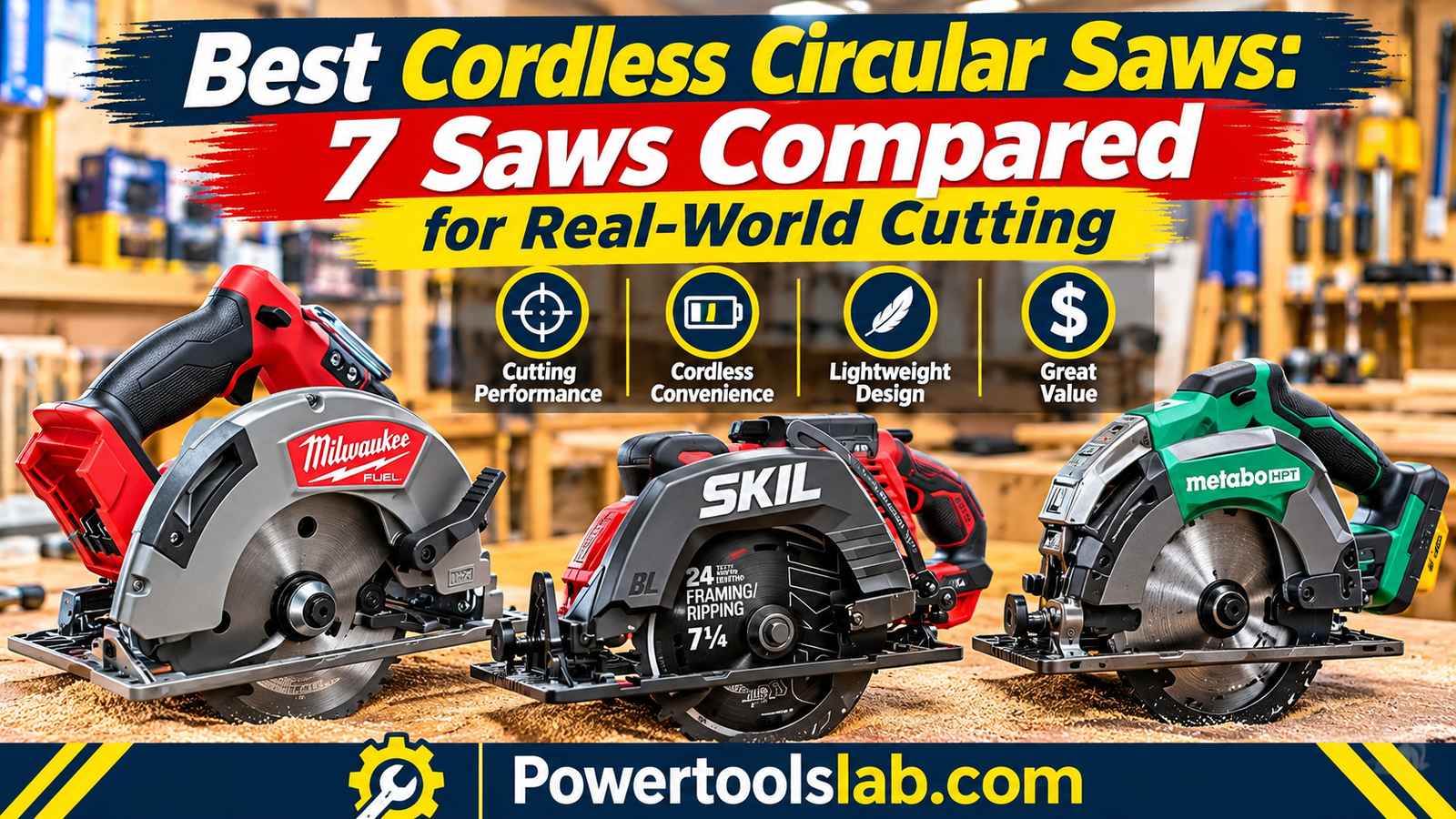
A cordless circular saw used to be a compromise. You traded away cutting power, runtime and blade size for the freedom of walking anywhere on a job site without dragging an extension cord behind you. That trade no longer holds. Modern cordless circular saws cut framing lumber, sheet goods, decking and trim with a confidence that would have seemed impossible a decade ago, and the only real decision left is which kind of saw fits your work.
That decision is more nuanced than “which one is strongest.” The market has quietly split into three families. There are full-size saws built around larger blades and higher output for framing and production cutting. There are lighter, compact saws that give up a little capacity in exchange for control, balance and all-day handling. And there is a newer family of guided DIY saws designed around straight, accurate cuts with fences and guides rather than raw speed. Each family is excellent at something and poor at something else.
This guide covers seven cordless circular saws across those families: the Makita XSH06PT 36V Brushless Kit, the DEWALT DCS391B 20V MAX, the Milwaukee M18 FUEL 2732-20, the Greenworks 24V 7-1/4″, the SKIL PWR CORE 20 CR5429B Brushless, the CRAFTSMAN V20 RP CMCS551B and the Dremel Blueprint CS12V Guided. Every one gets a dedicated review block with features, pros and cons, and a straight answer on who should buy it.
Before the reviews, we explain the terminology that actually changes how a saw behaves — blade size, motor type, drive orientation, bevel and depth adjustment, and the battery platform question that tends to decide the purchase in the end. If you would rather skip straight to the shortlist, the quick comparison table puts all seven saws side by side with images and price links.
How to read this guide
First decide which class of saw your work needs. Second decide whether you are buying into a battery platform or starting fresh. Third match the shortlist to the review blocks below. Most disappointment with cordless saws comes from buying a great saw for the wrong job.
Two housekeeping notes. We deliberately avoid quoting prices, star ratings and review counts, because those figures change constantly and stale numbers are worse than none — the buttons below take you to current listings instead. And where a specification is easy to misremember, we describe capability in plain language rather than reciting a number from memory. The specification that matters most is your own project list.

Quick Comparison: Our Top Picks
All seven saws in this guide, ranked and compared in one place. Full-size production saws lead the table, followed by compact and guided models so you can scan across classes without losing the thread. Use the price buttons to confirm current availability and what each listing includes.
| # | Image | Product | Key Specs | Verdict | Check Price |
|---|---|---|---|---|---|
| 1 | |
Top PickMakita XSH06PT 36V Brushless 7-1/4″ Circular Saw KitBest Overall |
|
The complete package that cuts like a corded saw. | Check Price on Amazon |
| 2 |  |
Milwaukee M18 FUEL 2732-20 7-1/4″ Circular SawBest for Heavy-Duty Cutting |
|
Serious output for framing and production work. | Check Price on Amazon |
| 3 |  |
DEWALT DCS391B 20V MAX 6-1/2″ Circular SawBest for 20V MAX Owners |
|
A nimble everyday cutter with huge battery support. | Check Price on Amazon |
| 4 |  |
SKIL PWR CORE 20 CR5429B Brushless 7-1/4″ Circular SawBest Brushless Value |
|
Full-size cutting manners without premium pricing. | Check Price on Amazon |
| 5 | 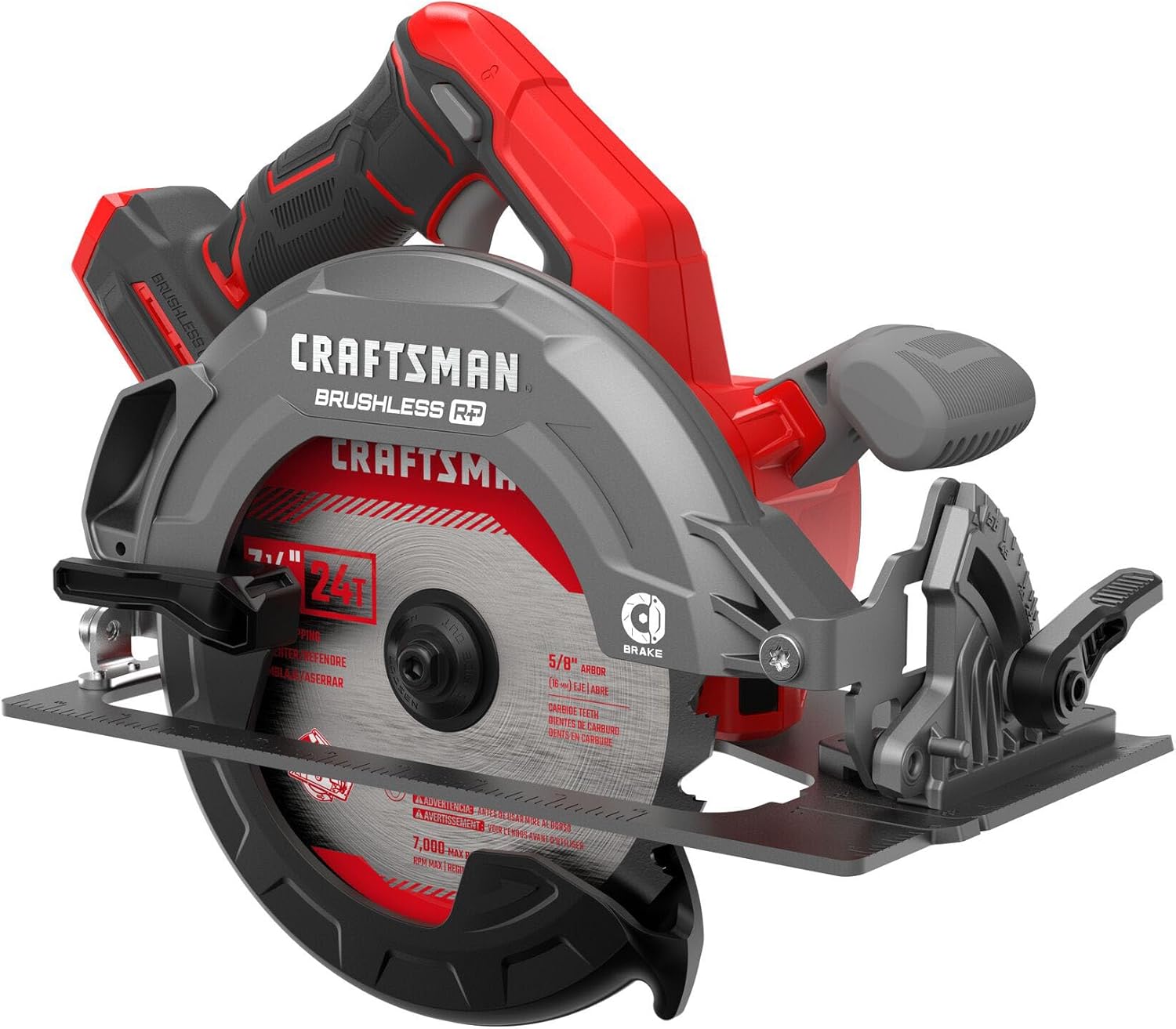 |
CRAFTSMAN V20 RP CMCS551B 7-1/4″ Circular SawBest for Home DIY |
|
An easy-owning saw for weekend projects. | Check Price on Amazon |
| 6 |  |
Greenworks 24V 7-1/4″ Cordless Circular SawBest Budget Full-Size |
|
Real capacity at a wallet-friendly level. | Check Price on Amazon |
| 7 |  |
Dremel Blueprint CS12V Guided Circular SawBest for Guided DIY Cuts |
|
Straight, confident cuts for weekend makers. | Check Price on Amazon |
Every saw above has a full review block further down the page, including the honest trade-offs we would mention to a friend before they spent money.
Ready to compare live prices?
See current listings, kits and availability.
Check Cordless Saws on Amazon1. The Three Classes of Cordless Circular Saw
Before comparing individual saws, it helps to understand the categories they fall into. Manufacturers rarely label them clearly, but the differences between these classes change how a saw feels, how it handles, and what it is genuinely good at.
Full-size saws for framing and production cutting
These are the machines built around larger blades and the higher output to drive them. They carry more mass, they hold their line in thick material, and they are designed to be used hard — cutting framing lumber, ripping sheet goods, and working through a project list without slowing down. The trade-off is weight and size: a full-size saw is a tool you carry to the work, not a tool you hold overhead all afternoon.
Among the saws here, the Makita XSH06PT and the Milwaukee M18 FUEL sit firmly in this class, with the SKIL, CRAFTSMAN and Greenworks models offering the same blade format in more accessible packages. If your projects involve real construction — decks, framing, sheds, subfloor — this is the class to buy into.
Compact saws for control and all-day handling
Smaller-blade saws give up some cutting capacity in exchange for balance, lighter weight and easier control. They are brilliant for sheet goods, trimming, cutouts, and any work where you are holding the saw in awkward positions or making frequent, precise cuts. Trim carpenters and remodelers often prefer a compact saw even when a larger one is available, simply because it is easier to place accurately.
The DEWALT DCS391B is the clearest example in this guide: a lighter, well-balanced saw in a smaller blade format that handles the huge majority of everyday cuts beautifully. If you find full-size saws tiring, this class will suit you far better than buying more power you will never enjoy using.
Guided saws for accuracy over raw output
The newest family is designed for people who value a straight, clean cut above everything else. These saws emphasize guidance systems, fences and approachable handling over brute output. They are ideal for makers, homeowners and DIYers who want results that look precise without spending years developing freehand technique.
The Dremel Blueprint CS12V represents this approach. It will never out-cut a framing saw through thick lumber, and it is not trying to. It is trying to help you cut a clean, accurate line the first time — which is exactly what most weekend projects demand.
| # | Image | Product | Key Specs | Verdict | Check Price |
|---|---|---|---|---|---|
| 1 | |
Top PickMakita XSH06PT 36V Brushless KitFull-Size Class |
|
Full-size output with nothing missing. | Check Price on Amazon |
| 2 | |
DEWALT DCS391B 20V MAXCompact Class |
|
Nimble, accurate and easy to place. | Check Price on Amazon |
| 3 | |
Dremel Blueprint CS12V GuidedGuided Class |
|
Accuracy-first design for weekend work. | Check Price on Amazon |
| 4 | |
SKIL PWR CORE 20 CR5429B BrushlessValue Full-Size Class |
|
Full-size format, accessible price. | Check Price on Amazon |
Understanding these classes also clarifies an older debate. If you are wondering how a circular saw compares with a miter saw or a table saw, the honest answer is that they solve different problems — the circular saw wins on mobility and breaking down sheet goods, while stationary saws win on repeatable accuracy. Our comparison of circular saw vs miter saw and table saw vs circular saw covers both in detail. For a broader look at every saw type, see our guide to types of power saws.
Find your class of saw
Browse full-size, compact and guided cordless saws.
Shop Cordless Circular Saws on Amazon2. How to Choose the Right Cordless Circular Saw
Spec sheets for circular saws mix genuinely useful information with marketing noise. Here is how to sort one from the other, in the order that actually affects your work.
Blade size determines capacity, not quality
The blade diameter dictates how deep the saw can cut in a single pass. Larger blades handle thicker material comfortably; smaller blades keep the tool lighter and easier to control. Neither is inherently better. Choose the blade size that matches the material you cut most often, then enjoy the handling characteristics that come with it. A compact saw used within its capacity will out-perform a large saw used reluctantly.
Motor type: brushless versus brushed
Brushless motors are the modern standard, and for good reasons: they tend to run longer on a charge, generate less heat, and require less maintenance over their life. Brushed motors still work perfectly well and often appear in more affordable saws. If you cut frequently or work full days, brushless earns its keep quickly. Our breakdown of brushless vs brushed motors explains the mechanics behind the difference.
Battery platform: the decision that outlives the saw
Cordless tools are ecosystems. The battery that powers your saw will also power your drill, your impact driver, your work light and your radio. That is why platform loyalty matters more here than in almost any other tool category. If you already own a set of batteries and a charger, buying a saw that accepts them removes an entire layer of cost and inconvenience. If you are starting fresh, think about which platform you want to grow into over the next several years.
Bevel capacity, depth adjustment and sightlines
These small design details decide how pleasant a saw is to live with. Bevel adjustment should be positive and easy to set accurately. Depth adjustment should be quick, secure and repeatable. And the sightline from the handle to the blade should be clear enough that you can follow a marked line without contorting yourself. You will notice these details within the first hour of use — and every hour after.
Weight, balance and the shape of the handle
A saw that feels balanced in the hand makes better cuts than a more powerful saw that fights you. Weight matters most on long days, overhead work and repetitive cutting. Handle grip diameter and trigger reach matter for anyone with smaller hands. If possible, hold the saw before buying, or buy from a retailer with a sensible return policy so you can confirm the ergonomics suit you.
The three questions we ask before buying any cordless saw
1. What material and thickness do I cut most often? 2. Which battery platform do I own or want to own? 3. How long will this saw run on a typical day? Answer those three and the spec sheet practically sorts itself.
Braking, guards and safety design
Modern cordless saws include features that older saws lacked: fast-acting blade brakes, well-designed retracting guards, and thoughtful placement of controls. These are not marketing extras — they change what happens in the fraction of a second after a cut finishes or something goes wrong. Safety design deserves real weight in your decision, and we cover the practical side in what should never be engaged when using power tools.
Kit versus bare tool
Some saws are sold as complete kits with batteries and a charger; others are offered as the tool alone for buyers who already own the platform. Kit format is convenient for first-time buyers and typically the simplest way to get cutting immediately. Bare-tool pricing makes sense when the charger and batteries are already hanging on your wall. Check what the listing includes before assuming either way.
For a wider look at how circular saws fit into a complete tool collection, read our guide to the best power circular saws and the broader roundup of the best power saws.
Sort by the specs that matter
Filter cordless saws by blade size and platform.
Search Cordless Saws on Amazon3. Makita XSH06PT 36V Brushless 7-1/4″ Circular Saw Kit
If we could only keep one saw from this list, the Makita XSH06PT would be the one. It is a full-size, brushless cordless saw sold as a complete kit, and it delivers the kind of cutting experience that makes corded saws feel like a historical footnote.
Makita XSH06PT 36V Brushless 7-1/4″ Circular Saw Kit
The XSH06PT sits at the top of this guide because it does everything well and nothing badly. It is powerful enough for real construction work, refined enough for finish-grade cuts, and sold as a kit so you are not left hunting for compatible batteries. It is the saw we would recommend to a professional who needs one machine to do everything.
Key features
- 36V cordless power that delivers the cutting authority normally reserved for corded tools.
- 7-1/4″ blade capacity for full-size cutting depth in framing lumber and sheet goods.
- Brushless motor design for efficient power delivery and long-term reliability.
- Complete kit format with batteries and charger included, so it cuts on day one.
- Refined adjustment for bevel and depth that holds settings accurately through the day.
- Balanced handling that keeps control where it belongs — in your hands.
Pros
- Full-size cutting capability with genuine cordless freedom
- Kit format removes the platform guessing game
- Brushless motor for efficiency and longevity
- Build quality that suits daily professional use
- Smooth, predictable behavior across material types
Cons
- More saw than occasional DIY strictly requires
- Full-size format is heavier than compact alternatives
- Represents a larger investment up front
Makita XSH06PT — check today’s price
See the current kit listing and what’s included.
Check Price on AmazonWhat separates the XSH06PT from competent competitors is consistency. Cheaper saws are capable on their best day; this saw behaves the same way at the end of a long session as it does at the start. That predictability matters enormously when a cut is visible in finished work, or when you are working quickly and need to trust that the tool will follow your line without wandering.
The kit format deserves emphasis too. Buying a bare saw and then discovering you need batteries and a charger is one of the most common — and most expensive — first-buyer mistakes. Starting complete also gives you a platform to grow into, whether that means adding a drill, an impact driver, or a work light down the line. For more on how Makita compares with other trade favorites, see our Makita vs DEWALT comparison and our detailed Makita circular saw review.
4. DEWALT DCS391B 20V MAX 6-1/2″ Circular Saw
Not everybody needs a full-size saw, and this is the saw that proves the point. The DEWALT DCS391B is a lighter, more compact circular saw in a smaller blade format, and for a huge range of everyday work it is not just sufficient — it is preferable.
DEWALT DCS391B 20V MAX 6-1/2″ Circular Saw
The DCS391B is built around handling. Its smaller blade format keeps weight down and control up, which makes it excellent for sheet goods, cutouts, trimming and the kind of work where accuracy depends on how steadily you can guide the tool. It is also the natural choice for anyone already invested in the 20V MAX battery platform.
Key features
- 20V MAX battery platform compatibility for anyone with existing DEWALT cordless tools.
- 6-1/2″ blade format that prioritizes control and maneuverability.
- Light, well-balanced body that reduces fatigue during longer sessions.
- Clear sightlines for following marked cut lines accurately.
- Straightforward bevel and depth adjustment for repeatable settings.
- Compact proportions that make overhead and awkward cuts easier.
Pros
- Exceptionally easy to control and place on a line
- Lighter than full-size saws for all-day work
- Huge existing battery platform to grow into
- Excellent for sheet goods and remodel work
Cons
- Smaller blade limits cutting depth in thick material
- Not aimed at heavy production framing
- Confirm what the listing includes before ordering
DEWALT DCS391B — check today’s price
See the current listing and available bundles.
Check Price on AmazonThere is a persistent myth that bigger blades are always better. In practice, the right blade size is the one that covers your typical material thickness while keeping the tool manageable. If most of your cuts are through sheet goods, trim and standard framing stock, a compact saw gives you more control and less fatigue — and control is what produces clean, accurate cuts. Our DEWALT circular saw review covers this design philosophy in more depth.
The platform argument is just as strong. DEWALT’s cordless ecosystem is one of the broadest available, so a saw purchase can plug into a collection that already includes drills, drivers, lights and more. That matters more than it sounds — see our guides to the best DEWALT drills and DEWALT vs Milwaukee for how these ecosystems compare in practice.
Build on your 20V MAX platform
Pair the saw with batteries, blades and accessories.
Shop 20V Circular Saws on Amazon5. Milwaukee M18 FUEL 2732-20 7-1/4″ Circular Saw
If the Makita is the all-rounder, the Milwaukee M18 FUEL 2732-20 is the brute. This is a saw designed for demanding cutting work, and it belongs to a platform that trades people rely on daily.
Milwaukee M18 FUEL 2732-20 7-1/4″ Circular Saw
Milwaukee’s FUEL line exists for one reason: to make cordless tools that behave like corded ones under load. The 2732-20 follows that brief with a full-size blade format and the kind of output that keeps cutting steadily when material gets tough, wet, or dense.
Key features
- M18 FUEL platform engineered for high-demand professional work.
- 7-1/4″ blade capacity for full-size cutting depth across common materials.
- Strong, sustained output designed for demanding cuts rather than light trimming.
- Rugged construction built for the realities of daily job site life.
- Confident control layout that supports fast, accurate production cutting.
- Platform compatibility with one of the widest professional cordless systems.
Pros
- Serious cutting authority for framing and production work
- Built to survive daily professional abuse
- Excellent platform breadth for future tool purchases
- Steady performance when the material fights back
Cons
- More saw than most homeowners will ever exploit
- Full-size weight and bulk on long overhead work
- Best value when you already own M18 batteries
Milwaukee M18 FUEL 2732-20 — check today’s price
See the current listing and bundle options.
Check Price on AmazonChoosing between the Makita and the Milwaukee often comes down to platform and preference rather than raw capability — both are professional-grade saws that will handle almost anything asked of them. Our comparison of Milwaukee circular saws digs into the details, and the head-to-head in DEWALT vs Milwaukee is useful if you are still choosing an ecosystem.
The other consideration is how often you cut at the extremes. If your work is mostly sheet goods and trim, a lighter saw will serve you better and tire you less. If you are ripping dimensional lumber repeatedly or working with tough material, the Milwaukee’s reserve of output is exactly what you are paying for. That distinction — buying for your heaviest typical job rather than your heaviest imaginable job — is the core of good tool selection.
Ready for production cutting
Compare heavy-duty cordless saws and kits.
Shop Heavy-Duty Cordless Saws on Amazon6. Greenworks 24V 7-1/4″ Cordless Circular Saw
Not every saw purchase needs a professional price tag. The Greenworks 24V 7-1/4″ represents the value end of full-size cordless saws: the same blade format as the premium machines, in a package aimed at homeowners and occasional users who want real capacity without a trade-level budget.
Greenworks 24V 7-1/4″ Cordless Circular Saw
The appeal here is straightforward: a full-size blade format at a much gentler price. For weekend projects, DIY renovations and the kind of work that happens in bursts rather than all day, this saw covers the essentials competently and keeps money in the budget for blades and materials.
Key features
- 24V cordless platform designed for accessible home and DIY use.
- 7-1/4″ blade capacity for full-size cutting depth on common material.
- Cutting reach comparable to premium full-size saws for typical tasks.
- Straightforward controls and adjustments that keep setup simple.
- Light enough to handle comfortably for occasional projects.
- Value-focused package that prioritizes capability per dollar.
Pros
- Full-size blade format at an approachable price
- Handles typical DIY cutting tasks confidently
- Simple to set up and easy to learn on
- Leaves budget for blades, clamps and safety gear
Cons
- Not engineered for daily professional production
- Smaller platform than the major trade brands
- Less refinement in fine adjustments
Greenworks 24V — check today’s price
See the current listing and available kits.
Check Price on AmazonValue saws reward realistic expectations. A budget-friendly saw will handle decking boards, sheet goods, shelving and framing stock happily; it will be less composed in sustained production cutting and less refined in fine adjustment. Used within that range, it is genuinely good value. Pushed beyond it, disappointment follows.
One worthwhile habit: pair a value saw with a quality blade. Blade selection changes cut quality more than almost any other single variable, and a good blade costs a fraction of a saw. If you are building out a beginner tool set more broadly, our guide to the best power tools for beginners covers how to spread a budget across saws, drills and drivers sensibly.
Get cutting on a sensible budget
Compare value cordless saws and blade bundles.
Shop Value Cordless Saws on Amazon7. SKIL PWR CORE 20 CR5429B Brushless 7-1/4″ Circular Saw
The SKIL CR5429B occupies an interesting middle ground: a full-size blade format with a brushless motor, offered at a price that sits below the premium trade brands. For buyers who want modern motor technology without professional pricing, it is a compelling option.
SKIL PWR CORE 20 CR5429B Brushless 7-1/4″ Circular Saw
Brushless motors used to be a premium-only feature. The CR5429B brings that technology into a more accessible saw, combining it with a full-size blade format that suits everyday construction and renovation work.
Key features
- PWR CORE 20 cordless platform designed around efficient battery use.
- 7-1/4″ blade capacity for full-size cutting depth on common materials.
- Brushless motor for efficient power delivery and reduced maintenance.
- Balanced design that supports controlled, accurate cutting.
- Straightforward adjustment for depth and bevel settings.
- Modern feature set without a professional-grade price.
Pros
- Brushless motor at an accessible price point
- Full-size blade format for real cutting capacity
- Good balance of power and handling
- Sensible choice for serious DIY and light trade use
Cons
- Platform smaller than the major trade ecosystems
- Less refinement in long production sessions
- Fewer specialist accessories available
The brushless question is worth revisiting in the context of value saws. In premium saws, brushless design is about maximizing an already-high level of performance. In value saws, it is often about getting closer to premium behavior at a lower price — better efficiency, less heat, and a motor that is not the weak link in the tool. That is precisely the argument the CR5429B makes, and it makes it convincingly.
If you are comparing platforms rather than saws, SKIL’s system is more compact than the major trade ecosystems, which means fewer long-term expansion options. For many buyers that is fine — a saw, a drill and a battery cover most needs. For buyers planning a large collection, the larger ecosystems discussed above are worth the premium.
Compare brushless cordless saws
See current listings across the brushless category.
Shop Brushless Saws on Amazon8. CRAFTSMAN V20 RP CMCS551B 7-1/4″ Circular Saw
The CRAFTSMAN CMCS551B is the saw we point homeowners toward when they want a straightforward, dependable machine for weekend projects. It is not trying to win spec-sheet battles — it is trying to make DIY cutting approachable and enjoyable.
CRAFTSMAN V20 RP CMCS551B 7-1/4″ Circular Saw
Built on the V20 RP platform and sized around a full-size blade, the CMCS551B handles the everyday cutting list — shelving, decking boards, framing stock, sheet goods — with handling that forgiving enough for anyone still building confidence with a circular saw.
Key features
- V20 RP cordless platform for consistent power across a broad tool family.
- 7-1/4″ blade capacity suited to typical home and renovation material.
- DIY-friendly handling that keeps the saw controllable and approachable.
- Clear adjustments for depth and bevel that are easy to set correctly.
- Comfortable grip and balanced form for weekend-length projects.
- Practical design focused on the work homeowners actually do.
Pros
- Approachable and forgiving for less experienced users
- Full-size blade handles most household cutting tasks
- Wide tool platform for future additions
- Good ergonomics for extended weekend projects
Cons
- Not intended for daily professional production
- Less output headroom than premium trade saws
- Basic accessory set in most listings
CRAFTSMAN CMCS551B — check today’s price
See the current listing and bundle options.
Check Price on AmazonThere is real value in a saw that is designed to be forgiving. Newer users make better cuts with tools that handle predictably and adjust easily, and they are far more likely to use a saw that does not intimidate them. That is the CRAFTSMAN’s quiet strength: it makes good technique easier to develop.
Platform breadth matters here too. A homeowner buying a saw today often buys a drill tomorrow and a work light after that. Staying within one battery family simplifies charging, storage and cost. If you are mapping out that first collection, our guide to the best cordless drills and the comparison of Ryobi vs Milwaukee for platform thinking are both useful companions.
Start your DIY saw collection
Pair the saw with blades, clamps and safety gear.
Shop DIY Circular Saws on Amazon9. Dremel Blueprint CS12V Guided Circular Saw
The Dremel Blueprint CS12V is the outlier in this guide, and that is exactly why it earned a place. Rather than chasing output, it is built around guided cutting — helping you make straight, accurate cuts confidently, even if freehand circular saw technique is not yet second nature.
Dremel Blueprint CS12V Guided Circular Saw
This is a saw designed for makers and homeowners who care about the quality of the finished cut. The guided approach removes much of the guesswork from cutting straight lines, which makes it ideal for craft projects, shelving, panel work and renovation detail where a wandering cut would be visible.
Key features
- Guided cutting system designed to help you hold a straight, accurate line.
- CS12V cordless format for cable-free working anywhere in the home or workshop.
- Compact, approachable body that is easy to control for all skill levels.
- Design focus on accuracy and finished-cut quality rather than raw output.
- Well suited to craft, panel and detailed project work.
- Encourages good technique through guided, repeatable cutting.
Pros
- Makes straight, clean cuts far more achievable
- Light and unintimidating for newer users
- Excellent for detailed and visible finished work
- Guided system builds confidence quickly
Cons
- Not a replacement for a full-size framing saw
- Compact format limits thick-material cutting
- Best suited to guided and detailed work
Dremel Blueprint CS12V — check today’s price
See the current listing and kit contents.
Check Price on AmazonIt is worth stating clearly what this saw is not. It is not a framing saw and it will not replace one. Its advantage lies in accuracy and accessibility — helping people produce cuts they are proud of, without years of freehand practice. For visible finished work, that matters more than peak output ever will.
For other saw types that complement a guided approach, our guides to the best jigsaws and best miter saws are worth reading. Curves and detail work often belong to a jigsaw, while repeatable crosscuts belong to a miter saw — and knowing which saw owns which job is half the battle.
Explore guided cutting tools
See current listings for guided and compact saws.
Shop Guided Saws on Amazon10. Blades, Kickback and Safety: The Habits That Make the Difference
Owning a good saw is half the equation. The other half is how you use it — and the habits below matter more than most buyers expect when it comes to cut quality, accuracy and personal safety.
Blade choice changes everything
The blade fitted to your saw has a bigger effect on cut quality than almost any other variable. Blades designed for fine finishing produce cleaner cuts in sheet goods and trim; blades designed for framing cut faster in dimensional lumber with a rougher finish. Matching the blade to the material is one of the cheapest and most effective improvements you can make, and it takes seconds to change.
Understanding kickback
Kickback happens when the blade binds in the material and the saw is driven backwards suddenly. It is one of the most common causes of injury with circular saws, and it is largely preventable. Support material so it cannot sag and pinch the blade, keep the cut line clear, let the saw reach full speed before entering the material, and never force a cut. If the saw slows or binds, stop and relieve the pressure rather than pushing harder.
Non-negotiable safety habits
Wear eye and hearing protection every time. Let the blade stop completely before setting the saw down. Never reach under material while the blade is spinning. Retract the blade guard manually only when the saw is stopped and the cut is clear. Keep blades sharp and undamaged — a dull blade is a dangerous blade. For more, see our guide to what should never be engaged when using power tools.
Support, marking and clamping
Good cuts begin before the saw starts. Mark clearly, support material on both sides of the cut so offcuts do not tear away, and clamp workpieces whenever the geometry is awkward. A few minutes spent setting up produces dramatically better results than any amount of skill applied to a badly supported board.
Bevel and depth settings used properly
Set blade depth so the teeth extend just past the bottom of the material. This improves cut quality, reduces splintering and lowers the risk of binding. Set bevel angles with a square rather than trusting the scale alone when accuracy matters. These small habits separate clean professional-looking work from work that needs to be hidden.
Battery care and storage
Cordless tools live and die by their batteries. Store batteries away from extreme heat and cold, keep contacts clean, and rotate packs so they age evenly. For general workshop organization — the sort that keeps saws, batteries and blades where you can find them — see our guide on how to organize power tools in the garage.
Finally, know when a circular saw is the wrong tool entirely. Reciprocating saws own demolition, jigsaws own curves, and angle grinders own metal and masonry. Our comparison of jigsaw vs reciprocating saw and guide to the best reciprocating saws help you match the tool to the task.
Work safer and cut cleaner
Shop blades, clamps, squares and protective gear.
Shop Saw Accessories on Amazon11. Matching the Saw to the Job
Here is the practical translation of everything above: real projects, and which saw handles them best. This is the section most useful for making a final decision.
Framing and structural work
Thick material, repetitive cuts, and long days point firmly at full-size, high-output saws. The Makita XSH06PT and the Milwaukee M18 FUEL are the natural choices here, with the SKIL and Greenworks offering capable alternatives for lighter duty. The defining requirement is sustained power in material that resists the blade.
Sheet goods and breaking down panels
Cutting plywood, MDF and panel products rewards control and clean entry more than brute output. Compact saws like the DEWALT DCS391B shine here because they are easy to guide and easy to position, and value full-size saws handle the job comfortably too. Use a fine-finish blade and support panels properly for the cleanest edges.
Decking, outdoor projects and renovation
Outdoor work mixes material sizes and often happens away from power — exactly what cordless saws are for. A full-size saw gives you capacity across decking boards and framing stock, while a lighter saw is easier on long days spent bending over a deck frame. Match the saw to whether capacity or comfort is the limiting factor.
Shelving, cabinetry and visible finish work
When the cut will be seen, accuracy dominates. Guided saws, quality blades and careful setup matter more than raw output. The Dremel Blueprint CS12V is designed for precisely this territory, and any saw paired with a fine blade and a good straightedge will produce respectable results.
| Job Type | Best Saw Choice | Why It Fits |
|---|---|---|
| Framing and heavy cutting | Makita XSH06PT / Milwaukee 2732-20 | Full-size capacity with the output to work through demanding material all day |
| Sheet goods and panels | DEWALT DCS391B | Light, balanced handling that makes long straight cuts easy to guide |
| Decking and outdoor projects | SKIL CR5429B / Greenworks 24V | Full-size format at sensible value for seasonal outdoor work |
| Shelving and finish work | Dremel Blueprint CS12V | Guided cutting for clean, straight, visible finished edges |
| General home DIY | CRAFTSMAN CMCS551B | Approachable handling and broad platform for everyday projects |
One more piece of the puzzle: knowing which saws to add later. A circular saw is often the first major saw a DIYer owns, but projects quickly call for more. A miter saw handles repeatable crosscuts, a jigsaw handles curves and cutouts, and a reciprocating saw handles demolition. Our comparison of circular saw vs miter saw explains exactly where each one earns its place.
Match the saw to your project
Compare saws by cutting capacity and handling.
Browse Cordless Saws on Amazon12. Budget vs Premium: Where Your Money Actually Goes
There is a significant price spread between the saws in this guide, and it is worth understanding what the extra money buys before spending it. The differences are real — but they do not always matter to every buyer.
What premium money buys
Spending more on a cordless circular saw generally buys four things: more sustained output under load, better build quality and durability, finer adjustment accuracy, and a larger battery platform with deeper accessory support. For professionals cutting every day, all four pay for themselves quickly. For occasional use, the first three matter far less.
Where budget saws are genuinely smart
For weekend projects, seasonal outdoor work and general household cutting, a well-chosen budget saw delivers results that look identical to a premium saw’s — particularly when paired with a good blade and proper setup. Spending the savings on blades, clamps, a square and safety gear will improve your results more than upgrading the saw would.
Platform economics
The hidden cost of a cordless saw is the batteries. A saw that fits batteries you already own is effectively cheaper than a discounted saw that forces you into a new charger and pack. Conversely, if you are building a collection from scratch, the platform with the widest tool range may deliver more long-term value even at a higher entry price. This is the same reasoning behind our guides to corded vs cordless drills and power tool brands.
| # | Image | Product | Key Specs | Verdict | Check Price |
|---|---|---|---|---|---|
| 1 | |
Top PickMakita XSH06PT 36V Brushless KitPremium Pick |
|
Where premium money pays off daily. | Check Price on Amazon |
| 2 | |
SKIL PWR CORE 20 CR5429BBest Mid-Range |
|
Premium features, mid-range outlay. | Check Price on Amazon |
| 3 | |
CRAFTSMAN V20 RP CMCS551BBest Value DIY |
|
Sensible money for weekend projects. | Check Price on Amazon |
| 4 | |
Greenworks 24V 7-1/4″Best Budget Full-Size |
|
Capacity first, price second. | Check Price on Amazon |
Accessories worth owning alongside the saw
- A quality blade matched to your material. The single best performance upgrade available.
- A straightedge or guide track. Straight cuts become far easier and far more repeatable.
- Clamps of several sizes. Properly secured work is safer work and cleaner work.
- A combination square and a sharp pencil. Accurate marking is the foundation of accurate cutting.
- Eye and hearing protection. Non-negotiable for any cutting work. See our pick of hearing and eye protection on Amazon.
- Storage that protects the blade. A saw hanging safely beats one buried under offcuts.
If we had to compress this whole section into a rule: buy the saw that matches your heaviest typical job, then spend the remainder of your budget on blades, guides and safety. A modest saw with excellent accessories out-performs a premium saw left bare every single time.
Complete your cutting setup
Add blades, guides, clamps and safety gear to your order.
Shop Saw Accessories on AmazonFrequently Asked Questions
These are the questions buyers ask most often once they start comparing cordless circular saws. Each answer is deliberately practical rather than technical.
1. What size circular saw should a homeowner buy?
Match the blade size to your typical material. A full-size saw handles framing lumber and thicker stock comfortably and suits anyone doing renovation or outdoor projects. A smaller-blade saw is lighter, easier to control, and excellent for sheet goods and trim. Most homeowners with mixed projects do well with a full-size saw; those working mainly with panels and finish material often prefer a compact one.
2. Is a brushless circular saw worth the extra cost?
For frequent use, yes. Brushless motors tend to run longer per charge, run cooler, and need less maintenance over their life. For occasional weekend use, a well-made brushed saw will do everything you ask of it. The deciding factor is how often and how long you cut — brushless earns its premium on workdays, not on rare projects.
3. Should I buy a saw on my existing battery platform?
Usually yes. Batteries are the most expensive part of cordless ownership, and sticking with a platform you already own means one charger, one battery type and lower overall cost. The exception is if your current platform has no saw that suits your needs — in that case, choosing the right tool and accepting a new battery family is the smarter long-term move.
4. Can a cordless circular saw replace a corded one?
For most cutting work, yes. Modern cordless saws handle framing, sheet goods and trim with ease. Where corded saws still hold an advantage is sustained, all-day production cutting with no pause for charging. If you cut continuously through long workdays, consider whether battery swapping fits your rhythm; otherwise cordless is the more convenient choice.
5. What blade should I use for clean cuts in plywood?
Choose a blade designed for fine finishing, with more teeth and a tooth geometry suited to sheet goods. Set the depth so the teeth just clear the bottom of the material, support the panel fully to prevent sagging, and cut with the good face oriented appropriately. Blade choice and support matter far more than the saw itself for cut quality.
6. Why does my circular saw bind or kick back?
Binding usually happens when material sags and pinches the blade behind the cut. Support both sides of the board, keep the cut opening clear, let the saw reach full speed before entering the material, and never force the cut. If the blade slows, stop and relieve pressure rather than pushing harder. Dull blades increase binding risk significantly.
7. How deep can a cordless circular saw cut?
It depends on blade size. Full-size saws cut through common framing lumber in a single pass; smaller-blade saws may need the material turned for a two-pass cut in thicker stock. Always check the cutting capacity of the specific saw against the material you use most often before buying.
8. Is a guided circular saw good enough for furniture projects?
For straight cuts in panels, shelving and visible finished work, a guided saw can produce excellent results — often better than freehand cutting from an inexperienced user. It is not a replacement for stationary saws when you need repeatable precision across dozens of identical cuts, but for most home furniture projects it is a strong, approachable choice.
9. How do I make my cordless saw batteries last longer?
Store batteries away from extreme heat and cold, keep the contacts clean, and avoid running them completely flat repeatedly. Rotate between packs so they age evenly, and let hot packs cool before charging. Battery care is the single biggest factor in long-term cordless tool satisfaction.
10. Do I need a miter saw as well as a circular saw?
They serve different jobs. A circular saw is unbeatable for breaking down sheet goods, cutting on site and general mobility. A miter saw excels at repeatable, accurate crosscuts in dimensional lumber. Many workshops own both — the circular saw for flexible work and the miter saw for repeatable production.
11. What safety gear should I use with a circular saw?
Eye protection and hearing protection every time, without exception. Gloves should never be worn near rotating blades. Keep the blade guard functioning, let the blade stop before setting the saw down, and never reach beneath material while cutting. Add a dust mask when cutting materials that generate fine dust.
Still weighing your options?
Browse the full category and compare live listings.
Browse Cordless Circular Saws on AmazonConclusion: Choose the Class First, Then the Saw
The most useful conclusion we can give you is a method rather than a single recommendation. Decide which class of saw your work needs, decide which battery platform makes sense for you, and then choose within that narrow lane. Do that and the seven saws above sort themselves out quickly and confidently.
If you want one recommendation per situation, here is ours. For the best overall package, the Makita XSH06PT does everything well and arrives ready to work. For heavy, demanding cutting, the Milwaukee M18 FUEL 2732-20 is built for exactly that. If you already run 20V MAX tools or want lighter handling, the DEWALT DCS391B is the smart pick. For brushless value, look at the SKIL CR5429B; for home DIY, the CRAFTSMAN CMCS551B; for budget full-size capacity, the Greenworks 24V; and for guided, accuracy-first cutting, the Dremel Blueprint CS12V.
Whichever saw you choose, pair it with a good blade matched to your material, a straightedge, solid clamping and proper protection. Those additions cost far less than a saw and improve your results more than any upgrade. That combination — the right saw plus good habits — is what turns a purchase into a tool you still reach for years from now.
Ready to buy your cordless circular saw?
Check current prices and pick your class of saw.
Check Prices on Amazon