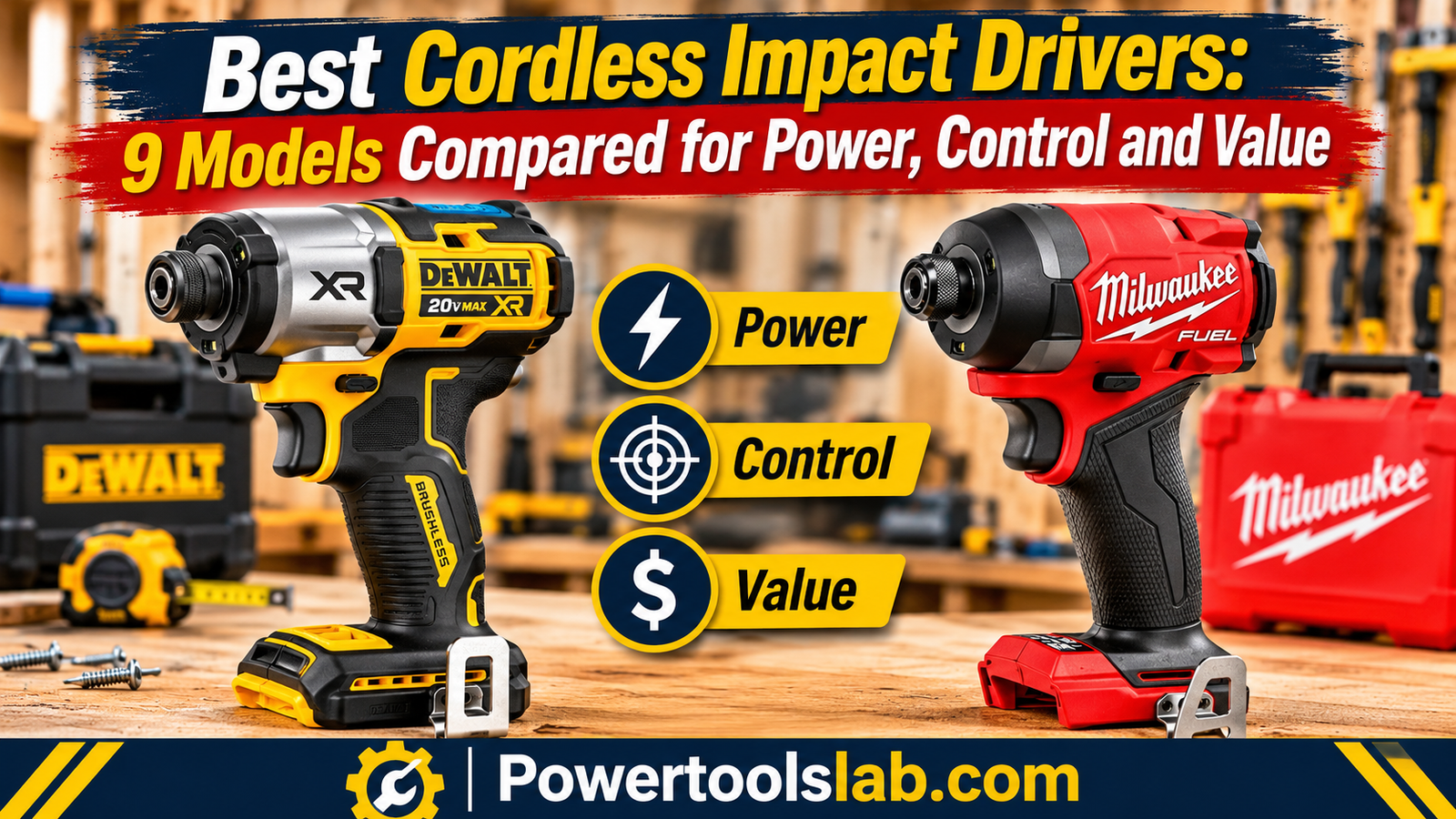
Best Cordless Impact Drivers: 9 Models Compared for Power, Control and Value
An impact driver is the tool that quietly turns a two-hour fastening job into a twenty-minute one. We lined up nine cordless models — from pro-grade flagships to budget-friendly kits — and compared the things that actually matter on the job: how they feel in the hand, how they handle long fasteners, what you get in the box, and whether the battery platform is worth buying into.
Why an Impact Driver Deserves a Spot in Your Kit
Ask anyone who has driven a hundred deck screws with a cordless drill and then picked up an impact driver for the first time, and you will hear the same thing: it changes the job. A drill applies steady rotational force and asks your wrist to absorb whatever the fastener gives back. An impact driver does something smarter — it spins the bit normally until resistance builds, then an internal hammer mechanism delivers rapid rotational strikes that push the fastener through without transferring that twisting force back into your arm.
The practical result is threefold. First, you can drive long screws and structural fasteners into dense material without stripping heads or stalling. Second, you stay in control because the tool is not trying to twist out of your grip. Third, you fatigue far less over a full day, which matters more than any spec sheet ever will.
That is also why the impact driver category has become one of the most competitive corners of the cordless market. Every major brand makes at least one, and the differences between them are rarely about raw headline numbers. They are about balance, collet quality, trigger response, LED placement, how the belt hook sits against your leg, and whether the battery you already own will work with the tool you are about to buy.
In this comparison, we look at nine cordless impact drivers spanning the full price spectrum: the DEWALT 20V MAX XR DCF845B, the Milwaukee M18 FUEL 1/4" Hex Impact Driver, the Makita 18V LXT Impact Driver, the Bosch GDR18V-1860C, the Ryobi PBLID01, the CRAFTSMAN V20 CMCF800C1, the BLACK+DECKER BDCI20C, the GoYwato Cordless Impact Driver, and the Robustrue Impact Driver Set. Each one gets its own hands-on style review block further down, with the strengths, the trade-offs, and who it genuinely suits.

If you are new to fastening tools entirely, it helps to understand where an impact driver sits in the wider ecosystem before you spend money. Our guides to impact driver versus drill and the types of power tools in a standard kit lay out the difference quickly, and we will cover the essentials in plain language further down this page.
Shopping for Your First Impact Driver?
See the current range of cordless impact drivers and kits.
Check Price on AmazonQuick Comparison: Our Top Picks
Every driver in this roundup is listed below with the essentials: which platform it belongs to, what kind of drive and motor it offers, and the single reason it earns a place in the conversation. Remember that most of these are sold as bare tools, meaning the battery and charger are purchased separately unless the listing clearly says it is a kit.
| # | Image | Product | Key Specs | Verdict | Check Price |
|---|---|---|---|---|---|
| 1 |  |
Top PickDEWALT 20V MAX XR DCF845BBest Overall for Pro Work |
|
Compact, confident and built for all-day fastening. | Check Price on Amazon |
| 2 | |
Milwaukee M18 FUEL 1/4" HexBest Heavy-Duty Performance |
|
Serious driving muscle with refined trigger control. | Check Price on Amazon |
| 3 | 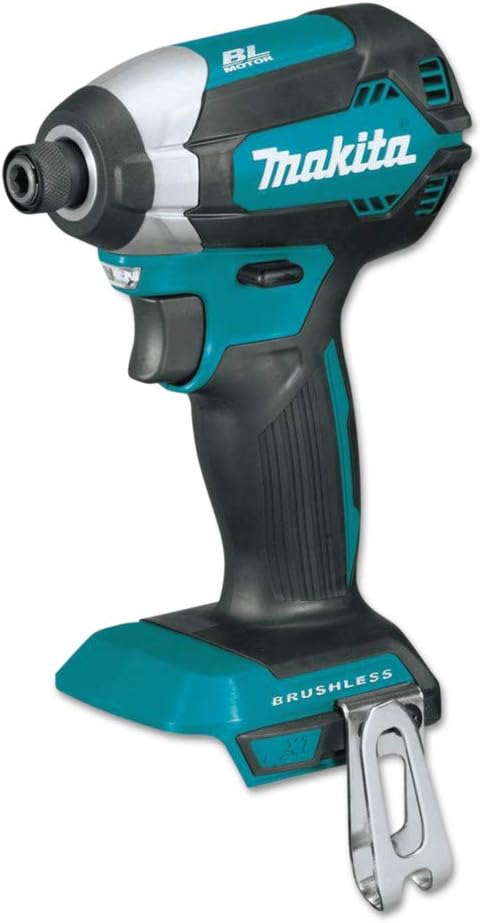 |
Makita 18V LXT Impact DriverBest Balanced All-Rounder |
|
Light in the hand, long-running and beautifully balanced. | Check Price on Amazon |
| 4 |  |
Bosch GDR18V-1860CBest for Control and Precision |
|
Steady, compact and easy to place accurately. | Check Price on Amazon |
| 5 | 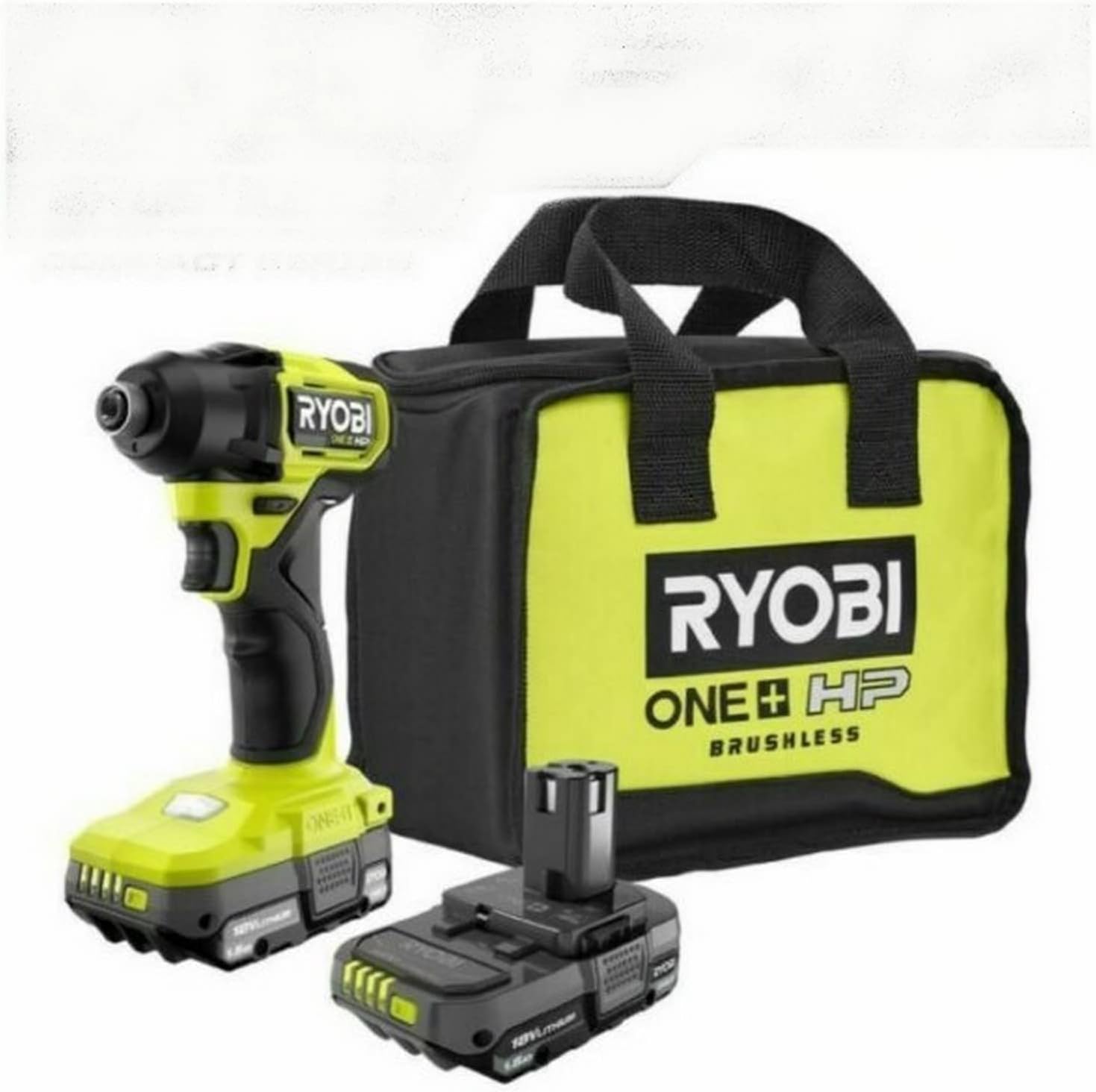 |
Ryobi PBLID01Best Value for Serious DIYers |
|
Pro-leaning performance without the pro-tier price. | Check Price on Amazon |
| 6 |  |
CRAFTSMAN V20 CMCF800C1Best Ready-to-Work Kit |
|
Everything you need in one box at a sensible price. | Check Price on Amazon |
| 7 |  |
BLACK+DECKER BDCI20CBest for Homeowners |
|
Straightforward, lightweight and ideal for occasional work. | Check Price on Amazon |
| 8 | 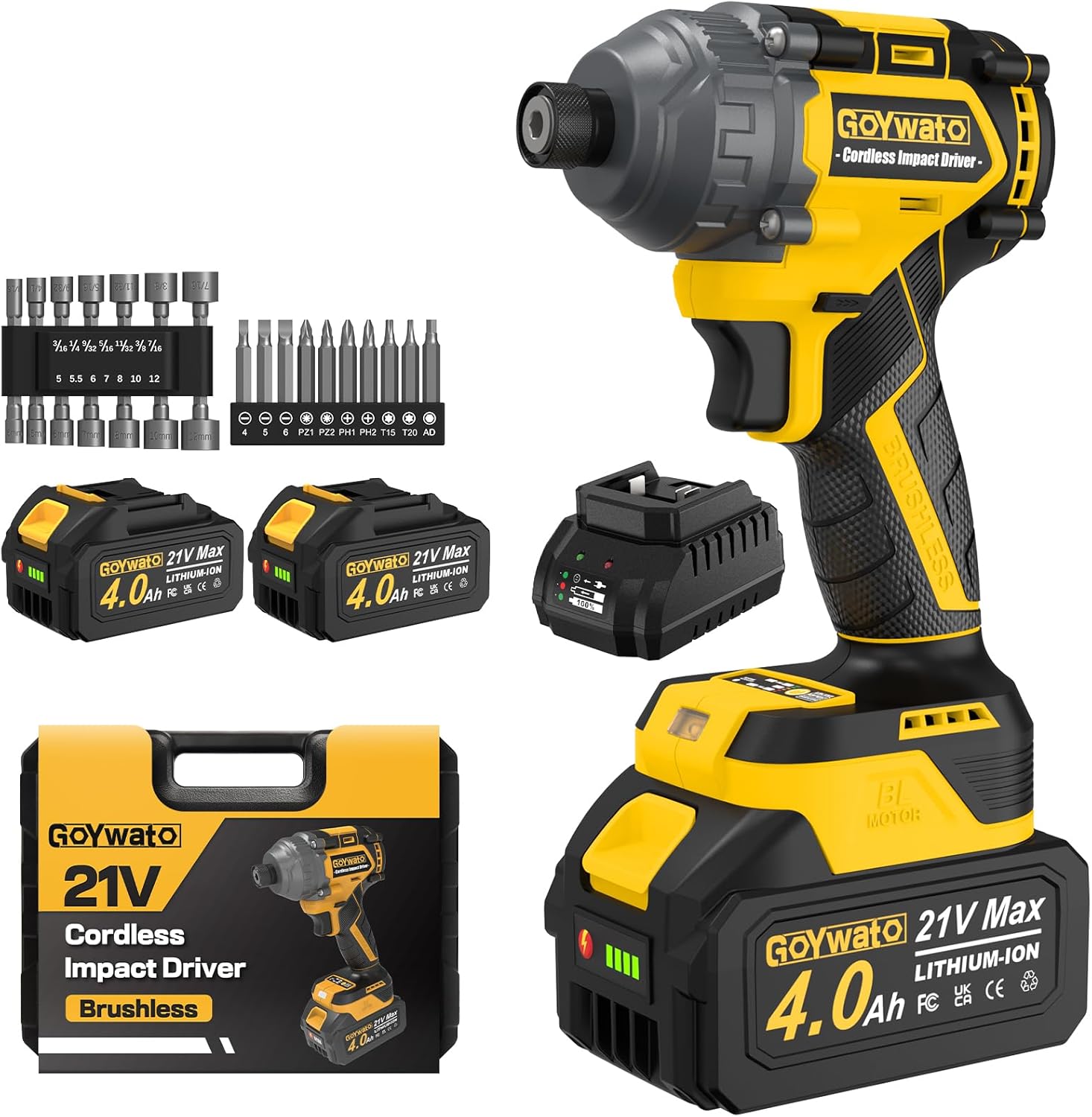 |
GoYwato Cordless Impact DriverBest Budget Entry Point |
|
A low-cost way to own a working impact driver. | Check Price on Amazon |
| 9 | 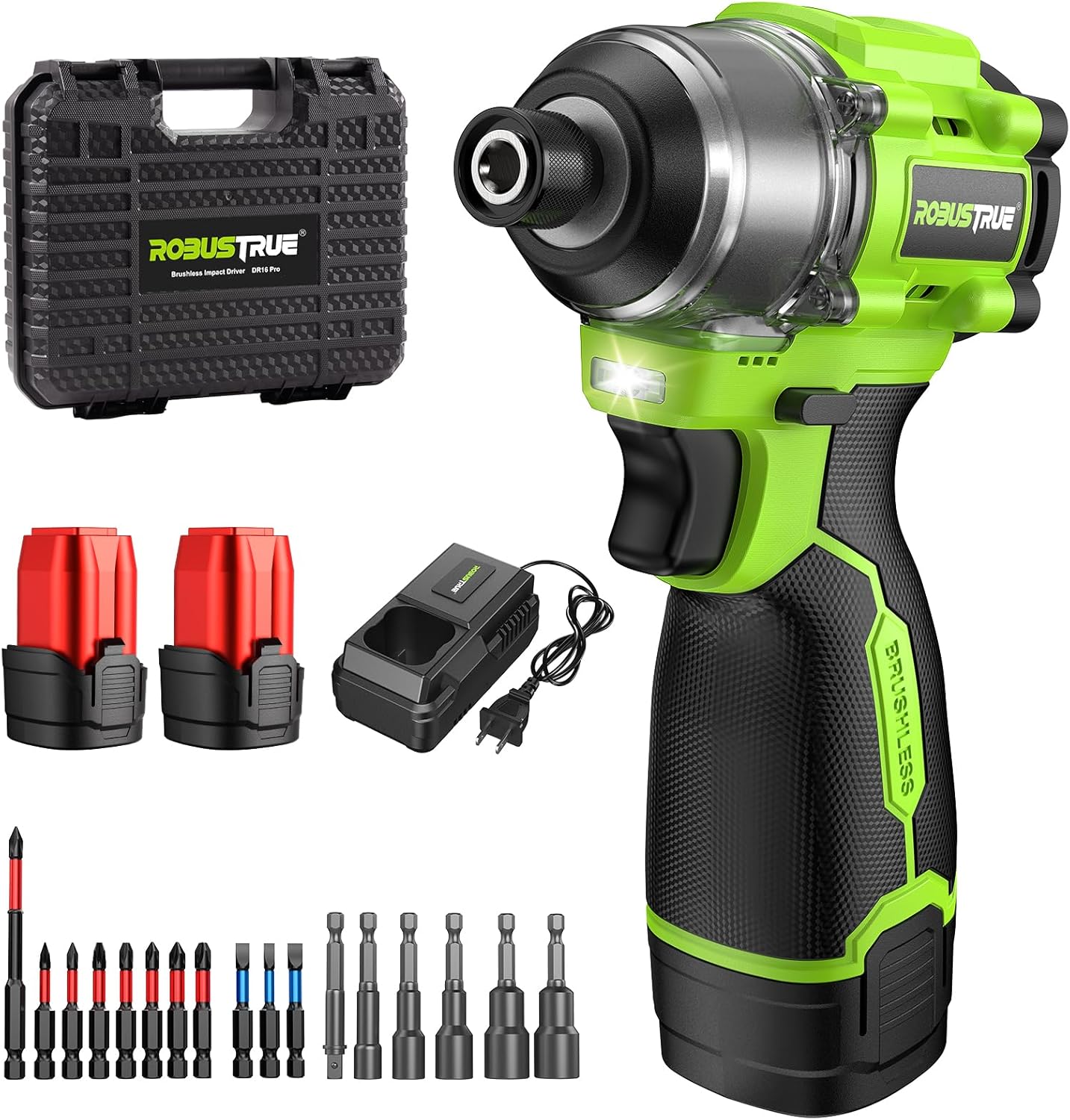 |
Robustrue Impact Driver SetBest Accessory Bundle |
|
Comes with the accessories most kits leave out. | Check Price on Amazon |
See the Full Range of Impact Drivers
Compare kits, bare tools and battery bundles side by side.
Check Price on AmazonHow We Compared These Nine Impact Drivers
Comparing impact drivers is harder than it looks, because the numbers printed on a box tell you very little about how a tool behaves at the top of a ladder with one hand on a rail. Manufacturers quote peak torque figures that are measured in ways that are not always comparable across brands, and a tool that sounds dominant on paper can feel clumsy and front-heavy the moment you use it for an hour.
So we set aside the marketing and focused on the traits that show up in real work. Every driver in this lineup was considered against the same set of criteria, and each review block below reflects those criteria rather than a list of headline claims.
Drive System and Chuck Quality
All nine tools use the standard 1/4-inch hex quick-connect collet, which is the defining feature of the category. But not all collets are equal. A good one accepts a bit with a single hand, holds it firmly under vibration, and releases without a fight when your fingers are cold or dusty. A poor one rattles bits loose and makes you second-guess whether the bit is seated. We weight chuck feel heavily because it is the part of the tool you touch most often.
Motor Type and Efficiency
Brushless motors run cooler, use battery power more efficiently and remove the wear item that eventually kills brushed tools. That said, a well-built brushed motor in a homeowner-grade driver is perfectly serviceable for weekend work. Where it matters is at the top of the range, and that is where we look at whether a brand’s premium claim is backed by genuine build quality. Our comparison of brushless versus brushed motors goes deeper on this if you want the technical background.
Balance, Weight and Ergonomics
An impact driver is a one-handed tool, which means balance is not a luxury — it is the whole experience. We look at where the center of gravity falls with the battery fitted, how the grip suits a gloved hand, whether the head length lets you get into a cabinet corner, and how the tool sits on a belt hook when you climb down from a scaffold.
Control and Feedback
Trigger response separates a tool you trust from one you work around. The best drivers let you feather the trigger to start a fastener slowly, then apply full power without a lurch. Speed modes and precision settings matter here too: driving a small brass screw into a cabinet hinge is a completely different task from sinking a structural screw into a joist, and a tool that only knows one speed will punish you on the delicate end.
Lighting, Visibility and Small Touches
LED placement is one of those details nobody thinks about until they are working in a dim stairwell. We favor lights that illuminate the work area without casting a shadow from the chuck, plus small design decisions like a well-placed belt hook, a battery fuel gauge, and a housing that wipes clean.
Platform, Value and What You Get in the Box
Finally, we consider the bigger financial picture. An impact driver is rarely a standalone purchase — it is an entry point into a battery platform that will likely include a drill, a saw, a light and maybe an angle grinder later. That makes the platform conversation almost as important as the tool itself, which is why we return to it in the buying guide below and why our broader look at power tool brands and their ecosystems is worth a read before you commit.
A Note on This Comparison
We do not quote torque figures, prices, battery runtimes or user ratings here, because those change constantly and vary by region and bundle. Instead we describe what a tool is designed to do well, so you can match the design intent to the work in front of you. Always confirm current specifications on the retailer listing before purchasing.
Need Bits and Accessories Too?
Impact-rated bit sets make a bigger difference than most people expect.
Check Price on AmazonDEWALT 20V MAX XR DCF845B: The All-Round Pro Pick
The DEWALT 20V MAX XR DCF845B is the tool most people picture when they think of a professional impact driver: compact, unshowy, and engineered for people who use it every single day. The XR designation signals that it sits in DEWALT’s higher-performance tier, and the design reflects that with a brushless motor, a tight head profile and the kind of no-nonsense housing that survives being tossed in a truck bed.
DEWALT 20V MAX XR DCF845B Impact Driver
Best Overall for Pro Work
What sets this driver apart is not one dramatic feature but the way the small decisions accumulate. The head is short enough to work between studs and inside cabinet carcasses. The grip is contoured with a rubber overmold that stays predictable with dusty or gloved hands. The trigger has a long, usable travel that lets you start a fastener gently before committing to full power, which is exactly what you want when you are placing a screw near a finished edge.
Key Features
- Brushless XR motor: built for sustained use and efficient battery draw over long fastening sessions.
- Compact head length: reaches into tight framing bays, cabinet interiors and under-sink spaces without trouble.
- Quick-connect hex collet: accepts standard impact bits with one hand and holds them under vibration.
- Onboard lighting: illuminates the fastener area so you can see what you are driving in dark corners.
- Belt hook and rugged housing: designed for professional carry and rough handling on site.
What We Like
- Excellent balance with the battery fitted
- Trigger control is smooth and progressive
- Compact enough for cabinetry and framing alike
- Fits into a very widely used battery platform
- Build quality feels genuinely job-site ready
What to Consider
- Typically sold as a bare tool, so budget for battery and charger
- May be more tool than an occasional user needs
- Overkill for light furniture assembly
Who It Is Best For
This is the driver to buy if fastening is part of your weekly life — tradespeople, serious renovators, and dedicated DIYers who have already started building out a 20V MAX tool collection. It handles structural screws, cabinet hardware, framing anchors and long deck screws with the same calm competence, and it never feels like it is working harder than you are.
If you already own DEWALT cordless tools, the decision is even easier, and pairing this driver with a DEWALT drill is a natural combination. Our review of the DEWALT circular saw covers the saw that typically joins this driver in a serious kit.
DEWALT 20V MAX XR DCF845B
Compact, brushless and ready for daily professional use.
Check Price on AmazonBuilding Out a DEWALT Kit?
Match this driver with a drill, battery and bit set.
Check Price on AmazonMilwaukee M18 FUEL 1/4" Hex Impact Driver: Heavy-Duty Muscle
Milwaukee built its reputation on tools that refuse to back down from demanding work, and the M18 FUEL 1/4" hex impact driver is very much in that tradition. The FUEL name marks Milwaukee’s brushless line, and the tool is designed for people who routinely drive large fasteners into tough material and expect the driver to simply keep going.
Milwaukee M18 FUEL 1/4" Hex Impact Driver
Best Heavy-Duty Performance
What you notice immediately is the confidence. The tool feels substantial without feeling clumsy, and the impact mechanism delivers its energy with a decisive rhythm that makes short work of long structural screws, lags and stubborn fasteners. The trigger is well weighted, which matters more than people realize: a driver with a twitchy trigger makes delicate work stressful, while a well-damped one lets you place hardware precisely.
Key Features
- Brushless FUEL motor: engineered for demanding fastening work and efficient power delivery.
- Strong impact mechanism: handles long screws and dense material without stalling out.
- Refined trigger response: supports slow, controlled starts before full power is applied.
- Rugged jobsite build: protective housing and grip surfaces designed for rough handling.
- Broad M18 platform compatibility: shares batteries with a huge range of professional tools.
What We Like
- Drives demanding fasteners without hesitation
- Excellent trigger feel for both finesse and power
- Comfortable grip for long sessions
- Backed by a deep professional tool ecosystem
- Feels durable enough for daily trade use
What to Consider
- Priced toward the premium end of the market
- More capability than a light-duty user will need
- Usually sold as a bare tool
Who It Is Best For
Contractors, deck builders, installers and anyone whose fastening work leans toward the heavy end. If you regularly sink long screws into pressure-treated lumber, drive structural connectors or work with stubborn materials, this is a tool that will not leave you wishing for more. For a wider look at where it sits against its closest rival, see our DEWALT versus Milwaukee comparison, and our Milwaukee circular saw review covers the saw most often paired with it.
Milwaukee M18 FUEL Impact Driver
Built for demanding fastening work and heavy daily use.
Check Price on AmazonMakita 18V LXT Impact Driver: The Balanced All-Rounder
Makita has spent decades refining the feel of its cordless tools, and that experience shows up everywhere in the 18V LXT impact driver. This is a tool that seems to disappear in your hand, which is the highest compliment you can pay to something you hold above your head for half the day.
Makita 18V LXT Impact Driver
Best Balanced All-Rounder
The LXT line is one of the most complete cordless platforms on the market, and the impact driver within it reflects that maturity. The weight distribution is excellent, the head is compact, and the tool has a refined, well-damped feel that makes repetitive fastening work genuinely pleasant. It is the driver you reach for when the job mixes delicate hardware with heavier structural work, because it moves between the two without drama.
Key Features
- 18V LXT platform: one of the broadest cordless ecosystems available across trade categories.
- Light, balanced build: reduces wrist and shoulder fatigue during overhead and repetitive work.
- Compact head profile: fits into cabinet interiors, stair stringers and tight framing spaces.
- Smooth trigger modulation: supports precise starts on small hardware and finish work.
- 1/4 in. hex drive: compatible with the full range of standard impact-rated bits.
What We Like
- Among the best-balanced drivers in this group
- Comfortable for long and overhead sessions
- Strong platform with extensive tool options
- Smooth, predictable trigger behavior
- Compact enough for finish and cabinetry work
What to Consider
- The LXT range includes multiple models — check which one you are buying
- Not always sold as a complete kit
- Users with large hands may want a chunkier grip
Who It Is Best For
Carpenters, cabinet installers, remodelers and detail-oriented DIYers who value control and comfort over brute force. It is an outstanding choice if your work swings between assembling furniture, fitting hardware, and driving the occasional long screw into framing. If you are building a Makita-based kit, our Makita circular saw review and our look at Makita versus DEWALT are good next reads.
Makita 18V LXT Impact Driver
Lightweight, balanced and versatile across many task types.
Check Price on AmazonShopping the 18V Cordless Range
Browse impact drivers, batteries and kit bundles.
Check Price on AmazonBosch GDR18V-1860C: Precision Where It Counts
Bosch has always had a particular talent for engineering tools that feel measured rather than muscular, and the GDR18V-1860C fits that mold neatly. This is a compact 18V impact driver designed around control, accessibility and the kind of careful placement that makes finish work look professional.
Bosch GDR18V-1860C 18V Impact Driver
Best for Control and Precision
Where some drivers announce themselves with raw force, the Bosch wins on composure. The inline, compact body style puts your hand close to the work, which improves accuracy when you are starting fasteners in awkward positions. It is an easy tool to guide, and that matters enormously when the fastener is visible in the finished project or when you are working in a spot where slipping means damaging a surface.
Key Features
- Compact inline design: keeps the tool close to the work for better aim and placement.
- 18V platform compatibility: fits into Bosch’s wider cordless range.
- Responsive control: geared toward careful starts and precise driving.
- 1/4 in. hex drive: accepts standard impact bits with quick changes.
- Thoughtful ergonomics: designed for comfort in tight and repetitive work.
What We Like
- Excellent accuracy in tight and awkward spaces
- Compact body suits cabinet and install work
- Composed, predictable handling
- Strong fit and finish
- Good choice for detail-focused users
What to Consider
- Less suited to very heavy structural fastening
- Platform is smaller than the market leaders
- Compact form may feel unfamiliar at first
Who It Is Best For
Installers, technicians, cabinet makers and anyone who values precision over maximum driving force. If your typical fastener is a hinge screw, a trim anchor, a machine screw with a hex head or a fixture mounting bolt, the Bosch is an outstanding companion. For those considering the wider Bosch range, our best Bosch drill roundup covers the natural drill partner.
Bosch GDR18V-1860C Impact Driver
Compact control for precision fastening and installation work.
Check Price on AmazonLooking for Precision Accessories?
Quality bits and holders improve accuracy more than you would think.
Check Price on AmazonRyobi PBLID01: Serious DIY Performance Without the Premium
Ryobi occupies an interesting position in the market: it targets committed DIYers who want real capability without paying professional-tier prices, and the PBLID01 is one of the strongest examples of that philosophy. This is a brushless impact driver that behaves far more like a trade tool than its price suggests.
Ryobi PBLID01 Impact Driver
Best Value for Serious DIYers
The reason this driver punches above its weight is the brushless motor. Brushless tools deliver more consistent performance as the battery drains, run cooler during extended use and avoid the long-term wear that eventually slows a brushed motor down. Combined with a comfortable grip and a well-sized head, the result is a tool that handles weekend deck repairs, shelving builds, flat-pack assembly and moderate renovation work without complaint.
Key Features
- Brushless motor: efficient, cooler-running and built to hold performance over time.
- Accessible 18V platform: shares batteries with an enormous range of homeowner and garden tools.
- Comfortable grip: sized well for extended DIY sessions.
- 1/4 in. hex drive: quick bit changes with standard impact-rated accessories.
- Strong value proposition: pro-leaning capability at a mid-range price.
What We Like
- Brushless performance at a mid-range price
- Huge, affordable battery platform
- Comfortable and easy to control
- Great for renovation and serious DIY projects
- Wide availability of batteries and chargers
What to Consider
- Not aimed at constant daily professional use
- Plastic housing feels lighter than premium rivals
- May lack some fine control settings of premium models
Who It Is Best For
Homeowners who take on real projects, hobbyist woodworkers, landlords maintaining rental properties, and anyone who wants a genuinely capable impact driver without the professional price tag. It is also a smart entry point if you want one battery system for both tools and yard equipment. Our best Ryobi drill guide and our Ryobi versus Milwaukee comparison put it in context.
Ryobi PBLID01 Impact Driver
Brushless capability at a price that suits serious DIYers.
Check Price on AmazonStarting a Weekend Project?
Pair your driver with the right fasteners and bits.
Check Price on AmazonCRAFTSMAN V20 CMCF800C1: The Ready-to-Work Kit
One of the most common frustrations for new tool buyers is discovering that the tool they bought is a bare unit with no battery and no charger. The CRAFTSMAN V20 CMCF800C1 sidesteps that problem entirely by arriving as a complete kit, which makes it one of the most straightforward purchases in this comparison.
CRAFTSMAN V20 CMCF800C1 Impact Driver Kit
Best Ready-to-Work Kit
Beyond the convenience, the driver itself is a solid, honest tool. It is designed for the homeowner and weekend builder who wants to assemble furniture, build raised garden beds, hang shelving, tackle deck repairs and handle the hundred small fastening jobs that come with owning a house. The V20 platform is well established, meaning batteries and chargers are easy to find and reasonably shared across the range.
Key Features
- Complete kit format: arrives ready to work without separate battery and charger purchases.
- V20 platform: batteries are compatible across a broad range of cordless tools.
- 1/4 in. hex drive: quick bit swaps with standard impact-rated accessories.
- User-friendly handling: sized and weighted for comfortable home and workshop use.
- Practical storage: kit packaging keeps the tool and accessories together.
What We Like
- Everything needed to start working immediately
- Well-established, widely available battery platform
- Comfortable for everyday household tasks
- Strong value when bought as a complete kit
- Easy to expand with matching tools later
What to Consider
- Less suited to constant professional use
- Fewer fine-control features than premium models
- Serious contractors will likely want a heavier-duty option
Who It Is Best For
First-time buyers, homeowners setting up a garage workshop, and anyone who wants one purchase that covers the fastening side of home maintenance completely. If you are building a first tool collection from scratch, this pairs naturally with a matching drill — see our guide to the best cordless drills for the companion tool.
CRAFTSMAN V20 CMCF800C1 Kit
A complete, ready-to-fasten kit for home and workshop.
Check Price on AmazonSetting Up a Home Workshop?
Start with a kit that includes battery and charger.
Check Price on AmazonBLACK+DECKER BDCI20C: Simple, Light and Easy to Live With
Not everyone needs a professional-grade impact driver, and pretending otherwise is a good way to spend money on capability you will never use. The BLACK+DECKER BDCI20C is designed for the person who needs to drive screws regularly but not relentlessly — assembling furniture, mounting fixtures, doing seasonal maintenance and tackling the occasional bigger project.
BLACK+DECKER BDCI20C Impact Driver Kit
Best for Homeowners
Its greatest strength is simplicity. There is very little learning curve: load a bit, pull the trigger, drive the screw. The tool is light enough for overhead work and for anyone who finds heavier drivers tiring, and it is compact enough to live in a kitchen drawer or a hallway cupboard rather than demanding permanent workshop space.
Key Features
- Lightweight and compact: easy to handle, store and use overhead.
- Kit format: designed as a complete, straightforward purchase.
- 20V platform: shares batteries with a wide range of home and garden tools.
- 1/4 in. hex drive: works with standard impact-rated bits.
- Simple operation: minimal setup and a very gentle learning curve.
What We Like
- Very easy to use and comfortable to hold
- Light enough for most users and overhead work
- Affordable entry into cordless fastening
- Practical for household and hobby tasks
- Minimal storage footprint
What to Consider
- Not designed for sustained heavy fastening
- Fewer advanced control options
- Power users will want something more capable
Who It Is Best For
Apartment dwellers, homeowners, crafters, renters and anyone who wants a capable driver for occasional but regular use. It is also a genuinely good gift for someone setting up their first home. If you are building a starter tool collection, our best power tools for beginners guide covers the whole kit in the order you should buy it.
BLACK+DECKER BDCI20C Kit
Lightweight, simple and ideal for everyday home projects.
Check Price on AmazonValue Picks: GoYwato and Robustrue
The budget end of the impact driver market has improved enormously. A few years ago, inexpensive cordless drivers felt like compromises in every direction: weak collets, twitchy triggers, chattery motors and batteries that gave up halfway through a job. Today, the value tier is far more credible, and two products in this roundup show why it deserves attention.
| # | Image | Product | Key Specs | Verdict | Check Price |
|---|---|---|---|---|---|
| 8 | |
GoYwato Cordless Impact DriverBest Budget Entry Point |
|
An inexpensive way to own a working driver. | Check Price on Amazon |
| 9 | |
Robustrue Impact Driver SetBest Accessory Bundle |
|
Includes accessories others make you buy separately. | Check Price on Amazon |
GoYwato Cordless Impact Driver
Best Budget Entry Point
The GoYwato represents the accessible end of the market: a straightforward cordless impact driver at a price that makes ownership easy to justify. It is the kind of tool that earns its keep through occasional, practical jobs — flat-pack furniture, garden planters, mounting hardware, minor repairs — and it does so without demanding a large initial investment.
Key Features
- Budget-friendly pricing: an accessible entry point into impact driving.
- Kit-style packaging: designed to arrive with what you need to get started.
- 1/4 in. hex drive: accepts standard impact-rated bits and accessories.
- Lightweight handling: comfortable for casual, occasional use.
- Compact storage: easy to keep in a drawer, shelf or small toolbox.
What We Like
- Very affordable way to own an impact driver
- Light and easy to handle
- Good for household and hobby fastening
- Low commitment for occasional users
What to Consider
- Not intended for heavy or continuous work
- Smaller accessory and battery ecosystem
- Less refinement than established brands
Who It Is Best For
Anyone who wants an impact driver on hand for occasional jobs without committing to a major battery platform. It is a practical choice for renters, students, crafters and homeowners with light-to-moderate fastening needs.
GoYwato Cordless Impact Driver
An affordable, no-fuss entry into cordless fastening.
Check Price on Amazon
Robustrue Impact Driver Set
Best Accessory Bundle
The Robustrue set takes a different approach to value: rather than just selling a tool, it bundles the accessories that most buyers end up purchasing separately. For someone starting from nothing, that convenience has real worth, because the bits, holders and small extras are exactly what new owners discover they need on their first project.
Key Features
- Set-based package: includes the driver alongside useful accessories.
- 1/4 in. hex drive: compatible with standard impact-rated bits.
- Cordless convenience: no trailing cables during fastening work.
- Beginner-friendly: everything needed to start a project in one purchase.
- Compact storage: keeps the tool and accessories organized together.
What We Like
- Comes with extras most kits leave out
- Convenient starting point for beginners
- Saves a separate accessory shopping trip
- Good value as a complete bundle
What to Consider
- Accessories are the main draw, not premium tool refinement
- Smaller brand ecosystem
- Heavy users will eventually want an upgrade
Who It Is Best For
First-time buyers who want one box with everything in it, gift buyers, and anyone who values convenience and completeness over brand prestige. If you are still weighing what to buy first, our comparison of a corded versus cordless drill explains the power-source decision that also applies to drivers.
Robustrue Impact Driver Set
Driver plus the accessories most buyers need on day one.
Check Price on AmazonComparing Budget Impact Drivers
See the latest value kits and accessory bundles.
Check Price on AmazonImpact Driver vs Drill: Do You Need Both?
This is the question we hear more than any other, and the honest answer is: probably yes, but not necessarily at the same time. A drill and an impact driver look similar and share the same batteries in most cordless systems, but they solve different problems, and understanding the difference will save you from buying the wrong tool for a job.
What a Drill Does Best
A drill applies constant rotational force through a chuck that accepts both round-shank drill bits and hex-shank accessories. Because it spins smoothly and continuously, it is the right tool for drilling holes, for driving screws where you need precise depth control, and for any task involving a clutch — which lets you set a torque limit so you do not over-drive a screw into soft material. If you are assembling flat-pack furniture or hanging cabinets, a drill with a clutch is genuinely the better instrument.
What an Impact Driver Does Best
An impact driver sacrifices some finesse for a great deal more driving force. Its 1/4-inch hex collet accepts only hex-shank accessories, and its hammer mechanism delivers rotational strikes that make short work of long screws, structural fasteners and dense material. It is also far easier on your wrist and shoulder, because the tool does the hammering rather than asking your arm to resist the reaction force.
Where an Impact Driver Falls Short
Impact drivers are not precision instruments for drilling. You can drill holes with hex-shank drill bits, and for rough work it is perfectly acceptable, but the impact action can wander if the bit cams out, and you lack the smooth control and clutch protection that a drill provides. They are also the wrong tool for delicate machine screws in soft material, where a drill’s clutch would stop you before you split the workpiece.
The Smartest Buying Order
If you are building a kit from nothing, buy a drill first — it is more versatile — then add an impact driver as soon as your fastening work grows. Most people who do this never regret it. If you already own a drill and find yourself driving a lot of long screws, the impact driver will feel like a revelation.
For a full breakdown, our dedicated impact driver versus drill guide covers the technical differences in depth, while our hammer drill versus regular drill comparison explains the third category you may encounter. And when you are ready to buy, the best drills for DIY and pro use and the best cordless drill roundups are the natural next step.
Quick Rule of Thumb
Drilling holes and driving small hardware with controlled depth? Reach for the drill. Driving long screws, structural fasteners or anything that makes your wrist ache? Reach for the impact driver. Owning both is not duplication — it is having the right tool for each half of the job.
Need a Drill to Pair With Your Driver?
Compare cordless drills and combo kits for every budget.
Check Price on AmazonHow to Choose the Right Impact Driver for Your Work
Once you have decided an impact driver belongs in your kit, the remaining decisions are mostly about matching the tool to your habits. Here is how to think through the choice without getting lost in specification sheets.
Start With the Battery Platform, Not the Tool
This is the single most important strategic decision you will make. Once you own two batteries and a charger from one brand, every future purchase gets cheaper and simpler, and switching platforms later means abandoning usable equipment. If you already own cordless tools, stay in that family unless you have a compelling reason to change. If you are starting fresh, think about which platform covers the tools you are most likely to own over the next decade: drills, saws, lights, grinders, outdoor equipment.
Our guide to power tool brands and their ecosystems maps out the landscape, and the brand-specific roundups help if you already have a leaning: best DEWALT drill, best Milwaukee drill, best Makita drill, best Ryobi drill and best Bosch drill.
Brushless or Brushed?
Brushless motors are more efficient, run cooler, and hold performance as the battery drains. For professional or heavy use, they are worth the premium. For occasional household tasks, a well-made brushed tool is entirely adequate, and the money saved may buy you a better battery. The trade-offs are laid out plainly in our brushless versus brushed motor comparison.
Size and Head Length Matter More Than You Think
A driver that feels fine in an open garage can become awkward inside a cabinet, between studs or under a sink. Compact-head designs buy you access, and the difference between a long and short head is often the difference between finishing a job and dismantling part of it to reach a fastener.
Weight, Grip and Fatigue
Pick the tool up with a battery fitted, hold it at shoulder height, and imagine doing that fifty times. Rubber overmolding, grip contouring and sensible weight distribution all reduce fatigue. If you can, try the grip before buying, because a tool that suits one hand size may not suit another.
Speed Modes and Trigger Control
Multiple speed settings are genuinely useful: a low mode protects delicate hardware and prevents you from driving a screw straight through a hinge, while a high mode handles structural work. Trigger travel and modulation matter just as much, because they let you start a fastener slowly and accurately before committing to full power.
Collet Quality and Bit Retention
Test the collet if you can. A good one accepts a bit with one hand, holds it firmly and releases cleanly. Bits that work loose waste time and can damage workpieces, and collet wear is one of the first things that separates a cheap driver from a durable one. Pair your driver with impact-rated bits — standard bits are hardened for drilling, not for the shock loading that an impact mechanism delivers.
Bare Tool or Kit?
Bare tools cost less and make sense if you already own batteries. Kits cost more but eliminate the compatibility puzzle and often include a case. For a first purchase, a kit is usually the smarter route; for an addition to an existing platform, a bare tool is fine.
Match Your Driver to Your Projects
An impact driver is rarely the only tool in a project. If you build decks, you will want a miter saw or circular saw alongside it; if you do cabinetry, a jigsaw and a drill matter; if you cut tile or stone, a tile saw earns its place. Useful pairings to explore include the best miter saws, the best power circular saws, the best cordless circular saws and the best jigsaws.
If you are deciding between overlapping saw categories, our comparisons of circular saw versus miter saw, table saw versus circular saw and jigsaw versus reciprocating saw make the distinctions quickly. For demolition and rough cutting, the best reciprocating saws and the best tile saws cover specialist needs, and the best angle grinders round out a fabrication setup.
Brand Rivalries Worth Reading
Brand choice is partly practical and partly personal, and the head-to-head comparisons are the fastest way to see where each one puts its emphasis: DEWALT versus Milwaukee, Makita versus DEWALT, and Ryobi versus Milwaukee. If you want the wider view of saws and how they fit alongside fastening tools, start with our best power saws overview.
Ready to Choose Your Impact Driver?
Compare kits, bare tools and battery bundles now.
Check Price on AmazonCare, Safety and Getting the Most From Your Driver
Impact drivers are among the safer power tools simply because they do not spin continuously against resistance and they transfer very little torque back to the user. That said, they are still high-speed rotating tools with a hammering mechanism, and treating them casually is how people end up with damaged work, damaged bits and, occasionally, injured hands.
Personal Protective Equipment
Eye protection is non-negotiable: impact driving routinely shatters screw heads and flings fragments. Gloves give you a better grip and protect against splinters and sharp edges, but they must fit well — loose gloves near rotating components are a hazard. Hearing protection is sensible for long sessions, particularly in enclosed spaces where the hammering noise reflects back at you. If you are shopping for protective gear, look for properly rated eye and hearing protection rather than whatever is cheapest.
Safe Operating Habits
Always let the tool stop before you set it down or change a bit. Keep the workpiece secured — an impact driver will happily spin a loose board off a bench and into your shin. Never use an impact driver as a pry bar or as a wrench, and never hold the workpiece with your hand in the line of the bit. When working at height, use the belt hook and keep both hands free for climbing. Our overview of what should never be engaged when using power tools covers the habits that cause most workshop injuries.
Bit Care and Chuck Maintenance
Impact-rated bits last far longer than standard bits, and worn bits cam out more often, which strips fastener heads and can cause the bit to slip out at speed. Replace them when the edges round off. Wipe the collet clean occasionally to keep bit changes smooth, and check that the retention mechanism still grips firmly.
Battery Care
Modern lithium-ion packs are robust, but they last longest when they are not stored fully depleted or left in extreme heat. Let a hot pack cool before charging, store packs indoors and off concrete floors, and charge with the correct charger for that platform. If you want to understand the electrical side of cordless tools and chargers, our article on how many amps a typical power tool uses is a useful primer.
Heat, Overload and When to Stop
If a tool smells hot or starts to labor unusually, stop and let it cool. Continuing to drive against a stalled fastener builds heat in the motor and the battery. The same logic applies across cordless tools — our explanation of why a drill might smoke covers the warning signs worth recognizing.
Cordless Versus Pneumatic: When an Air Compressor Still Wins
In a fixed workshop with a compressor line, pneumatic tools still have advantages: they are lighter in the hand, run indefinitely and cost less per tool once the compressor is paid for. For mobile work, cordless wins overwhelmingly. If you are weighing the two, the guides on how to choose an air compressor, how air compressors work, what size air compressor you need and how to use an air compressor lay out the practicalities. Safety with compressed air deserves its own attention, covered in our air compressor safety guide, and our roundups of the best air compressors and best portable air compressors cover the equipment side. If you have ever wondered about related shop tools, our explanation of what type of tool a porta power is is worth a read.
Storage and Workshop Organization
A driver stored loose in a drawer ends up scratched, with a bent belt hook and a lost battery. A simple hook, a wall-mounted rack or a dedicated shelf keeps the tool accessible and in good condition, and it makes it far more likely you will actually use it. Our guide to organizing power tools in the garage has practical systems at every budget.
Pairing With Saws for Bigger Projects
If the projects are growing — a deck, a shed, a kitchen refit — your fastening tool is only half the equation. The cutting side matters just as much, and our reviews of individual models such as the DEWALT circular saw, Milwaukee circular saw, Makita circular saw and Ryobi circular saw are a good place to start. For specialist cutting, see the Ryobi tile saw review, the PORTER-CABLE tile saw review and the DEWALT reciprocating saw review. For a broader view of cutting categories, start with types of power saws, and for the boundary between workshop and yard tools, our comparison of a power saw versus chainsaw clarifies where each belongs.
Gear Up for Safe Fastening
Eye protection, impact bits and storage accessories.
Check Price on AmazonFrequently Asked Questions About Impact Drivers
What is the main difference between an impact driver and a cordless drill?
A drill applies steady rotational force through a chuck that accepts both round and hex shanks, and most models include a clutch for controlled depth driving. An impact driver uses a 1/4-inch hex collet and an internal hammer mechanism that delivers rapid rotational strikes. In practice, drills are better for drilling holes and controlled driving, while impact drivers are far better for long screws, structural fasteners and any task that would otherwise strain your wrist.
Can I drill holes with an impact driver?
Yes, using hex-shank drill bits, and for rough work it is entirely acceptable. The limitations are control and precision: an impact driver lacks a clutch and its hammering action can cause a bit to wander if it cams out. For clean, accurate holes, especially in metal or finished wood, a drill is the better choice. See our impact driver versus drill guide for the details.
Do I need impact-rated bits, or will regular bits work?
Regular bits will physically fit, but they are hardened for drilling rather than for repeated shock loading, so they tend to shatter or round off quickly under impact. Impact-rated bits are made from more flexible steel that absorbs the hammering action. They last dramatically longer and are strongly recommended.
Is a brushless impact driver worth the extra cost?
For professional or heavy use, yes. Brushless motors run cooler, use battery power more efficiently and maintain performance as the charge drops. For occasional household tasks, a good brushed model works perfectly well and the money may be better spent on a spare battery. Our brushless versus brushed motor comparison explains the trade-offs.
Can I use an impact driver to remove lug nuts?
A 1/4-inch hex impact driver is not designed for that task and will not deliver the force needed reliably. Removing wheels calls for an impact wrench with a square drive and properly rated impact sockets. Using a driver for wheel work risks damaging the tool, the bit and the fastener.
Are batteries interchangeable between brands?
No. Each platform uses its own battery connection, and cross-brand adapters are not recommended because they bypass the electrical protection the tool and battery are designed around. This is why the platform decision matters so much — see our power tool brands guide before committing.
Should I buy a bare tool or a kit?
If you already own batteries and a charger from the same platform, a bare tool saves money. If this is your first purchase in that platform, a kit is almost always the better value, because it removes compatibility guesswork and usually includes a case. Our corded versus cordless comparison touches on the same buy-once-think-ahead logic.
How long do impact drivers typically last?
With normal care, a quality impact driver should give many years of service. The usual failure points are the collet, the trigger switch and the battery, all of which are replaceable. The most common cause of early failure is heat — running a tool hard against a stalled fastener without letting it cool.
What safety gear should I wear when using an impact driver?
At minimum, properly rated eye protection. Gloves improve grip and protect against splinters as long as they fit snugly, and hearing protection is sensible for long sessions in enclosed spaces. Always secure the workpiece and never hold it by hand while driving. Our article on power tool safety habits covers the basics.
Can an impact driver drive screws into concrete or masonry?
It can drive specialized masonry screws into pre-drilled holes using the correct bit, but it cannot drill the holes themselves. Drilling into masonry requires a hammer drill or rotary hammer — our hammer drill versus regular drill guide explains the tooling.
Which impact driver is best for a beginner?
A complete kit that includes a battery and charger is the easiest way to start, because you can open the box and work immediately. The CRAFTSMAN and BLACK+DECKER models in this roundup both fit that description, and the value sets here are worth a look if budget is the priority. Our best power tools for beginners guide covers the full starter kit.
How should I store my impact driver and batteries?
Hang the tool on a hook or keep it in its case rather than loose in a drawer, store batteries at a moderate charge in a climate-controlled space, and avoid leaving packs in a hot vehicle or on a cold concrete floor. Our garage tool organization guide has practical storage setups.
Which Impact Driver Should You Buy?
After working through all nine models, the pattern is clear: the right impact driver is the one that matches the work you actually do and the battery platform you already own. There is no single winner for every situation, but there is a clear best choice for each type of buyer.
If you want one tool that handles professional fastening work day after day without becoming fatiguing or awkward, the DEWALT 20V MAX XR DCF845B is the pick we keep coming back to. It balances power, control and compactness better than anything else in this group, and it fits into a platform that covers almost any tool you will need later. For the heaviest driving work and the most demanding materials, the Milwaukee M18 FUEL delivers the kind of confident performance that removes doubt from the job.
For balance and comfort, the Makita 18V LXT is hard to beat, and for precise installation and finish work, the Bosch GDR18V-1860C is a genuinely thoughtful tool. The Ryobi PBLID01 is the value standout, bringing brushless performance to a price point that suits committed DIYers. The CRAFTSMAN V20 CMCF800C1 and BLACK+DECKER BDCI20C are the smart buys for homeowners who want simplicity and completeness, while the GoYwato and Robustrue sets make ownership accessible to anyone on a tight budget.
Whichever you choose, buy once and buy thoughtfully. Pick the platform first, match the tool to your typical fastener, invest in impact-rated bits, and use the proper safety gear every time. Do that, and the impact driver will quietly become the most-used tool in your collection.
Find Your Impact Driver Today
Compare all nine models and check current availability.
Check Price on AmazonTop Pick: DEWALT 20V MAX XR DCF845B
Our overall favorite for daily professional fastening work.
Check Price on AmazonYou May Also Like
More from our workshop and tool guides to help you build out the rest of your kit.
What Size Air Compressor Do I Need?
Matching compressor capacity to the tools you actually run.
Read the guideBest Drills for DIY and Pro Use
Drills for every level, from first kit to daily trade use.
Read the guideExplore More Cordless Tools
Browse drills, saws and accessories for your next project.
Check Price on Amazon