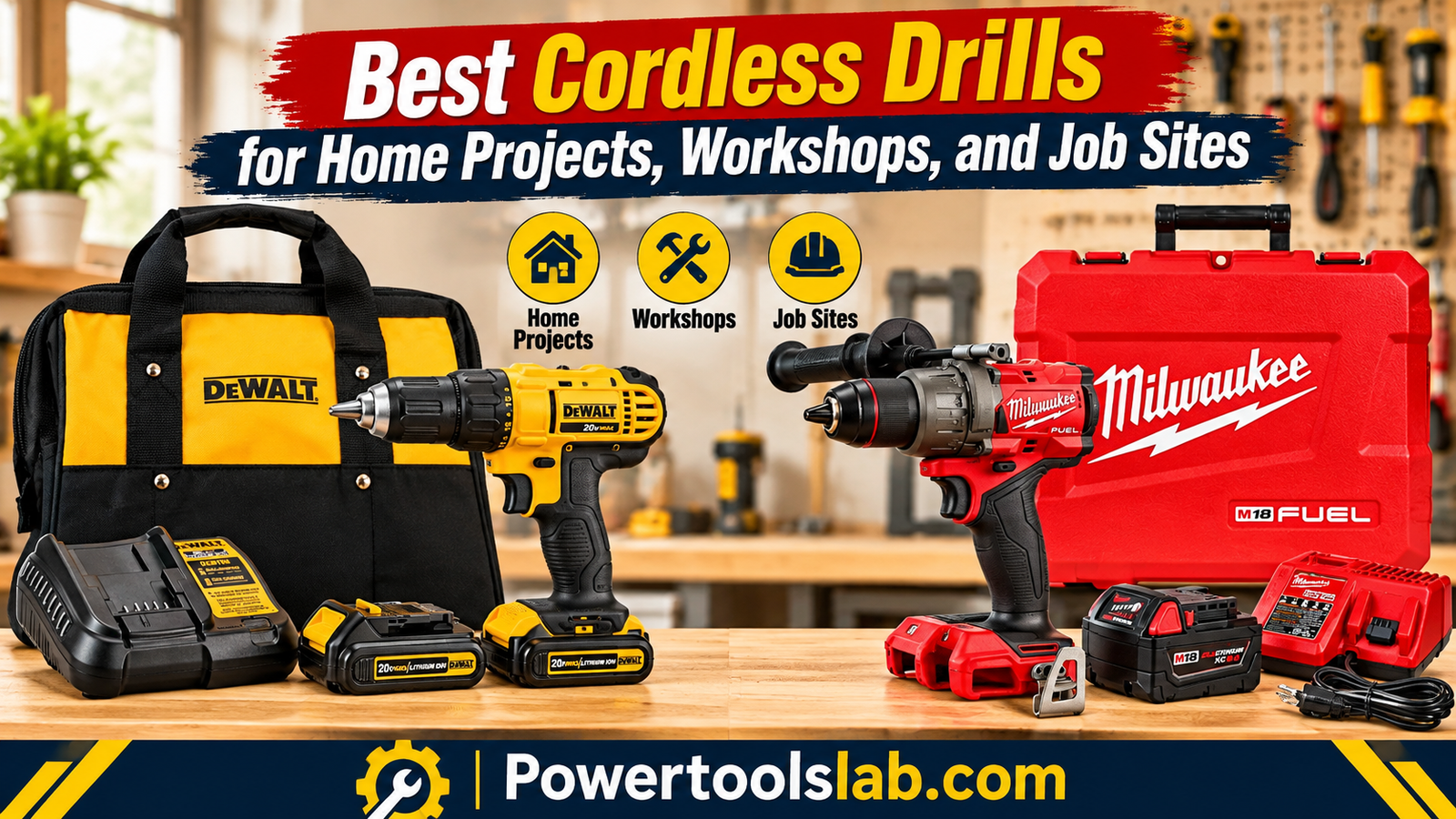
A cordless drill is the one power tool that earns its space in almost every household. Hang a shelf, assemble flat-pack furniture, build a raised garden bed, drive a hundred deck screws on a Saturday afternoon — a good drill/driver handles all of it without dragging a cord across the room or hunting for an outlet behind the couch.
The trouble is that “cordless drill” covers an enormous range of tools. There are lightweight homeowner kits meant for occasional shelving projects, compact professional models built to run all day, high-voltage machines for drilling into masonry and dense hardwood, and budget-friendly bundles that cost less than a decent dinner out. Sorting through battery platforms, motor types, chuck styles, and kit contents can quickly turn into an evening of spreadsheet research that you never wanted.
That is exactly what this guide is for. We pulled together nine of the most talked-about cordless drills on the market — from the DEWALT 20V MAX DCD771C2 that sits in millions of garages to the trade-focused Milwaukee M18 FUEL 2903-22 — and compared them the way a real buyer would: what each one is genuinely good at, where it falls short, and who should spend money on it.
Short on Time? Here’s the Fast Version
Best for most people: the DEWALT 20V MAX DCD771C2 — approachable, widely supported, and matched to a battery platform that grows with you. Best for daily trade use: the Milwaukee M18 FUEL 2903-22. Best for light home jobs: the BLACK+DECKER 20V MAX. Best value kit: the CRAFTSMAN V20 CMCD700C1. Best for a bigger accessory ecosystem: the Ryobi PBLDD01 HP Brushless.
A cordless drill is really a system decision: the tool in your hand today is the same battery platform you’ll be buying into for years.
Before the numbers and the nitpicking, one honest caveat. Cordless tool lineups refresh constantly, and packaging changes from season to season. Everything in this guide is written to stay useful regardless of when you read it — we describe capabilities and handling characteristics in plain language rather than leaning on figures that might shift. When you’re ready to buy, the links go straight to the current listing so you can confirm the exact kit contents and what’s included in the box.
One more thing worth knowing before you shop: a drill is rarely the only tool you’ll want. Plenty of our readers pair their drill/driver with an impact driver for long fasteners, and we cover that trade-off in detail in our guide to impact driver vs. drill. If you’re building out a full workshop, our roundup of the best impact drivers is the natural companion piece to what you’re reading now.
Quick Comparison: Our Top Picks
Every drill in this guide appears in the table below. Use it to narrow the field, then read the full review blocks further down for the details that matter to the way you actually work.
| # | Image | Product | Key Specs | Verdict | Check Price |
|---|---|---|---|---|---|
| 1 |  |
Top PickDEWALT 20V MAX DCD771C2Best Overall |
|
The dependable, do-everything drill most homes should own. | Check Price on Amazon |
| 2 |  |
Milwaukee M18 FUEL 2903-22Best for Pros |
|
Built for people who drill for a living, not a weekend. | Check Price on Amazon |
| 3 |  |
BLACK+DECKER 20V MAXBest for Light Home Jobs |
|
Simple, friendly, and easy to grab for small projects. | Check Price on Amazon |
| 4 |  |
CRAFTSMAN V20 CMCD700C1Best Value Kit |
|
A strong all-round starter kit at a sensible price. | Check Price on Amazon |
| 5 |  |
AVID POWER 20V Cordless DrillBest Budget Entry |
|
A low-cost first drill for occasional projects. | Check Price on Amazon |
| 6 |  |
Flex 24V FX1271TBest for Heavy Drilling |
|
Extra headroom when the material fights back. | Check Price on Amazon |
| 7 |  |
Ridgid R86115 BrushlessBest Brushless Value |
|
Brushless efficiency without premium-tier pricing. | Check Price on Amazon |
| 8 |  |
Metabo HPT DS18DBL2 MultiVoltMost Flexible Power |
|
A smart choice if you value battery flexibility. | Check Price on Amazon |
| 9 |  |
Ryobi PBLDD01 HP BrushlessBest Ecosystem |
|
One battery, an absurd number of tools that use it. | Check Price on Amazon |
How to read this table: the “Best For” label tells you the kind of buyer each drill suits most naturally. None of these is a bad tool — the difference is whether you’re paying for capability you’ll actually use, or for headroom you’ll never need.
Ready to Compare Current Pricing?
See today’s cordless drill listings and kit bundles.
Check Price on Amazon1. How We Compared These Drills
Plenty of tool roundups are just a list of product names with a paragraph of marketing copy underneath. That doesn’t help you decide anything. So before we get into individual tools, it’s worth explaining what we actually looked at and why those criteria matter when a drill is in your hand.
Our comparison framework rests on five pillars: power delivery, handling and ergonomics, battery platform value, kit completeness, and real-world suitability. Each one solves a different question. Power delivery answers “will it do the work?” Handling answers “will I enjoy using it for an hour?” Platform value answers “am I locking myself into something sensible?” Kit completeness answers “what else do I have to buy?” And suitability answers the biggest question of all: “is this the right tool for the jobs I actually have?”
Power delivery matters more than headline numbers
It’s tempting to compare drills by a single figure on a spec sheet, but the number that matters is the one you feel at the trigger. A drill that keeps spinning steadily as it bites into pressure-treated lumber is far more useful than one that looks impressive on paper and bogs down the moment resistance climbs. Manufacturers describe this capability in different ways, so rather than pretend one universal measurement exists, we focus on how each tool is positioned and what owners report when the work gets demanding.
This is also where motor design enters the conversation. A brushless motor behaves differently under load than a brushed one, and that difference shows up as sustained output and longer runtime per charge. We cover the mechanics in our comparison of brushless vs. brushed motors if you want the deep explanation.
Handling is the difference between a tool and a chore
Weight distribution, grip texture, the balance point with a battery attached, trigger sensitivity, and how easily you can switch between forward and reverse with one hand — none of that appears in a headline spec, and all of it shapes whether you finish a project smiling or nursing a sore wrist. If you’ve ever driven a long run of screws overhead, you already know what we mean. Compact tools with a short head length shine in cabinets and between studs; larger tools with more mass tend to feel steadier when you’re leaning into a deep hole.
Battery platform value is the long game
The drill you buy is really the entry point to a battery ecosystem. Once you own two batteries and a charger from one brand, the next tool you buy becomes a much cheaper decision. That’s why platform breadth counts as heavily as it does in our ranking. We’ve written a whole piece on power tool brands if you want to understand how the major families compare.
Kit completeness and real-world fit
A kit that includes a battery and a charger saves you from an unpleasant surprise on day one. A bare tool looks cheaper until you price the power source separately. Beyond the box contents, we look at who each drill genuinely serves — the apartment dweller assembling bookshelves has different needs from a carpenter driving structural screws all day, and pretending otherwise produces bad recommendations.
Our promise on accuracy: rather than quoting figures we can’t verify, we describe capability in practical terms. Whenever a manufacturer publishes detailed specifications, check the current listing before you buy so you know exactly what ships in the box.
Want a Deeper Drill Buying Walkthrough?
Our full drill selection guide covers every decision point.
Check Price on Amazon2. Drill/Driver, Impact Driver, or Hammer Drill: Which One Do You Actually Need?
Most of the confusion in the cordless drill aisle comes from the fact that three different tools look nearly identical in a photo. They all have a handle, a trigger, a chuck, and a battery hanging off the bottom. The differences are inside, and they decide what the tool can and cannot do.
The drill/driver: the everyday all-rounder
A drill/driver is what most people mean when they say “cordless drill.” It drills holes in wood, plastic, and light metal, and it drives screws with a clutch that lets you dial in how much torque is applied before the tool stops turning. That clutch is the secret weapon — it’s what keeps you from burying a screw through a cabinet door or snapping the head off a small fastener in soft pine.
Every drill in this guide is fundamentally a drill/driver, which is exactly why they belong in the same comparison. If you want a refresher on technique, our walkthrough on how to use a drill covers the basics from bit selection to clutch settings.
The impact driver: torque with a percussive kick
An impact driver applies rotational force in rapid bursts rather than continuously. That mechanism lets it drive long screws into dense material without the tool twisting your wrist or stripping the fastener head. It’s brilliant for deck building, structural screws, and lag bolts — and it’s noticeably less precise for delicate work. If you find yourself doing a lot of fastening, read our comparison of impact driver vs. drill, and check the best impact drivers if you decide you want both.
The hammer drill: for masonry and concrete
A hammer drill adds a rapid forward-and-back striking action to the rotation, which is what lets a bit chew through brick, block, and concrete. Standard drill/drivers can make a small hole in soft masonry in a pinch, but if you’re regularly anchoring into concrete, you want the hammer function — or a dedicated rotary tool for heavy anchoring work. We explain the distinction in detail in hammer drill vs. regular drill.
What about corded tools?
Corded drills still exist and still make sense in certain shops where an outlet is always within reach and the tool runs for hours. For most homeowners and remodelers, though, the freedom of a cordless model outweighs the unlimited runtime. Our breakdown of corded vs. cordless drill walks through the trade-offs honestly.
Quick type comparison
| Tool Type | Best At | Less Ideal For | Who Needs It |
|---|---|---|---|
| Drill/Driver |
|
|
Almost everyone |
| Impact Driver |
|
|
Builders and serious DIYers |
| Hammer Drill |
|
|
Renovators working with masonry |
For most readers, the answer is a solid drill/driver first, then an impact driver later when the projects get bigger. That’s the path we’d take — and it’s the reason this guide stays focused on drill/drivers rather than mixing tool categories into one confusing list.
Shopping for Your First Cordless Tool?
Start with a drill/driver kit and expand from there.
Check Price on Amazon3. Brushless Motors and Battery Platforms: The Decisions That Outlast the Tool
Two technical choices shape your experience with a cordless drill more than any other: the motor inside it and the battery system it belongs to. Get both right and the tool feels like a long-term investment. Get either wrong and you’ll be replacing things sooner than you planned.
What “brushless” actually changes
A brushed motor uses physical carbon brushes to transfer electricity to the spinning rotor. It’s a proven, inexpensive design — and it creates friction, heat, and gradual wear. A brushless motor replaces those brushes with electronic controls that manage the current digitally. The practical results are threefold: less wasted energy as heat, more usable work from each battery charge, and fewer wearable parts inside the tool.
For a homeowner who uses a drill a dozen times a year, brushed is perfectly fine. For anyone drilling or driving weekly — cabinet installers, deck builders, hobbyist woodworkers — brushless earns its keep quickly. If you want the technical side spelled out, our brushless vs. brushed motor comparison covers the details.
Platform lock-in is real, and it’s mostly a good thing
Once you own a battery and charger from a given brand family, buying the next tool bare (without a battery) becomes dramatically cheaper. That’s the appeal of platforms like DEWALT’s 20V MAX, Milwaukee’s M18, Ryobi’s ONE+, Metabo HPT’s MultiVolt, and CRAFTSMAN’s V20. The trade-off is commitment: your batteries only fit that brand’s tools.
Our advice is to think two purchases ahead. If you can see yourself buying an oscillating multi-tool, a circular saw, and a work light in the next couple of years, choose the platform with the widest range you can afford to stay in. Our roundups of the best cordless circular saws and the best angle grinders show how much variety exists within a single battery family.
Brushless picks from this group
| Product | Platform | Best For | Verdict | Check Price |
|---|---|---|---|---|
| Milwaukee M18 FUEL 2903-22 | M18 FUEL | Daily professional use | Premium brushless in a proven trade platform. | Check Price on Amazon |
| Ridgid R86115 | Ridgid cordless | Value-focused brushless buyers | Brushless efficiency at a friendlier price. | Check Price on Amazon |
| Ryobi PBLDD01 HP | ONE+ | Homeowners building a big kit | Brushless performance with endless tool options. | Check Price on Amazon |
| Metabo HPT DS18DBL2 | MultiVolt | Flexible power sourcing | A platform designed around battery versatility. | Check Price on Amazon |
Finally, remember that batteries are consumables. They age, they hold less charge over time, and they prefer moderate temperatures. If you want your investment to last, the habits in our power tool storage guide matter more than any single purchase decision.
Building Out a Battery Platform?
Compare brushless cordless drill kits and bare tools.
Check Price on Amazon4. DEWALT 20V MAX DCD771C2: Best Overall for Most Homes
DEWALT 20V MAX DCD771C2 Drill Driver Kit
There’s a reason this drill shows up in so many garages, workshops, and first apartments. The DCD771C2 is the friendly face of DEWALT’s 20V MAX lineup — approachable enough for someone who has never owned a power tool, and capable enough that most owners never feel the need to upgrade. It’s the drill we point to when someone asks “what should I just buy and be done with it?”
The 20V MAX platform is the real headline here. Batteries, chargers, and dozens of tools share that connection, which means the drill you buy today is the cheapest possible entry into a much larger kit. Whether you eventually want a reciprocating saw, a jobsite light, or an oscillating tool, you’ll already own the power source. That kind of forward compatibility is worth more than a marginal spec advantage on a tool you’ll use twice a month.
Key Features
- 20V MAX battery platform — shared across DEWALT’s broad cordless range
- Compact drill/driver format — comfortable for overhead and cabinet work
- Variable-speed trigger — for starting holes slowly and finishing fast
- Adjustable clutch — helps prevent over-driving screws in soft materials
- Kit format — includes the essentials to start working out of the box
- Widely supported ecosystem — accessories and batteries are easy to find
In daily use, what stands out is balance. The tool sits comfortably in the hand whether you’re driving a short screw into drywall anchor or boring a clearance hole through a two-by-four. Trigger response is predictable, which matters more than people expect — a drill that surges the instant you touch the trigger will wander across a workpiece and leave a scar. This one ramps up smoothly.
Where it fits less well is sustained heavy work. If your typical day involves repeated large-diameter holes in dense hardwood or long structural fasteners, you’ll be happier stepping up into a more powerful class. For everything short of that — furniture assembly, shelving, deck repair, light framing, workshop projects — this drill is genuinely hard to fault.
Pros
- Excellent all-round capability for home and light trade work
- Huge 20V MAX accessory and battery ecosystem
- Comfortable, well-balanced handling
- Straightforward controls that new users pick up instantly
Cons
- Not intended for constant heavy-duty drilling
- Serious tradespeople may want a more powerful step-up
Who It’s Best For
Homeowners, renters, DIYers, and anyone buying their first serious cordless drill who wants a tool they won’t outgrow for years. It’s also a smart pick if you plan to expand into other DEWALT cordless tools later.
Want the wider picture on this brand’s cordless lineup? Our full look at the best DEWALT drills covers the models above and below this one, and the DEWALT vs. Milwaukee comparison answers the question that comes up most often once you’re shopping at this level.
Ready to Upgrade Your Home Toolkit?
Compare current cordless drill kit bundles.
Check Price on Amazon5. Milwaukee M18 FUEL 2903-22: Best for Professionals and Heavy Use
Milwaukee M18 FUEL 2903-22 Drill/Driver
If the DEWALT is the drill most people should own, the Milwaukee M18 FUEL 2903-22 is the drill people who drill for a living reach for. FUEL is Milwaukee’s brushless line, and the 2903-22 sits right in the sweet spot of that range: enough power to take on demanding work all day, in a body that stays manageable when you’re up a ladder or wedged inside a cabinet.
This is a tool designed around the realities of professional use. Controls are where your thumb expects them. The grip holds up when your hands are dusty or gloved. The overall feel is dense and purposeful rather than flashy — the kind of tool that gets scuffed up and keeps working. Pair it with the wider M18 family and you’re building a kit that covers almost every trade task imaginable.
Key Features
- M18 FUEL brushless platform — designed for sustained, efficient output
- Trade-duty construction — built to handle daily professional use
- Compact head length — fits into tight framing and cabinet spaces
- Responsive trigger control — precise starts and clean finishes
- Kit format — the two-battery setup typical of professional bundles
- Extensive M18 ecosystem — compatible with a huge range of trade tools
What separates a professional-grade drill from a homeowner one is rarely peak capability — it’s what happens at hour six. Motors that stay cooler, gears that hold their alignment, and a battery platform that keeps delivering as the charge drops. The M18 FUEL line is engineered around exactly that kind of endurance, and the 2903-22 carries it forward.
For the average weekend DIYer, this is honestly more tool than you need, and the price reflects the positioning. But if your livelihood depends on it — or if you simply want to buy once and never think about it again — the value is straightforward.
Pros
- Serious, sustained performance for demanding tasks
- Brushless M18 FUEL platform with a massive tool family
- Excellent ergonomics during long work sessions
- Build quality suited to daily job-site use
Cons
- Priced for professional expectations
- Overkill for occasional household projects
Who It’s Best For
Tradespeople, contractors, remodelers, and ambitious DIYers who want top-tier capability and plan to stay in the M18 platform. If your drill rides in a tool bag every day, start your search here.
Milwaukee’s cordless range runs deep, and this drill is only the entry point. If you’re weighing this brand against its closest rival, our DEWALT vs. Milwaukee comparison is the place to start, followed by our roundup of the best Milwaukee drills. Serious builders should also look at the best miter saws and best reciprocating saws for the rest of a professional setup.
Building a Trade-Grade Toolkit?
Compare professional cordless drill kits side by side.
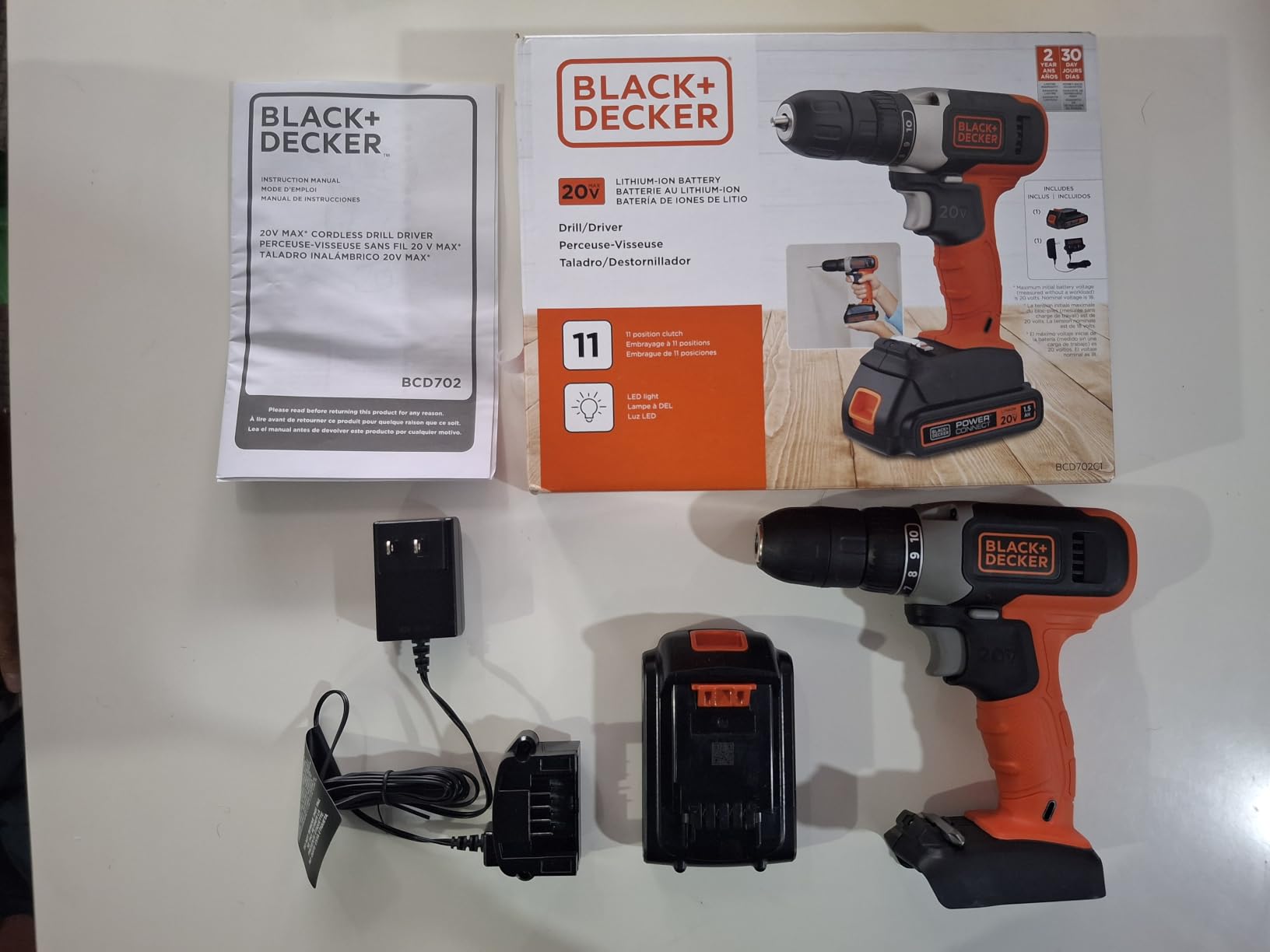
Check Price on Amazon6. BLACK+DECKER 20V MAX: Best for Light Home Projects
BLACK+DECKER 20V MAX Cordless Drill
Not everyone needs a tool that can drill through a railroad tie. Plenty of people need a drill that lives in a kitchen drawer, gets grabbed twice a month, and never intimidates anyone in the household. That’s the space the BLACK+DECKER 20V MAX occupies, and it occupies it well.
This is a friendly tool. It’s light enough that hanging a curtain rod doesn’t turn into an arm workout, simple enough that a teenager can use it safely with a little instruction, and affordable enough that buying one doesn’t require a decision-making committee. The 20V MAX battery format gives it more credibility than a throwaway tool — it’s part of a real cordless family rather than a dead-end purchase.
Key Features
- 20V MAX battery system — shared across the brand’s cordless lineup
- Lightweight handling — comfortable for quick tasks and overhead work
- Adjustable clutch — helps protect softer materials from over-driving
- Variable-speed trigger — smooth starts for accurate screw placement
- Compact footprint — easy to store in a drawer or small toolbox
- Beginner-friendly controls — nothing here needs a manual to understand
Where this drill shines is the everyday task list: assembling furniture, tightening cabinet hardware, mounting hooks, drilling pilot holes for picture hangers, building a small planter box. It handles those jobs with room to spare. Where it asks for patience is anything sustained — a full day of deck construction or repeated large holes in hardwood will push it past what it’s designed for, and that’s fine, because that isn’t what it’s for.
We also appreciate how unintimidating it is. Tool ownership has a psychological barrier that people undersell: a heavy, complicated tool ends up unused in a closet. A light, obvious one gets picked up constantly and quietly improves a home for years.
Pros
- Very approachable for new and occasional users
- Light enough for overhead and quick jobs
- Genuinely useful 20V MAX battery ecosystem
- Easy to store and easy to live with
Cons
- Not built for heavy, sustained drilling
- Power users will want a step up
Who It’s Best For
Apartment dwellers, first-time tool owners, families, and anyone who wants a drill for occasional home maintenance rather than construction work. Also a genuinely good gift.
Choosing a first drill can feel harder than it should, which is why we wrote a dedicated guide to the best power tools for beginners and a broader roundup of the best drills for DIY and pro use. Both help you match the tool to the ambition.
7. CRAFTSMAN V20 CMCD700C1: Best Value Kit
CRAFTSMAN V20 CMCD700C1 Cordless Drill/Driver Kit
Value is a tricky thing to recommend, because it’s easy to mistake “cheap” for “good value.” The CRAFTSMAN V20 CMCD700C1 earns the label honestly: it’s a complete kit from a brand with broad retail support and a wide cordless family, at a price that doesn’t punish you for starting your collection.
The V20 platform is the strategic advantage here. Once you own the batteries and charger from this kit, the cost of adding a circular saw, a sander, or a work light drops substantially, because you’re buying the tool only. For a new homeowner facing a long list of projects, that math matters more than any individual feature.
Key Features
- V20 battery platform — shared across a broad CRAFTSMAN cordless lineup
- Complete kit format — the essentials included to get started
- Drill/driver capability — holes and fasteners in everyday materials
- Adjustable clutch and speed control — matched to the material at hand
- Widely available support — easy to find accessories and replacements
- Workshop-friendly design — suited to garage and home project use
In practice, this is a drill that feels comfortable with the standard homeowner workload. Furniture assembly, shelving, deck board repair, mounting a TV bracket into studs, drilling into soft metals with the right bit — it does all of that without drama. The controls are conventional in the best sense: you don’t have to learn anything, you just pick it up and go.
The honest limitations are the ones you’d expect at this positioning. Extended heavy drilling will test it, and anyone working with dense hardwoods daily will want something from higher in the range. For the middle ground where most people live — weekend projects, home repairs, seasonal builds — it lands in a comfortable spot.
Pros
- Complete kit that avoids hidden add-on costs
- Strong value within a broad cordless platform
- Comfortable, familiar handling
- Easy access to accessories and support
Cons
- Not aimed at continuous heavy-duty work
- Trade users will outgrow it quickly
Who It’s Best For
Value-conscious homeowners, first-time buyers setting up a garage workshop, and anyone who wants a dependable kit without paying for professional-grade headroom.
Once your drill collection starts growing, storage becomes the next problem. Our guide to organizing power tools in the garage is worth reading before the toolbox overflows, and our look at typical power tool amp draw helps if you’re wiring a shop.
Setting Up a Home Workshop?
Compare complete drill kits that include batteries.
Check Price on Amazon8. AVID POWER 20V Cordless Drill: Best Budget Entry Point
AVID POWER 20V Cordless Drill
Sometimes the right drill is the one that gets you started today rather than the one you save for next spring. The AVID POWER 20V cordless drill is aimed squarely at that moment: first apartment, first house, first project list, and a budget that has already absorbed plenty of other expenses.
For occasional use, this kind of tool makes a lot of sense. You get cordless convenience, variable speed control, and the ability to handle the tasks that generate the most frustration in daily life — loose hinges, wobbly shelves, unopened flat-pack boxes, and picture frames that need hanging before guests arrive. If a drill gets used a dozen times a year, spending a small fortune on one is genuinely difficult to justify.
Key Features
- 20V cordless platform — cord-free convenience for household tasks
- Value-focused kit — designed to keep the entry cost low
- Variable-speed trigger — control over how fast the bit turns
- Adjustable clutch — helps avoid driving screws too deep
- Light-duty focus — matched to home and hobby projects
- Compact storage footprint — fits easily on a shelf or in a closet
Set the right expectations and you’ll be happy. This drill is at its best assembling furniture, hanging hardware, drilling pilot holes, and tackling light repairs. It’s not the tool for boring repeated large holes in dense hardwood, driving structural fasteners all day, or surviving daily professional use — and no honest budget-drill review should pretend otherwise.
The other thing to weigh is ecosystem. Value brands tend to offer narrower tool families, so think about whether your next purchase is likely to be another cordless tool from the same brand. If you already know you want a full range of tools someday, paying a little more to enter a broader platform often pays off. If you just need a drill, this category makes sense.
Pros
- Lowest-cost path into cordless drilling
- Perfectly suited to occasional home tasks
- Simple, light, and easy to store
- Good fit for first-time tool owners
Cons
- Not intended for heavy or professional use
- Narrower long-term platform options
Who It’s Best For
Students, renters, first-time homeowners, and anyone who wants cordless convenience for light, occasional projects without committing a large budget.
Buying on a budget is exactly when research pays off most. Our comparison of the corded vs. cordless drill may change your thinking if outlet access isn’t an issue, and the drills for DIY and pro use roundup shows where each price band tends to land.
9. Flex 24V FX1271T: Best for Demanding Drilling Jobs
Flex 24V FX1271T Drill/Driver
There’s a category of work where a standard drill starts to feel like a compromise: deep holes in dense stock, stubborn fasteners in old framing, long days where the tool barely cools down between tasks. The Flex 24V FX1271T is built for that territory, and the 24V platform behind it signals the intent clearly.
Higher platform voltage generally points toward more available output, and the Flex system leans into that positioning with a lineup that emphasizes capability over minimalism. The result is a drill that feels confident when the material pushes back — you can lean into it and it keeps working rather than stalling and complaining.
Key Features
- 24V cordless platform — positioned for higher-output work
- Robust build — designed for demanding, repetitive tasks
- Drill/driver versatility — holes and fasteners across materials
- Confident power delivery — suited to tougher drilling conditions
- Expandable tool family — shares batteries with other Flex cordless tools
- Job-site oriented design — built to take a reasonable amount of abuse
Trade-offs exist, and they’re predictable. Tools in this class tend to be larger and heavier than compact homeowner models, which matters when you’re working overhead or in tight quarters. Battery packs are physically bigger too. That’s the exchange for extra headroom, and it’s the right exchange for some people and the wrong one for others.
If your projects trend toward the ambitious — timber framing, workshop builds, renovation work in older homes — this is a compelling option. If your drill mostly assembles bookshelves, you’d be paying for capability you’ll rarely call on.
Pros
- Strong headroom for demanding drilling work
- Confident feel when the material resists
- Serious, durable build quality
- Growing cordless tool family
Cons
- Heavier than compact homeowner models
- More capability than casual users need
Who It’s Best For
Serious DIYers, remodelers, and tradespeople who regularly drill in tough materials and want extra power headroom without moving to a different tool class entirely.
For comparison, it’s worth reading our take on the hammer drill vs. regular drill, since some heavy masonry work is better served by a hammer function than by more raw drilling power. And if your jobs are saw-heavy, our guides to the best power saws and the best jigsaws round out the toolkit.
10. Ridgid R86115 Brushless Drill: Best Brushless Value
Ridgid R86115 Brushless Drill
Brushless motors used to be a premium-only feature. The Ridgid R86115 is part of the generation of tools that changed that, offering the efficiency and durability advantages of brushless design at a price that lands well below the top-tier professional models. For a lot of buyers, that combination is the whole argument.
What brushless buys you in practice is straightforward: more work per charge, less internal heat build-up, and fewer wear parts over the life of the tool. If you use a drill frequently — weekly workshop sessions, ongoing renovation projects, weekend builds — those advantages compound. The tool feels livelier as the battery drains, and the motor has fewer things inside it that eventually need attention.
Key Features
- Brushless motor design — efficient output with fewer wearable parts
- Value positioning — brushless capability at a mid-range price
- Drill/driver versatility — holes and fasteners across common materials
- Variable-speed trigger — fine control at the start of a hole
- Adjustable clutch — matched to the fastener and material
- Solid accessory support — backed by broad retail availability
Handling sits comfortably in the middle of the pack — not as compact as the lightest homeowner models, not as hefty as the high-output class. That middle position suits the widest range of users, which is one reason this drill is easy to recommend to people who describe their projects as “a bit of everything.”
The main consideration is platform thinking. Before buying, take a quick look at the rest of the brand’s cordless range and ask whether it covers the tools you expect to want. Batteries are the long-term investment, and the tool is just the first thing they power.
Pros
- Brushless efficiency without premium pricing
- Great all-round performance for regular users
- Comfortable handling across varied tasks
- Strong value proposition overall
Cons
- Platform breadth is narrower than the biggest brands
- Heavy professional use favors higher-tier models
Who It’s Best For
Value-focused buyers who want brushless benefits and use a drill regularly but don’t need a top-of-the-line professional model.
Brushless is only one part of the value story. Our comparison of brushless vs. brushed motors explains exactly when the extra spend makes sense, and the power tool brands overview shows how each manufacturer positions its lineup.
Want Brushless Without the Premium Price?
Compare brushless drill models across brands.
Check Price on Amazon11. Metabo HPT DS18DBL2 MultiVolt: Best for Flexible Power Options
Metabo HPT DS18DBL2 MultiVolt Drill
The most interesting thing about the Metabo HPT DS18DBL2 isn’t the drill — it’s the thinking behind the platform. MultiVolt was designed around the idea that a battery should work more broadly across a manufacturer’s cordless range, and that flexibility has real consequences for how you build out a toolkit over time.
For the working professional, that kind of interoperability reduces the number of separate battery types jangling around in the truck. For the committed DIYer, it means the battery you buy today has more future uses than it would in a closed system. Those are meaningful advantages even before you consider the drill itself.
Key Features
- MultiVolt platform — designed for cross-tool battery flexibility
- Job-site oriented build — suited to demanding, varied work
- Drill/driver capability — holes and fasteners across common materials
- Efficient motor design — oriented toward sustained professional output
- Variable-speed control — matched to the task at hand
- Established trade heritage — from a long-standing power tool manufacturer
As a drill, the DS18DBL2 sits comfortably in the serious-work category. It’s the kind of tool that feels at home drilling into framing lumber, driving into dense stock, and working through a full day of mixed tasks without losing composure. The grip and balance suit extended use, which matters more than most buyers realize until they’ve spent a few hours with a tool that doesn’t.
The trade-off is ecosystem scale. In some markets, the accessory and tool range is narrower than the largest brands, so a little research into what else shares the platform will save frustration later. If the available range covers what you need, the platform’s flexibility becomes a genuine advantage rather than a footnote.
Pros
- Excellent battery platform flexibility
- Capable, durable, job-site ready build
- Strong sustained performance for demanding work
- Well suited to professional mixed-task use
Cons
- Tool range is narrower in some markets
- More tool than casual users typically require
Who It’s Best For
Professionals and serious DIYers who value battery interoperability and want a capable drill that fits into a flexible cordless system.
Platform decisions get easier when you can see the whole picture. Our comparisons of Makita vs. DEWALT and Ryobi vs. Milwaukee cover similar ground for the two largest families, and our best Makita drills guide is worth a look if Japanese-engineered cordless tools appeal to you.
Choosing a Battery Platform?
Compare cordless drill systems and their tool ranges.
Check Price on Amazon12. Ryobi PBLDD01 HP Brushless: Best for the Biggest Tool Ecosystem
Ryobi PBLDD01 HP Brushless Drill
Ask a hundred homeowners what they bought after their first Ryobi drill and a remarkable number will say “everything else Ryobi makes.” That’s the story of the ONE+ platform, and the PBLDD01 HP Brushless is a genuinely capable way into it. This isn’t a case of buying a weak tool just to join an ecosystem — the HP brushless design puts real performance on the table.
The appeal is straightforward economics. Once you own the batteries, adding tools becomes dramatically cheaper, and the range of things those batteries power is enormous: saws, sanders, lights, inflators, fans, outdoor equipment, and much more. For a homeowner with a long and varied to-do list, that breadth has a value all its own.
Key Features
- HP brushless motor design — efficient, modern power delivery
- ONE+ battery platform — shared across an exceptionally broad tool family
- Drill/driver versatility — everyday holes and fasteners with confidence
- Variable-speed trigger — smooth, controlled starts
- Adjustable clutch — protects delicate materials and fasteners
- Home and workshop ready — suited to the full range of domestic projects
In use, the HP brushless variant feels noticeably more modern than entry-level brushed models. It holds speed better under load, and the overall response is crisper. For home renovation work, hobby woodworking, and the endless miscellaneous jobs a house generates, it has plenty in reserve.
Where it doesn’t compete is sustained professional trade use. This is a homeowner and enthusiast tool first, and that’s exactly the market it’s built for. If you’re framing houses all day, look higher up the range; if you’re building a garden bed on Saturday and hanging shelves on Sunday, this is a very comfortable fit.
Pros
- Enormous ONE+ tool ecosystem to grow into
- Capable HP brushless performance
- Excellent value for homeowners
- Comfortable handling for everyday projects
Cons
- Not positioned for daily professional use
- High-demand users may want a heavier-duty class
Who It’s Best For
Homeowners, hobbyists, and DIYers who want a capable drill and expect to expand into a large cordless tool collection over time.
Ryobi’s range deserves its own look, which is why we wrote a full guide to the best Ryobi drills. If you’re deciding between ecosystems, Ryobi vs. Milwaukee lays out the differences clearly, and our review of the Ryobi circular saw shows what the platform looks like one purchase later.
Planning a Full Cordless Tool Collection?
Start with a drill from a platform that grows with you.
Check Price on AmazonBuying Guide: How to Choose the Right Cordless Drill
You’ve seen the options. Now the practical part: matching a drill to your actual life rather than to a spec sheet. The questions below are the ones that reliably separate a good purchase from one that ends up gathering dust.
Start with the work, not the tool
Write down the last five projects you did or plan to do. Furniture assembly and shelving? A compact homeowner model is plenty. Deck building and framing? Move up a class. Renovation work involving old hardwood and stubborn fasteners? You want serious power headroom. This exercise takes two minutes and saves hours of second-guessing.
Decide on a battery platform early
As we covered earlier, batteries are the long-term commitment. Think about the next three tools you’re likely to want and check what’s available in each platform. Our guides to DEWALT drills, Milwaukee drills, Bosch drills, and Makita drills each cover a full family.
Kit contents are part of the price
A kit that includes a battery and charger costs more up front but usually less overall. If you already own batteries in a platform, a bare tool is the smarter buy. Always confirm what’s in the box on the current listing before ordering.
Weight and balance beat raw power for most people
A drill that’s comfortable gets used. A drill that’s a chore gets left alone. If you can, consider how the tool feels with a battery attached, and pay attention to head length if you’ll be working in cabinets or between studs.
Feature checklist worth having
Before You Buy, Look For
- Variable-speed trigger — control over how quickly the bit turns
- Adjustable clutch — prevents over-driving screws in soft materials
- Keyless chuck — quick, tool-free bit changes
- Multiple speed ranges — matched to drilling versus driving
- Battery compatibility — shared across the tools you want later
- Warranty and support — coverage that reflects how you’ll use the tool
And remember that a drill is often just the first tool in a workshop. Our roundups of the best miter saws, best portable air compressors, and best power tools for beginners map out what comes next.
Care and Maintenance: Making a Cordless Drill Last
Cordless drills are remarkably durable, but they’re not maintenance-free. The habits below take almost no time and add years to a tool’s useful life.
Keep the batteries sane
Batteries are the single most common failure point. Avoid leaving them on a hot dashboard or in an unheated shed through winter, and don’t store them completely drained. Moderate temperatures and a partial charge are the sweet spot for long-term storage.
Keep the chuck and vents clean
Sawdust finds its way everywhere. Blow out the vents periodically, wipe the chuck jaws, and check that bits seat properly. A bit that wobbles in the chuck produces sloppy holes and wears the mechanism faster.
Listen to the tool
Grinding, burning smells, and unusual heat are all signals to stop and reassess. If you’ve noticed smoke or a burning odor, read our troubleshooting guide on why a drill might be smoking before continuing — it’s usually a symptom of a fixable problem.
Use the right bit for the material
Forcing a wood bit through masonry, or a dull bit through anything, punishes both the bit and the motor. Sharp, appropriate bits make the tool work less and last longer. A modest drill bit set is one of the highest-value small purchases in any workshop.
Store it properly
A shelf beats the bottom of a damp toolbox. Our guide to organizing power tools in the garage covers storage systems that protect your investment, and a decent set of safety glasses should live next to the drill.
Protect Your Investment
Compare drill accessories, bits, and storage solutions.
Check Price on AmazonSafety Essentials for Cordless Drilling
Cordless drills are among the safest power tools, which is exactly why people get careless with them. A few habits prevent the overwhelming majority of workshop injuries.
Eye protection is non-negotiable
Drilling throws chips, dust, and occasionally fragments. Keep a pair of safety glasses within arm’s reach of wherever you work, and put them on before the trigger, not after.
Secure the workpiece
Most drill injuries happen when the material spins or the bit catches and the tool jerks. Clamps and a stable surface cost nothing compared to a trip to urgent care.
Know what never to do
There are certain practices around power tools that are simply never acceptable — holding work by hand while drilling, bypassing safety features, using damaged bits, working in standing water. Our reference on what should never be engaged when using power tools covers the full list, and it’s worth reading even if you’ve used tools for years.
Respect the battery
Don’t puncture, crush, or expose batteries to extreme heat. If a battery is damaged or swollen, stop using it and dispose of it properly. Basic common sense that prevents genuinely serious incidents.
Working with other tools adds its own considerations — our guides to air compressor safety and general types of power saws cover the equipment most workshops grow into.
Gear Up Before You Drill
Compare safety glasses, gloves, and workshop essentials.
Check Price on AmazonFrequently Asked Questions About Cordless Drills
What’s the difference between a drill/driver and an impact driver?
A drill/driver applies steady rotational force and uses a clutch to control how deep a screw goes. An impact driver delivers rapid rotational impacts, which lets it drive long fasteners into dense material without twisting your wrist. Most people end up owning both eventually — our impact driver vs. drill comparison explains when each one earns its keep.
Do I really need a brushless motor?
Not necessarily. Brushed drills handle occasional home use perfectly well. Brushless becomes worthwhile when you use the tool regularly, because it runs more efficiently per charge and has fewer wearable internal parts. The full trade-off is covered in brushless vs. brushed motors.
Should I buy a kit or a bare tool?
Buy a kit if this is your first tool in a platform. Buy bare if you already own batteries and a charger from that family. The kit almost always costs less than buying the components separately, which is why the first purchase in a platform is usually a kit.
Can a cordless drill go into concrete?
Small holes in soft masonry, occasionally, with the right bit and patience. For real anchoring work in concrete or brick, you want a hammer drill or a rotary hammer — see hammer drill vs. regular drill for the details.
How long do cordless drill batteries last?
It depends on use and storage, but batteries are consumables that gradually hold less charge over time. Keeping them at moderate temperatures and avoiding full discharge during storage makes a meaningful difference.
Is a more expensive drill always better?
No. Expensive drills are built for heavier duty cycles and more demanding work. If your projects are light, a mid-range or value model delivers everything you’ll use. Paying for headroom you never call on is just spending.
What should I look for in a first cordless drill?
A variable-speed trigger, an adjustable clutch, a comfortable grip, and a battery platform you can grow into. Those four things cover the vast majority of real-world use. Our beginner power tools guide goes deeper.
Corded or cordless — which is better today?
For most home and renovation work, cordless wins on convenience and has closed the performance gap considerably. Corded still makes sense in shops where the tool runs for hours near an outlet. Read the full breakdown in corded vs. cordless drill.
Why does my drill smell like it’s burning?
Usually friction, an overworked motor, a dull or wrong-type bit, or blocked ventilation. Stop, let it cool, and check the bit and vents. Our guide to why a drill smokes walks through the causes.
Which battery platform should I commit to?
Choose based on the tools you expect to own next, not just the drill in front of you. Platform breadth is why so many buyers end up in the largest families. Our overview of power tool brands helps frame the decision.
Can I use a drill to drive long deck screws?
You can, but an impact driver makes the job dramatically easier and is kinder to your wrist. For regular fastening work, look at the best impact drivers.
Still Have Questions?
Browse current cordless drills and compare options directly.
Check Price on AmazonFinal Verdict: Which Cordless Drill Should You Buy?
Nine drills, three use cases, one clear answer for each. If you want a single recommendation, the DEWALT 20V MAX DCD771C2 remains the safest bet for most households — capable, comfortable, and backed by a platform you can grow into for years.
If your drill is a daily work tool, the Milwaukee M18 FUEL 2903-22 is the one built for that reality. For light, occasional home projects, the BLACK+DECKER 20V MAX is friendly and affordable. For value with a complete kit, the CRAFTSMAN V20 CMCD700C1 is hard to beat, and for budget-conscious first-time buyers, the AVID POWER 20V gets you started without a big commitment.
The heavier end of the field has its own clear matches: the Flex 24V FX1271T for demanding drilling, the Ridgid R86115 for brushless value, the Metabo HPT DS18DBL2 MultiVolt for battery flexibility, and the Ryobi PBLDD01 HP Brushless for the biggest ecosystem to grow into.
Whichever you choose, buy into the platform with your eyes open, look after the batteries, and use eye protection every single time. Do those three things and a good cordless drill will serve you for a very long time.
Find Your Next Cordless Drill
Compare today’s prices across the top cordless drill kits.
Check Price on Amazon