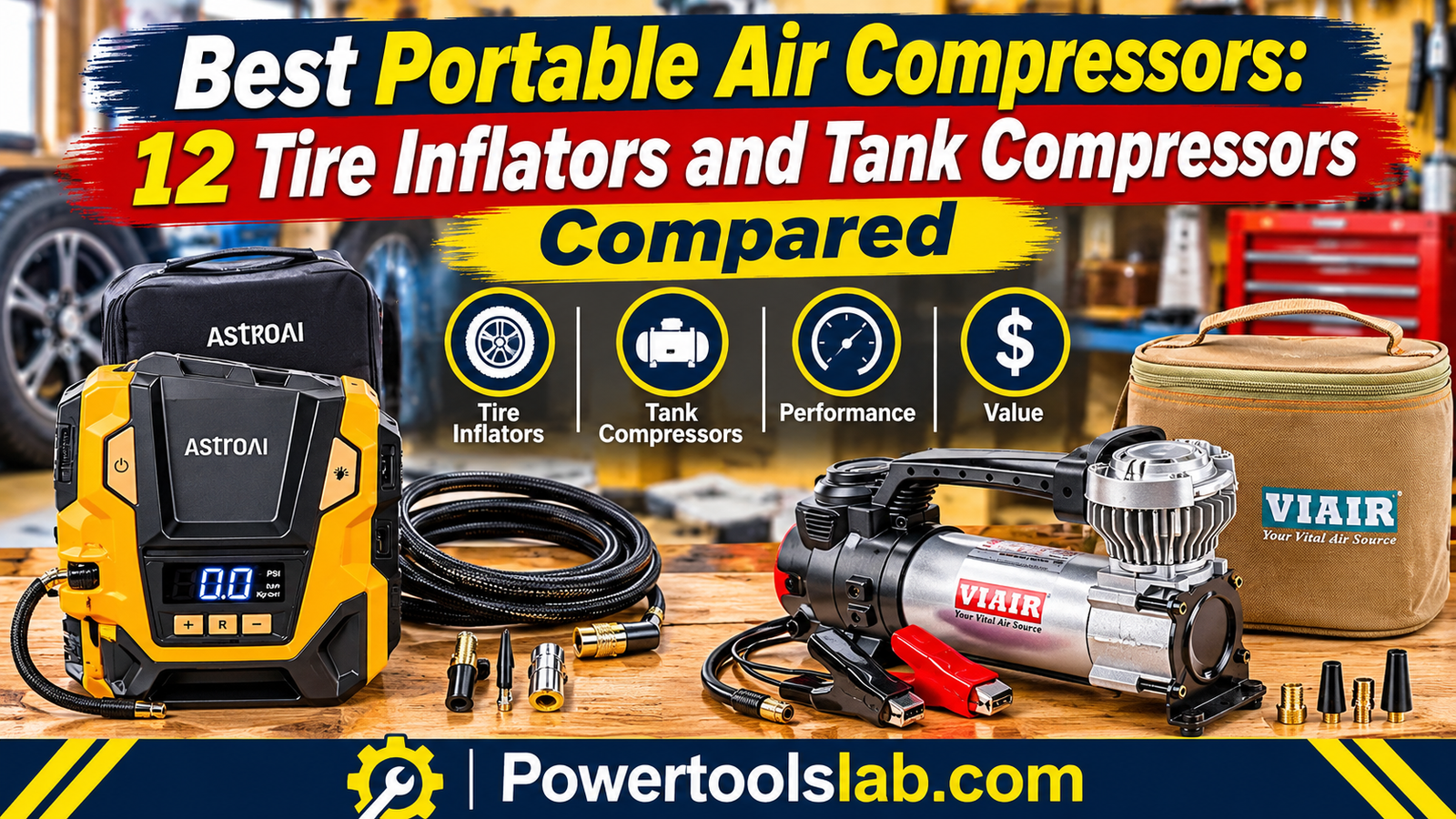
Ask ten people what a “portable air compressor” is and you will get ten different pictures: a small box in the trunk that rescues a soft tire on a rainy night, a humming tank on wheels that drives a finish nailer in a hallway, or a battery-powered gadget no bigger than a thermos. All of them compress air. Almost none of them are interchangeable.
That single word — portable — hides two completely different product families. On one side are tire inflators: compact units built to push air into a tire, an air mattress, a sports ball, or a bicycle tube. They run off a vehicle’s 12-volt outlet, off clamps connected to the battery, or off a rechargeable battery pack. On the other side are tank compressors: machines with a storage tank that holds pressurized air so you can run air tools — finish nailers, brad nailers, staplers, blow guns, and in some cases heavier equipment — without the pump cycling every second.
Grouping those two families into one “best portable air compressors” list is only useful if the list tells you which family each product belongs to, what it can realistically do, and where it falls short. That is exactly how this article is built. We cover seven tire inflators — the AstroAI C2002, VIAIR 88P, EPAuto 12V DC, Airmoto, ETENWOLF VORTEX S6, DEWALT DCC020IB and Powools — and five tank compressors — the California Air Tools 8010DSPC, Makita MAC2400, BOSTITCH 6-Gallon Pancake, CRAFTSMAN CMEC6150K and DEWALT DWFP55126.
Each product gets its own hands-on-style review block with a feature list, pros and cons, and an honest “who should buy this” line. Before that, we run through the buying fundamentals — pressure, airflow, duty cycle, noise, and power source — so you can evaluate any compressor you see on a shelf, not just the twelve here. If you would rather skip the theory, jump straight to the quick comparison table, which puts all twelve side by side with images and price links.
How to use this guide
Step one: decide whether you need inflation duty or tool duty. Step two: decide how the unit will be powered and carried. Step three: match the shortlist to the review blocks below. Roughly ninety percent of buying mistakes come from skipping step one.
Two practical notes before we start. First, we deliberately avoid quoting prices, star ratings, and review counts here, because those numbers move constantly and a stale figure is worse than no figure — the buttons below take you straight to the current listing. Second, whenever a specification is model-specific and easy to get wrong, we describe the capability in plain language rather than repeating a number from memory. Your needs are the specification that matters.

Quick Comparison: Our Top Picks
All twelve products in this guide, in one place. The tire inflators sit at the top of the table and the tank compressors follow, so you can scan across families without losing track of which job each machine is built for. Use the price button to check current availability and any active promotion.
| # | Image | Product | Key Specs | Verdict | Check Price |
|---|---|---|---|---|---|
| 1 |  |
Top PickAstroAI C2002 Portable Air CompressorBest Overall for Tire Care |
|
The easy, no-drama default for trunk duty. | Check Price on Amazon |
| 2 | |
VIAIR 88P Portable CompressorBest for Trucks and SUVs |
|
Built for heavier tires and longer sessions. | Check Price on Amazon |
| 3 | 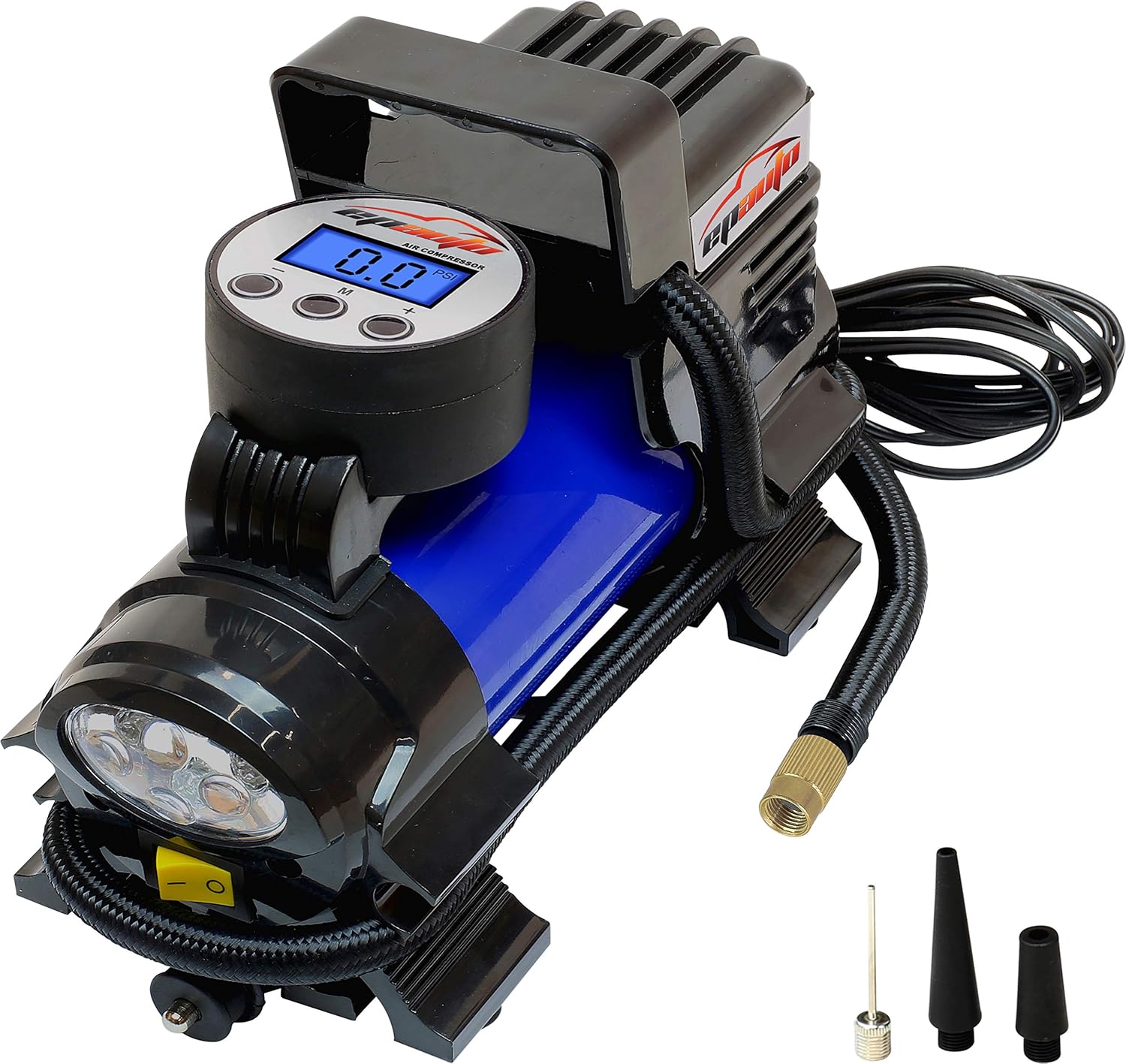 |
EPAuto 12V DC Portable Air CompressorBest Budget 12V Inflator |
|
Dependable inflation without extra frills. | Check Price on Amazon |
| 4 |  |
Airmoto Cordless Tire InflatorBest Compact Cordless |
|
Keep one in every vehicle you own. | Check Price on Amazon |
| 5 |  |
ETENWOLF VORTEX S6 Cordless Tire InflatorBest Cordless for Speed |
|
Fast, fussless cordless inflating. | Check Price on Amazon |
| 6 | 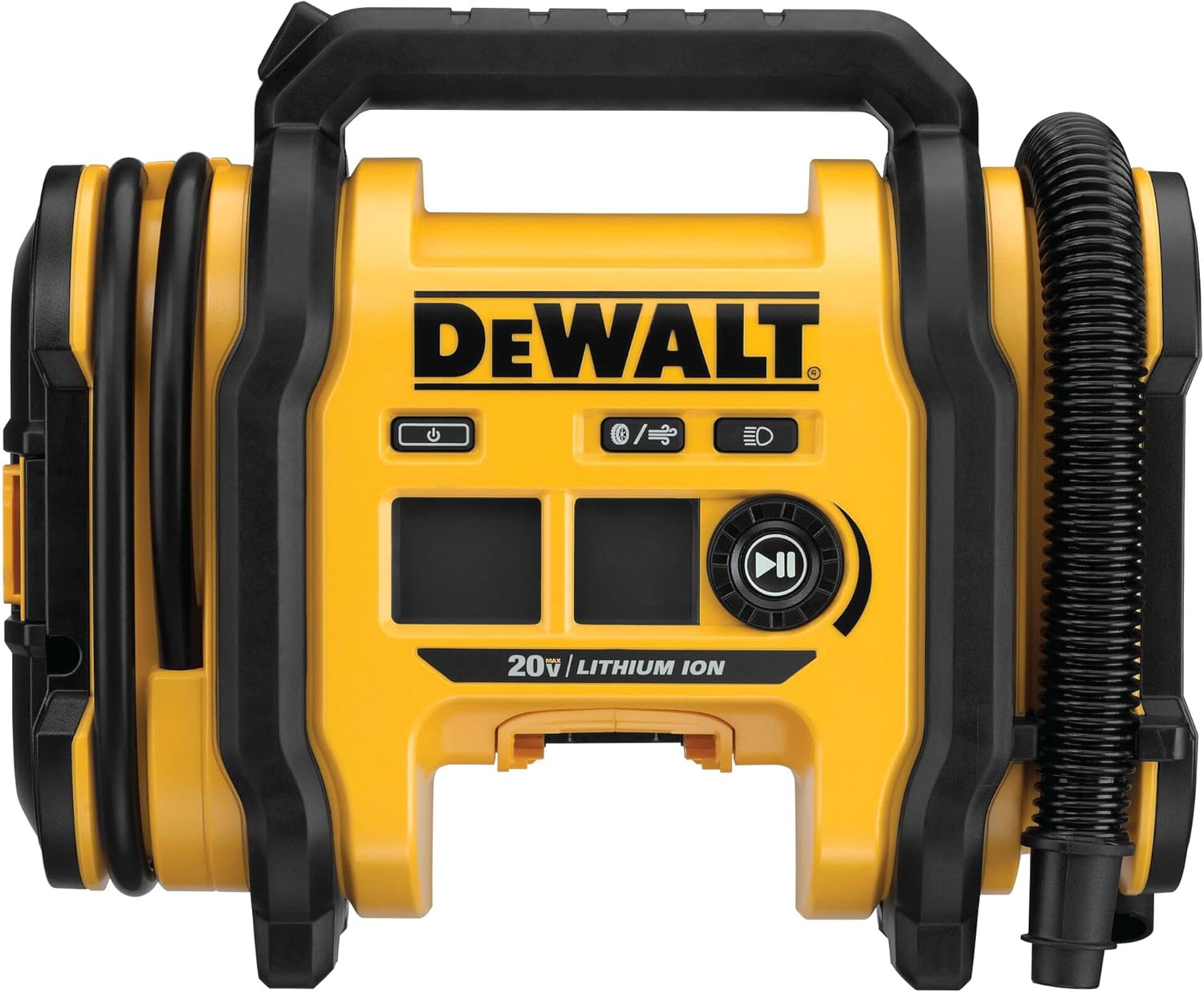 |
DEWALT DCC020IB 20V MAX Tire Inflator (tool only)Best for 20V MAX Owners |
|
A natural fit for DEWALT battery owners. | Check Price on Amazon |
| 7 |  |
Powools Portable Air CompressorBest Value Cordless |
|
Cordless convenience at a sensible outlay. | Check Price on Amazon |
| 8 |  |
California Air Tools 8010DSPC 8-Gallon Ultra-Quiet CompressorBest Quiet Tank Compressor |
|
Quiet enough for indoor projects. | Check Price on Amazon |
| 9 |  |
Makita MAC2400 Big Bore Air CompressorBest Heavy-Duty Tank |
|
The workhorse that keeps on running. | Check Price on Amazon |
| 10 |  |
BOSTITCH 6-Gallon Oil-Free Pancake CompressorBest Starter Pancake |
|
Everything a first compressor should be. | Check Price on Amazon |
| 11 |  |
CRAFTSMAN CMEC6150K Air CompressorBest for Home Garages |
|
A garage staple covering the everyday basics. | Check Price on Amazon |
| 12 |  |
DEWALT DWFP55126 Pancake Air CompressorBest for Finish Nailing |
|
A steady, predictable finish-nailing platform. | Check Price on Amazon |
Every product above has a dedicated review block further down the page, including the pros and cons we would tell a friend about before they spent money.
Ready to compare live prices?
See the current listings, bundle options and availability.
Check Portable Compressors on Amazon1. Two Families Under One Name: Tire Inflators vs Tank Compressors
The fastest way to waste money on a compressor is to buy the wrong family, so let’s draw a hard line between the two. A tire inflator is a direct pump. It takes ambient air, compresses it on the spot, and pushes it through a hose into whatever you are filling. There is no storage tank, which means it is small, light, and cheap — but also means the pump runs the entire time you are inflating, and it can only deliver as much air as its motor can move per minute.
A tank compressor works differently. Its pump fills a pressure vessel until the tank reaches a set level, then the motor stops. When you pull the trigger on a nail gun, the tank releases a stored burst of air instantly and the pump kicks back in to refill. That stored reserve is what makes air tools usable at all. A finish nailer needs a fast, decisive puff of air at the exact moment the driver fires; a direct inflator cannot deliver that kind of instant flow.
What each family is genuinely good at
Tire inflators shine at low-volume, high-pressure filling: car and SUV tires, trailer tires, bicycle tubes, motorcycle tires, sports balls, inflatable kayaks, air mattresses, and pool toys. They live in a trunk, a cargo area, or a garage shelf, and they earn their keep the moment a dashboard warning light appears or a family trip starts with a soft spare.
Tank compressors shine at tool work: driving brad nailers and finish nailers into trim and cabinetry, running a stapler on upholstery, powering a blow gun for cleanup, and handling spray guns for small paint jobs. They also inflate tires beautifully — a tank unit will often inflate a tire faster than a handheld inflator — but they are heavier, bulkier, and more expensive, which is why nobody carries one “just in case” in the trunk.
Where the confusion starts
Marketing language blurs the line on purpose. Both families are advertised as “portable,” “powerful,” and “quiet,” and both use the same PSI language in their descriptions. The difference shows up in the airflow figure, usually expressed as CFM at a given pressure. Inflators generally produce modest airflow intended for filling volumes slowly and steadily. Tank compressors are rated around the airflow their pump can sustain while their tools consume it, and that number is the single most important spec for tool compatibility.
| Attribute | Tire Inflator | Tank Compressor |
|---|---|---|
| Primary job | Filling tires, balls, mattresses and inflatables | Running nailers, staplers, blow guns and spray equipment |
| Power source | Vehicle 12V outlet, battery clamps, or rechargeable pack | Standard household outlet |
| Storage tank | None — air goes straight to the tire | Yes — reserves compressed air for instant bursts |
| Weight and storage | Fits in a glovebox, bag or shelf | Needs floor space and a carry handle |
| Typical use case | Roadside emergencies and seasonal inflating | Trim work, DIY renovation, garage projects |
| Verdict | Buy one for every vehicle | Buy one when you own air tools |
Most households end up owning one of each eventually, and that is not duplication — it is the correct tool for two different jobs. The inflator handles the roadside and the seasonal; the tank handles the weekends when the trim goes up and the workshop gets loud. Understanding this split also explains why our top picks look so different from one another: we are not ranking one product above another so much as matching each one to the work it was engineered for.
If you are still unsure which family you need, ask a single question: will I ever connect an air tool to this? If the answer is no, a tire inflator will serve you better than any tank unit, at a fraction of the size and cost. If the answer is even “maybe, one day,” read the airflow section in the next chapter carefully before spending anything.
Which family fits your garage?
Browse both inflators and tank compressors side by side.
Browse Air Compressors on Amazon2. How to Choose the Right Compressor: The Specs That Actually Matter
Compressor spec sheets are a strange mix of the critical and the cosmetic. Some numbers tell you almost everything about real-world performance; others exist purely to look impressive. Here is how to read them, in the order that matters.
Pressure (PSI) is the ceiling, not the muscle
Maximum pressure tells you the highest reading the unit can reach. In practice, almost every compressor on the market can reach the pressures required for car tires, and most tank units comfortably exceed the demands of finish nailing. Higher is not automatically better. What matters is that the compressor can reach your target pressure and stay there while you work. A unit that barely reaches the required pressure will leave you waiting and second-guessing the gauge.
Airflow (CFM) is where power really lives
For tank compressors, airflow is the number that decides whether your tools run properly. Every air tool consumes a certain volume of air per cycle, and the compressor must replace that volume fast enough to keep the tank from draining. If the pump cannot keep up, you will spend half your day listening to the motor run and the other half waiting for pressure to build. When in doubt, choose a compressor whose airflow comfortably exceeds the requirement of the hungriest tool you plan to run.
For tire inflators, airflow determines how quickly a tire fills. Bigger tires need more volume, and a compact inflator that handles a passenger car tire perfectly well may take noticeably longer on a truck or trailer tire. That is not a defect; it is physics.
Duty cycle: how long can it run before a rest?
The duty cycle describes what percentage of a given period the compressor can run continuously before it needs to cool down. Inflators have the strictest limits — most are designed for short, intermittent sessions rather than sustained operation. Tank compressors are more tolerant, and professional-grade units are designed for longer work stretches. This is one reason a tiny inflator can inflate a tire but cannot be used to top up twenty tires in a row without a cooldown.
Tank size: reserve, not capability
Tank volume determines how much air is stored and how often the pump cycles while you work. Larger tanks mean fewer motor starts and steadier pressure during tool use; smaller tanks are lighter and easier to haul up stairs. For finish nailing and inflation duty, a modest tank is perfectly adequate. For tasks that consume air quickly, the tank should be paired with a pump strong enough to refill it under load.
Noise, weight, and where it will live
Compressors used indoors, in occupied homes, or in shared garages benefit enormously from quieter designs. Noise matters more than most buyers expect — a loud pump that makes conversation impossible will get used less. Weight and form factor decide whether the unit travels with you or stays bolted to the corner of a bench. If you plan to carry it to job sites or up and down stairs, pay close attention to the handle layout and overall balance.
The three questions we ask before every compressor purchase
1. What will I actually connect to this — a tire chuck, a brad nailer, or a spray gun? 2. Where will it be used and how far from a power outlet? 3. How often will it run, and for how long at a stretch? Answer those honestly and the spec sheet becomes easy to read.
Power source and platform loyalty
Inflators come in three flavors: vehicle-powered units that plug into a 12-volt outlet, units that clamp directly to a battery for maximum draw, and cordless units with their own rechargeable battery. If you already own a cordless tool platform, an inflator that accepts your existing battery packs removes an entire category of annoyance — no separate charger, no forgotten battery. Platform loyalty is worth real money here, and it is one of the strongest arguments for the DEWALT unit later in this guide.
For a deeper walk-through of capacity and airflow, see our companion guides on how to choose an air compressor, what size air compressor you need, and how air compressors work. Together they turn the spec sheet into plain English.
Sort by the specs that matter
Filter by tank size, power source and airflow on Amazon.
Search Air Compressors on Amazon3. AstroAI C2002 Portable Air Compressor
Of all the inflators in this guide, the AstroAI C2002 is the one we would hand to someone who says, “I just want something in the trunk that works.” It is a straightforward vehicle-powered compressor with a clear readout and a compact body, and it covers the everyday list — car tires, bike tires, balls, inflatables — without demanding that you learn anything about duty cycles or coupler sizes.
AstroAI C2002 Portable Air Compressor
The C2002 is the sensible middle of the market: more capable than a bargain inflator, more compact than a truck-oriented unit, and simple enough that a nervous driver can use it at the roadside without reading a manual twice. Its size and its clear gauge are the two things people mention most, and both matter more than raw output when you are kneeling next to a tire in the dark.
Key features
- Vehicle-powered design that runs from the power outlet already in your cabin.
- Compact body that stows in a trunk cubby, under a seat, or beside the spare.
- Clear gauge readout so you can watch pressure climb as you inflate.
- Set-and-check workflow that suits quick top-ups as much as full inflation.
- General-purpose hose and connector setup for tires and common inflatables.
Pros
- Genuinely portable — it disappears into a corner of the trunk
- Easy to read and easy to operate under pressure
- Versatile enough for tires, balls, mattresses and toys
- Straightforward setup with no fiddly assembly
Cons
- Vehicle power means it is useless away from a car
- Bigger truck and trailer tires will test its patience
- Not intended for sustained, back-to-back use
AstroAI C2002 — check today’s price
See the current listing and bundle options.
Check Price on AmazonWhat separates the C2002 from the cheapest inflators on the market is not a spec sheet difference so much as an ownership difference. Cheap inflators tend to be fiddly — short leads, vague gauges, connectors that fight you. The C2002 behaves like a tool that expects to be used, which is exactly what you want from something that lives in a vehicle and gets pulled out twice a year in bad weather.
Where it stops being the right answer is truck and trailer duty. Larger tires hold significantly more air, and a compact inflator will run longer and hotter to fill them. If you own a full-size pickup, an SUV with heavy-duty tires, or a trailer you tow regularly, scroll down to the VIAIR 88P. For everything else, this is the one to beat.
Set up your roadside kit
Add a quality inflator to the tools every vehicle should carry.
Shop Tire Inflators on Amazon4. VIAIR 88P Portable Compressor
If the AstroAI is the everyday pick, the VIAIR 88P is the one you buy when “everyday” includes a pickup, an SUV, a camper, or a trailer. VIAIR has built its reputation on compressors that take abuse, and the 88P follows that playbook: a rugged, service-oriented design that draws power directly from the vehicle battery so it can work harder and longer than a cabin-outlet inflator.
VIAIR 88P Portable Compressor
The 88P is built like equipment rather than an accessory. It clamps to the battery, it is engineered for the kind of session that involves four big tires rather than one small one, and it is the unit most likely to still be working years after a cheap inflator has been replaced twice.
Key features
- Battery-clamp power delivery that taps the vehicle’s full starting battery instead of a limited cabin outlet.
- Rugged, service-minded construction with the durability VIAIR is known for.
- Capability sized for larger tires on trucks, SUVs, trailers and campers.
- Built-in pressure monitoring so you can inflate to a target and check as you go.
- Compact enough to travel in a truck box or behind a seat despite its tougher build.
Pros
- Handles bigger tires without feeling strained
- Battery power means more headroom than outlet-powered units
- Built to survive real use, not just occasional use
- Trusted choice for towing, overlanding and work trucks
Cons
- Requires access to the battery terminals, not just the cabin
- Heavier and bulkier than a glovebox inflator
- More inflator than a compact car actually needs
The practical difference shows up in how the session feels. Outlet-powered inflators slow down as the tire pressure climbs and can run long enough to get noticeably warm; a battery-powered unit has more electrical headroom, so it can keep pushing when the pressure is already high. That is exactly when truck tires ask the most of an inflator — the last few pounds of pressure take the most patience.
There is a small trade-off in convenience. Clamping to a battery means popping the hood, and in some vehicles that is less pleasant in the rain than simply reaching into the cabin. For a compact city car that sees mostly highway miles, the AstroAI or EPAuto is the easier companion. For a vehicle that works for a living, the 88P is the safer bet.
Kit out the work truck
Find inflators and accessories sized for bigger tires.
Shop Heavy-Duty Inflators on Amazon5. EPAuto 12V DC Portable Air Compressor
The EPAuto 12V DC is the budget end of this list, and the reason it earned a place is not the price — it is the fact that it does the boring, essential job properly. A cheap inflator that reads accurately and shuts off cleanly is worth more than an expensive one that lives in a drawer, and this is the unit we recommend when someone asks for “just the basics, but please make it work.”
EPAuto 12V DC Portable Air Compressor
Powered straight from the vehicle’s 12-volt outlet and controlled with a simple, direct interface, the EPAuto covers the daily inflation list without a single unnecessary feature. It is the unit you buy for a second car, for a teenager’s first vehicle, or for the household that just wants a reliable backup.
Key features
- 12V DC power that plugs into the outlet every vehicle already has.
- Straightforward controls that require no manual to operate.
- Compact footprint that tucks away in a trunk or under a seat.
- Pressure readout for set-and-check inflation of common tire sizes.
- General-purpose attachments suitable for tires and household inflatables.
Pros
- Approachable price for a genuinely useful tool
- Plug-in simplicity — no battery to charge or forget
- Small enough to store out of the way
- Covers car, bike and recreational inflation
Cons
- Not the tool for large truck or trailer tires
- Outlet power limits it to use near a vehicle
- Basic build — treat it as an emergency tool, not shop gear
EPAuto 12V DC — check today’s price
See the current listing and any active deal.
Check Price on AmazonIt is worth being realistic about what a budget inflator is for. It will inflate a passenger car tire competently and it will handle a bike tire in a couple of minutes. It will not enjoy filling four oversized tires back to back, and it should be given cooling breaks during longer sessions. Used as intended — short, occasional jobs — it is a tool that punches well above its position on the shelf.
The other honest note is that entry-level inflators reward careful storage. Keep it dry, keep the hose from being kinked, and check the gauge against a known-good one occasionally. Do that, and a modest inflator serves for years. If you want more reassurance and more capability, the AstroAI above is the natural step up.
Build a complete roadside kit
Pair an inflator with gloves, a gauge and a pressure pen.
Shop Emergency Inflation Gear on Amazon6. Cordless Inflators Head to Head: Airmoto, ETENWOLF VORTEX S6, DEWALT DCC020IB and Powools
Cordless inflators are the fastest-moving corner of this category, and for good reason. No cable to route from the cabin, no hood to pop, no hunting for an outlet — you pick the unit up, walk to the tire, and inflate. The trade-off is battery life and raw output: a cordless inflator is brilliant for topping up and maintenance, and less suited to rescuing a completely flat, oversized tire on a cold night.
The four units below take genuinely different approaches to the same problem. One is built for pocketability, one prioritizes speed, one leans on an established battery platform, and one aims for value without feeling flimsy. Choosing between them is less about “which is best” and more about which constraint matters most to you: size, speed, battery compatibility, or budget.
| # | Image | Product | Key Specs | Verdict | Check Price |
|---|---|---|---|---|---|
| 1 | |
Top PickAirmoto Cordless Tire InflatorBest Compact Cordless |
|
Small enough to always be with you. | Check Price on Amazon |
| 2 | |
ETENWOLF VORTEX S6 Cordless Tire InflatorBest for Speed |
|
The quick one when time matters. | Check Price on Amazon |
| 3 | |
DEWALT DCC020IB 20V MAX Tire InflatorBest for Platform Owners |
|
Skip the charger if you own DEWALT. | Check Price on Amazon |
| 4 | |
Powools Portable Air CompressorBest Value Cordless |
|
Cordless convenience without overspending. | Check Price on Amazon |
Airmoto Cordless Tire Inflator
Airmoto Cordless Tire Inflator
The Airmoto’s whole argument is size. It is small enough to live in a glovebox or a backpack permanently, and that is a bigger deal than it sounds — the best inflator is the one you actually have with you when a tire warning light comes on two hundred miles from home.
Key features
- Compact cordless body designed to be carried, not stored.
- Rechargeable power with no cables running into the cabin.
- Simple preset-and-go workflow for quick top-ups.
- Straightforward readout that shows progress as you inflate.
- General-purpose fittings for tires and everyday inflatables.
Pros
- Genuinely pocketable — it goes where you go
- Setup takes seconds, even in the rain
- Perfect for top-ups and seasonal inflation
- A smart second-unit purchase for multiple vehicles
Cons
- Battery capacity is limited by its size
- Not the fastest choice for big tires
- Needs regular charging to stay ready
ETENWOLF VORTEX S6 Cordless Tire Inflator
ETENWOLF VORTEX S6 Cordless Tire Inflator
Where the Airmoto optimizes for size, the VORTEX S6 leans into output. It is the cordless unit to pick when you want the job done quickly and you do not mind a slightly larger body in exchange for a shorter session at the tire.
Key features
- Cordless rechargeable design for cable-free inflation anywhere.
- Confident airflow that keeps waiting time short on common tire sizes.
- Clear control panel that makes target pressure easy to set and monitor.
- Balanced body that is comfortable to hold while the unit works.
- Useful across vehicles, bikes and recreational inflatables.
Pros
- Noticeably quick for a cordless unit
- Easy to read and easy to set accurately
- Good middle ground between size and capability
- Confident in regular, repeated use
Cons
- Chunkier than the most compact options
- Still bound by cordless battery limits on huge tires
- More inflator than occasional users strictly need
ETENWOLF VORTEX S6 — check today’s price
See the current listing and availability.
Check Price on AmazonDEWALT DCC020IB 20V MAX Tire Inflator (tool only)
DEWALT DCC020IB 20V MAX Tire Inflator (tool only)
This is the platform play. Sold as the tool alone, the DCC020IB runs on the same 20V MAX batteries that power the rest of a DEWALT cordless kit — so if you already own that system, the inflator costs you only the tool and slots into a workflow you know.
Key features
- Runs on the 20V MAX battery platform already familiar to DEWALT users.
- Tool-only configuration — ideal if you already own compatible batteries and a charger.
- Jobsite-oriented housing built to handle being tossed in a van or a truck box.
- Confident operation for routine tire maintenance and pressure checks.
- Consistent control feel with the rest of the DEWALT cordless range.
Pros
- No extra charger or battery ecosystem to manage
- Build quality that suits real jobsite life
- Swap batteries in seconds when one runs flat
- Fits neatly into an existing tool storage system
Cons
- Battery not included — an extra cost if you own none
- Less compelling for buyers outside the platform
- Heavier than pocket-sized inflators
Powools Portable Air Compressor
Powools Portable Air Compressor
The Powools rounds out the cordless group as the value option: light, easy to read, and simple to live with. It does not chase maximum output, and it does not need to — for routine pressure checks and top-ups, it covers the job cleanly.
Key features
- Lightweight cordless body that is easy to grab and carry.
- Clear digital display for straightforward pressure setting.
- Rechargeable operation with no cables to route.
- Compact profile that stores in a drawer, a bag or a trunk.
- Suitable for tires, bikes, balls and light inflatables.
Pros
- Very easy to handle and store
- Display makes accurate inflation simple
- Approachable price for a cordless unit
- A sensible gift or first inflator
Cons
- Better for maintenance than emergencies
- Not designed for heavy, repeated sessions
- Basic accessory set compared to premium units
The cordless category raises one familiar question for anyone building a tool collection: buy into a battery platform or buy standalone devices with their own internal batteries? Both approaches work, and the right answer depends on how much you already own. Cordless tools generally have moved toward brushless designs for good reason, as we explain in our brushless vs brushed motor comparison, though inflator buyers are usually choosing on size and convenience rather than motor type.
Compare cordless inflators live
See current pricing across the cordless category.
Shop Cordless Inflators on Amazon7. California Air Tools 8010DSPC 8-Gallon Ultra-Quiet Compressor
Now we move from the glovebox to the garage. The California Air Tools 8010DSPC is an 8-gallon tank compressor built around a single, strong idea: a compressor should not make your home unbearable. Its headline claim is ultra-quiet operation, and that claim matters more than most buyers realize before they have lived with a loud pump at eight in the morning.
California Air Tools 8010DSPC 8-Gallon Ultra-Quiet Compressor
Designed for calm, clean operation, this unit suits indoor work, occupied homes, apartments with attached garages, and anyone who works early or late. The 8-gallon tank provides a comfortable reserve for finish nailing and inflation duty, and the quiet pump means the neighbors never need to know you are building shelves.
Key features
- 8-gallon tank providing a steady reserve of stored compressed air.
- Ultra-quiet operation — the defining feature of this model.
- Clean-running design suited to indoor and residential environments.
- Comfortable capacity for finish nailers, staplers and inflation tasks.
- Form factor that fits a home garage or workshop corner.
Pros
- Quiet enough to work while others are in the house
- Generous tank for its intended use cases
- Ideal for finish work and detail projects
- Encourages you to actually use your compressor
Cons
- Still a floor-standing machine to store and move
- Aimed at light and medium tool duty, not heavy air demand
- Quiet performance is a feature you pay for
California Air Tools 8010DSPC — check today’s price
See the current listing and availability.
Check Price on AmazonQuiet compressors earn a devoted following because noise changes how you work. With a loud unit, you plan around nap times and work in short bursts; with a quiet one, you simply work. That sounds like a luxury until you have spent a Saturday filling trim nail holes in a hallway while a conversation happens in the next room.
It is worth aligning expectations on capability. This class of compressor is built for controlled, detail-oriented air use — finish nailing, stapling, blowing out a workbench, inflating tires. It is not engineered to feed tools with large, continuous air demands. If that is your world, the heavier-duty option in the next section is the better match. For guidance on matching output to tools, see what size air compressor do I need.
Work quieter at home
Explore ultra-quiet compressors for indoor projects.
Shop Quiet Compressors on Amazon8. Makita MAC2400 Big Bore Air Compressor
Where the California Air Tools model optimizes for silence, the Makita MAC2400 optimizes for endurance. This is a compressor built around a cast-iron Big Bore pump and a twin-tank layout, and it belongs to the category of machines that trades portability for the ability to keep working, session after session.
Makita MAC2400 Big Bore Air Compressor
The MAC2400 is the answer to a simple question: what happens when the compressor runs all day? Cast-iron construction, a larger-bore cylinder design, and a twin-tank layout all point at sustained use rather than occasional DIY. If you run air tools professionally or renovate constantly, this is the shape of machine you want.
Key features
- Big Bore pump design aimed at efficient, durable compression.
- Twin-tank layout for steady pressure during longer sessions.
- Cast-iron construction that prioritizes lifespan over shaving weight.
- Serious tool capacity for nailing, stapling and workshop tasks.
- Built to handle the rhythm of regular, demanding use.
Pros
- Designed for all-day reliability rather than occasional use
- Durable construction that rewards long ownership
- Confident performance with air tools
- Steady pressure through repeated tool cycles
Cons
- Heavier and harder to haul than pancake-style units
- More compressor than casual DIY requires
- Represents a bigger commitment in cost and space
Makita MAC2400 — check today’s price
See the current listing and shipping options.
Check Price on AmazonThere is a straightforward way to think about this trade-off. Quiet, compact compressors are designed around the home; durable, cast-iron compressors are designed around the workday. Neither is better in the abstract. A hobbyist who buys a heavy-duty machine will resent carrying it, and a contractor who buys a light machine will burn through it. Match the tool to the rhythm of your work and both machines last.
If you are weighing pump styles and long-term durability, our overview of how air compressors work explains the mechanics behind the terminology, and how to choose an air compressor walks through the buying decision end to end.
Shop durable workshop compressors
Compare cast-iron and heavy-duty tank designs.
Shop Workshop Compressors on Amazon9. Pancake Compressors Compared: BOSTITCH, CRAFTSMAN and DEWALT
The pancake compressor is the most popular shape in home air power, and the reason is geometry. A round, flat tank sits low and stable, carries easily by its handle, tucks into a closet, and costs far less than a cast-iron twin-tank. For trim work, upholstery, inflation, and general garage duty, the pancake is the format most buyers should start with.
The three units here are direct competitors, and they overlap heavily in capability. That is good news: it means the decision comes down to fit, feel, and the ecosystem you already own rather than a narrow performance gap.
| # | Image | Product | Key Specs | Verdict | Check Price |
|---|---|---|---|---|---|
| 1 | |
Top PickBOSTITCH 6-Gallon Oil-Free Pancake CompressorBest Starter Pancake |
|
The complete first compressor, done right. | Check Price on Amazon |
| 2 | |
CRAFTSMAN CMEC6150K Air CompressorBest for Home Garages |
|
Straightforward garage everyday performer. | Check Price on Amazon |
| 3 | |
DEWALT DWFP55126 Pancake Air CompressorBest for Finish Nailing |
|
Predictable and confident on trim duty. | Check Price on Amazon |
BOSTITCH 6-Gallon Oil-Free Pancake Compressor
BOSTITCH 6-Gallon Oil-Free Pancake Compressor
The BOSTITCH pancake is the archetype of the category: a 6-gallon oil-free tank in a stable, carry-anywhere format that handles inflation and nailing duty without fuss. Oil-free means less maintenance to think about, which is exactly right for a compressor used on weekends rather than daily.
Key features
- 6-gallon oil-free tank for a practical balance of reserve and portability.
- Pancake footprint that stays stable and stores in a small footprint.
- Output suited to brad nailers, finish nailers and staplers.
- Low-maintenance pump design that suits occasional, honest use.
- Grab handle that makes moving it around a job simple.
Pros
- Portable enough to carry with one hand
- Oil-free design keeps upkeep simple
- Comfortable capacity for trim and inflation
- An ideal first compressor for a growing tool kit
Cons
- Not aimed at continuous heavy air demand
- Tank must be drained and stored with care
- Limited to the tool class its output supports
BOSTITCH Pancake — check today’s price
See the current listing and any bundle.
Check Price on AmazonCRAFTSMAN CMEC6150K Air Compressor
CRAFTSMAN CMEC6150K Air Compressor
The CRAFTSMAN is a garage workhorse in the best sense: compact, easy to move, and happy handling the mix of tasks that a home actually generates — nailing, stapling, inflating tires, blowing dust off a workbench, and topping up the kids’ sports gear.
Key features
- Compact pancake-style tank that stores without taking over the garage.
- Carry-friendly balance for moving between driveway, garage and house.
- Capability suited to DIY nailing and everyday inflation.
- Simple controls that keep setup time close to zero.
- A practical entry point into air-powered DIY.
Pros
- Stores neatly in a corner or on a shelf
- Easy to move when the job shifts
- Handles the full range of light household air tasks
- Approachable for first-time users
Cons
- Built for light and moderate duty, not heavy production
- Basic package — plan for hose and accessory additions
- Not the choice for continuous tool work
CRAFTSMAN CMEC6150K — check today’s price
See the current listing and availability.
Check Price on AmazonDEWALT DWFP55126 Pancake Air Compressor
DEWALT DWFP55126 Pancake Air Compressor
DEWALT’s pancake offering aims squarely at finish work: stable, predictable, and easy to live with while you are crouched under a cabinet driving brads. It is the unit in this group we would choose first for trim-heavy projects.
Key features
- Pancake-style portable tank with a stable, low-profile stance.
- Performance aimed confidently at finish nailing and stapling.
- Straightforward gauges and controls for pressure management.
- Compact format that travels well between rooms and job sites.
- Consistent, predictable behavior during repeated tool cycles.
Pros
- Excellent manners during finish and trim work
- Stable base that will not tip while you work
- Easy to set up and easy to monitor
- Strong fit alongside other DEWALT tools
Cons
- Overkill if you only ever inflate tires
- Accessories like hoses are separate considerations
- Not built for high-volume continuous air demand
DEWALT DWFP55126 — check today’s price
See the current listing and shipping details.
Check Price on AmazonChoosing among these three comes down to a short list of preferences. Pick the BOSTITCH if you want the classic first compressor with the simplest maintenance story. Pick the CRAFTSMAN if you want an easy-living garage unit for mixed household duties. Pick the DEWALT if finish and trim work is the reason you are buying at all. And if your ambitions include impact tools or heavier air demand, read the next section before committing.
Compare pancake compressors
See current listings across the pancake category.
Shop Pancake Compressors on Amazon10. Match the Compressor to the Task, Not to the Marketing
By this point you have seen twelve machines and two product families. The most useful thing we can do now is translate all of it into jobs. Below is how we would match real tasks to compressor types, including the things people get wrong most often.
Tire inflation and roadside emergencies
For car and SUV tires, a vehicle-powered inflator is the right tool: always in the car, never needing a charge, and simple enough to use in bad conditions. For trucks, trailers and campers, step up to a battery-clamp unit with more capability. If you like the idea of never routing a cable at all, a cordless inflator is excellent for top-ups and pressure maintenance — just keep it charged.
Bikes, balls, mattresses and pool toys
Any inflator handles these, but the details decide how pleasant the job is. Look for straightforward connectors, an easy-to-set target pressure, and a unit small enough to bring to where the item is rather than dragging the item to the garage. Cordless units win this category outright for convenience.
Finish nailing, brad nailing and stapling
This is the home turf of the pancake compressor. A stable tank unit with steady pressure drives brads and finish nails cleanly, and the pancake format carries easily between rooms. For work inside occupied homes, prioritize quiet operation — the difference is dramatic when you are working near living spaces.
Heavier air demand and long work days
Once your tools consume air quickly or your sessions run long, tank capacity and pump durability become the deciding factors. Larger-bore, cast-iron designs are engineered for exactly this rhythm. Before you buy, check the airflow requirement of your hungriest tool and make sure the compressor exceeds it with room to spare — our guide to what size air compressor you need covers the calculation.
Air tools beyond nailers
Impact wrenches, grinders, spray guns and blow guns all live on the airflow side of the equation. A blow gun is forgiving; a spray gun is not. If spraying is the goal, choose for consistency of airflow and plan to work in controlled passes rather than assuming a small tank will cover continuous output.
| Task | Best Compressor Type | What to Prioritize |
|---|---|---|
| Car and SUV tires | Vehicle-powered inflator | Compact size, clear gauge, always-on hand availability |
| Truck, trailer and camper tires | Battery-clamp inflator | Output headroom and sustained operation on large volumes |
| Bikes, balls, inflatables | Cordless inflator | Portability, simple connectors, easy target setting |
| Finish and brad nailing | Pancake tank compressor | Stable tank, steady pressure, quiet operation indoors |
| Long work days, heavy use | Durable twin-tank compressor | Pump durability, tank reserve, duty cycle |
| Spraying and high air demand | Higher-output tank unit | Airflow matching the tool, plus a stable pressure curve |
One more task category deserves a mention because it is so often forgotten: cleanup. A blow gun connected to a tank compressor makes short work of sawdust, wood chips and debris on a bench, and it is one of those uses that quietly justifies the purchase all by itself. Nobody buys a compressor for the blow gun, but everybody who owns one uses it constantly.
If you are starting a tool collection from scratch and air power is your first purchase, it is worth thinking about the whole ecosystem rather than one machine. Our guide to the best power tools for beginners puts air power in context alongside drills, saws and drivers.
Find the right tool for the job
Browse compressors by task, tank size and output.
Search Compressors by Task on Amazon11. Maintenance, Safety and Making a Compressor Last
Compressors are among the more forgiving tools to own, but they are still machines that store energy, and a little routine care protects both the tool and you. The habits below take a few minutes and extend service life considerably.
Drain the tank after every session
Condensation collects inside a steel tank as compressed air cools, and standing water promotes internal corrosion. Open the drain valve at the base of the tank once the unit has cooled and let the moisture escape. This single habit is the most valuable thing you can do for a tank compressor, and it takes less time than coiling the hose.
Watch the intake filter and the hose
Dusty workshops clog intake filters faster than you expect, and a restricted intake makes the pump work harder for less result. Check and clean or replace the filter as part of your routine. Similarly, inspect hoses for cracking, chafing or damage at the couplers — a failing hose is both a performance problem and a safety one.
Respect the duty cycle
Inflators in particular are built for intermittent duty. Give them cooling breaks between jobs and avoid running them flat out to fill large volumes continuously. If you find yourself doing that regularly, the correct answer is a bigger or more capable unit, not a longer session with a small one.
Oil-free versus oil-lubricated
Oil-free designs ask almost nothing of you and are ideal for occasional home use. Oil-lubricated pumps generally demand periodic oil checks and changes but reward the care with long service lives under heavier duty. Neither is universally better; the right choice follows your usage pattern.
Safety habits worth building early
Never point a compressed air stream at skin, eyes or loose clothing. Keep the unit on a stable, level surface and clear of edges where it can be knocked over. Do not use a compressor with a damaged hose, a leaking coupler, or a tank showing rust or dents. Store the unit dry and protected from the weather. For a complete safety walkthrough, read our guide to air compressor safety.
Storage that actually protects the tool
Compressors dislike damp corners and extreme cold. Store the unit dry, keep the hose loosely coiled rather than kinked, and if a compressor will sit unused for months, run it briefly now and then to keep seals and valves healthy. Cordless inflators need one extra habit: keep the battery topped up and check the charge before long trips.
Operating technique matters too
Set the pressure regulator below the maximum your tool requires rather than at the ceiling, inflate in stages and check pressure with a reliable gauge, and let the pump complete its cycle before you expect full performance. These small habits reduce wear and make results far more consistent. Our practical walkthrough on how to use an air compressor covers the day-to-day technique in detail.
Keep your compressor running well
Shop filters, hoses, drain valves and care accessories.
Shop Compressor Care Gear on Amazon12. Where Your Money Should Go: Budget Picks, Premium Picks and the Accessories That Matter
There is a predictable pattern in compressor spending: buyers overspend on output they will never use and underspend on the accessories that make the tool pleasant to own. Here is how to split the budget sensibly.
What premium money actually buys
Spending more on a compressor generally buys four things: quieter operation, better durability, steadier pressure under load, and nicer controls. None of those show up dramatically in a spec sheet comparison, and all of them show up in daily use. If the compressor will live inside a home or run long sessions, premium features pay for themselves quickly. If it lives in a trunk and gets used twice a year, they do not.
Where budget buys are genuinely smart
Inflators are the best value category in this entire market. A modest inflator handles the overwhelming majority of inflation jobs correctly, and the money saved is better spent on a good tire pressure gauge and a proper emergency kit. Budget tank compressors are also sensible for light DIY, provided you accept that they are built for occasional rather than continuous work.
| # | Image | Product | Key Specs | Verdict | Check Price |
|---|---|---|---|---|---|
| 1 | |
EPAuto 12V DC Portable Air CompressorBest Budget Buy |
|
Maximum utility per dollar spent. | Check Price on Amazon |
| 2 | |
Powools Portable Air CompressorBest Value Cordless |
|
Cordless ease without a premium outlay. | Check Price on Amazon |
| 3 | |
California Air Tools 8010DSPCBest Premium Quiet Pick |
|
Worth it when peace and quiet matter. | Check Price on Amazon |
| 4 | |
Makita MAC2400 Big BoreBest Premium Durability Pick |
|
Pay once for a workday machine. | Check Price on Amazon |
Accessories worth owning
- A reliable standalone pressure gauge. Cheap built-in gauges vary; a known-good gauge removes all doubt about tire pressure.
- A quality air hose of the right length. Too short and you cannot reach the far tire; too long and pressure delivery suffers. Buy for your typical reach.
- Proper connectors and an inflation kit. Ball needles, valve adapters and a chuck you can attach one-handed save real frustration.
- Work gloves and eye protection. Routine for anyone using tools, and compressed air makes protection more important, not less. See our pick of the work gloves on Amazon.
- Storage that keeps things dry. A simple bin, shelf or garage cabinet protects hoses and accessories far better than a floor pile.
Organization deserves more attention than it gets. Compressors and their accessories sprawl quickly — hose, fittings, gauge, adapters, gloves — and a little structure saves time on every job. Our guide on how to organize power tools in the garage covers exactly this kind of setup.
The final value question
If we had to compress this entire buying philosophy into one sentence, it would be this: buy for the work you actually do, then spend the savings on the accessories that make that work accurate and safe. A well-chosen modest compressor plus a good gauge and hose will out-perform an expensive compressor left bare on the floor every single time.
Complete your compressor setup
Add hoses, gauges, fittings and storage to your order.
Shop Compressor Accessories on AmazonFrequently Asked Questions
These are the questions buyers ask most often once they start comparing inflators with tank compressors. Each answer is deliberately practical rather than theoretical.
1. What size portable air compressor do I need just for tires?
For routine car and SUV tire inflation, a compact vehicle-powered inflator is entirely sufficient — no tank required. Move up to a battery-clamp unit if you drive a truck, tow a trailer, or inflate large tires regularly. A tank compressor is unnecessary for tires alone, though it will inflate them quickly. The real decision is about frequency and tire volume, not about pressure, since nearly every inflator reaches normal tire pressures comfortably.
2. Is a small inflator enough for a truck or SUV?
It will get the job done, but slowly. Larger tires hold considerably more air, and a compact inflator runs longer and warmer to fill them, especially from low pressure. If you own a full-size pickup, a heavy SUV, or a trailer, choose a unit designed for bigger tires and more sustained operation. If you only ever top up pressure rather than fill from flat, a compact unit remains workable.
3. Should I buy a cordless or a 12V tire inflator?
Choose cordless when convenience and cable-free use matter most — topping up tires, bike work, and household inflatables. Choose a 12V vehicle-powered or battery-clamp unit when you want guaranteed power that never needs charging, particularly for emergency use where a dead battery would be a serious problem. Many households keep a 12V unit in each vehicle and a cordless one at home, which covers everything.
4. Can I run a nail gun off a small pancake compressor?
Yes — that is precisely what pancake compressors are designed for. Brad nailers, finish nailers and staplers are the natural companions of a portable tank unit. Check the airflow requirement of your specific tool and make sure the compressor can meet it, then set the regulator below the tool’s maximum and work in a steady rhythm. For heavier tools with large air demands, you need a compressor with greater output.
5. How long can a portable compressor run continuously?
It depends on the duty cycle, which describes how long a compressor can run before it needs to cool. Inflators have the most restrictive limits and should be used in short sessions with breaks between jobs. Tank compressors tolerate longer work periods, and durable designs handle sustained use best. If you routinely push a compressor to its limits, that is a sign you need a larger or more capable machine rather than a longer session.
6. Are quiet compressors less powerful?
Not inherently. Quiet compressors are engineered for lower operating noise, and many deliver output that is entirely adequate for finish nailing, stapling and inflation. The design priorities do differ, though: quiet machines often emphasize smooth, controlled performance over maximum raw output. If your tools demand large, continuous airflow, compare airflow figures carefully rather than assuming silence means weakness.
7. Do I need an oil-free compressor?
For occasional home use, oil-free is the easier and more practical choice — no oil checks, no changes, and very little maintenance. Oil-lubricated designs demand more routine care but typically reward it with long service lives under heavier duty. Most buyers using compressors on weekends and evenings are well served by oil-free machines.
8. Can I use a tank compressor to inflate tires instead of buying an inflator?
Absolutely, and it will often be faster than a handheld inflator. The catch is portability: a tank compressor needs a power outlet and space, so it is not a roadside tool. For emergency and travel use, a dedicated inflator remains essential. Think of the tank compressor as the garage solution and the inflator as the vehicle solution.
9. How should I store a portable air compressor?
Drain the tank after use, keep the unit dry and away from standing moisture, and store hoses loosely coiled rather than kinked. Avoid leaving a compressor outdoors or in a damp corner. For cordless inflators, keep the battery charged and check it before long trips. Good storage habits extend service life more than any other single practice.
10. Why does my inflator stop before reaching the pressure I set?
Usually one of three things: the unit has reached its thermal limit and needs to cool, the battery is low, or the pressure is being measured differently than expected — for instance, a hot tire reads higher than a cold one. Allow the unit to rest, confirm the power source is healthy, and re-check pressure when the tire is cool for an accurate reading.
11. Which accessories are worth buying with a compressor?
A reliable standalone pressure gauge, a quality hose at the correct length, a proper inflation kit with adapters and needles, and protective gear. These cost far less than the compressor and have an outsized effect on accuracy, safety and day-to-day convenience. Add storage for the small fittings — they are always the first things to disappear.
12. Is it safe to use a compressor indoors or in a car?
Using an inflator inside a vehicle to inflate a tire is normal and safe with sensible precautions: stable footing, dry conditions, and no pointing the air stream at skin or eyes. Tank compressors used indoors should sit on level ground with clear ventilation around the pump and a drained tank. Never use a compressor with a damaged hose or a corroded tank, and always follow the manufacturer’s safety guidance.
Still comparing options?
Browse the full category and compare live listings.
Browse Portable Compressors on AmazonConclusion: Pick the Family First, Then Pick the Machine
The most useful conclusion we can give you is not “buy this one.” It is the framework. Decide whether you need an inflator or a tank compressor, decide how it will be powered and carried, and then choose within that narrow lane. Do that and the twelve products above sort themselves quickly.
If you want a single recommendation per category, here is ours. For a reliable inflator living in the vehicle, the AstroAI C2002 is the easy default, with the VIAIR 88P stepping up for trucks and trailers and the EPAuto 12V DC covering the budget lane. For cordless convenience, start with the Airmoto for size, the ETENWOLF VORTEX S6 for speed, the DEWALT DCC020IB if you own the platform, or the Powools for value. On the tank side, the California Air Tools 8010DSPC is the quiet pick, the Makita MAC2400 is the durability pick, and the pancake trio from BOSTITCH, CRAFTSMAN and DEWALT covers the everyday DIY ground.
Whatever you choose, pair it with a good gauge, a decent hose, and the habit of draining and storing the tool properly. That combination — the right machine plus a little care — is what turns a purchase into a tool you still rely on years later.
Ready to buy your portable compressor?
Check current prices and pick your category.
Check Prices on Amazon