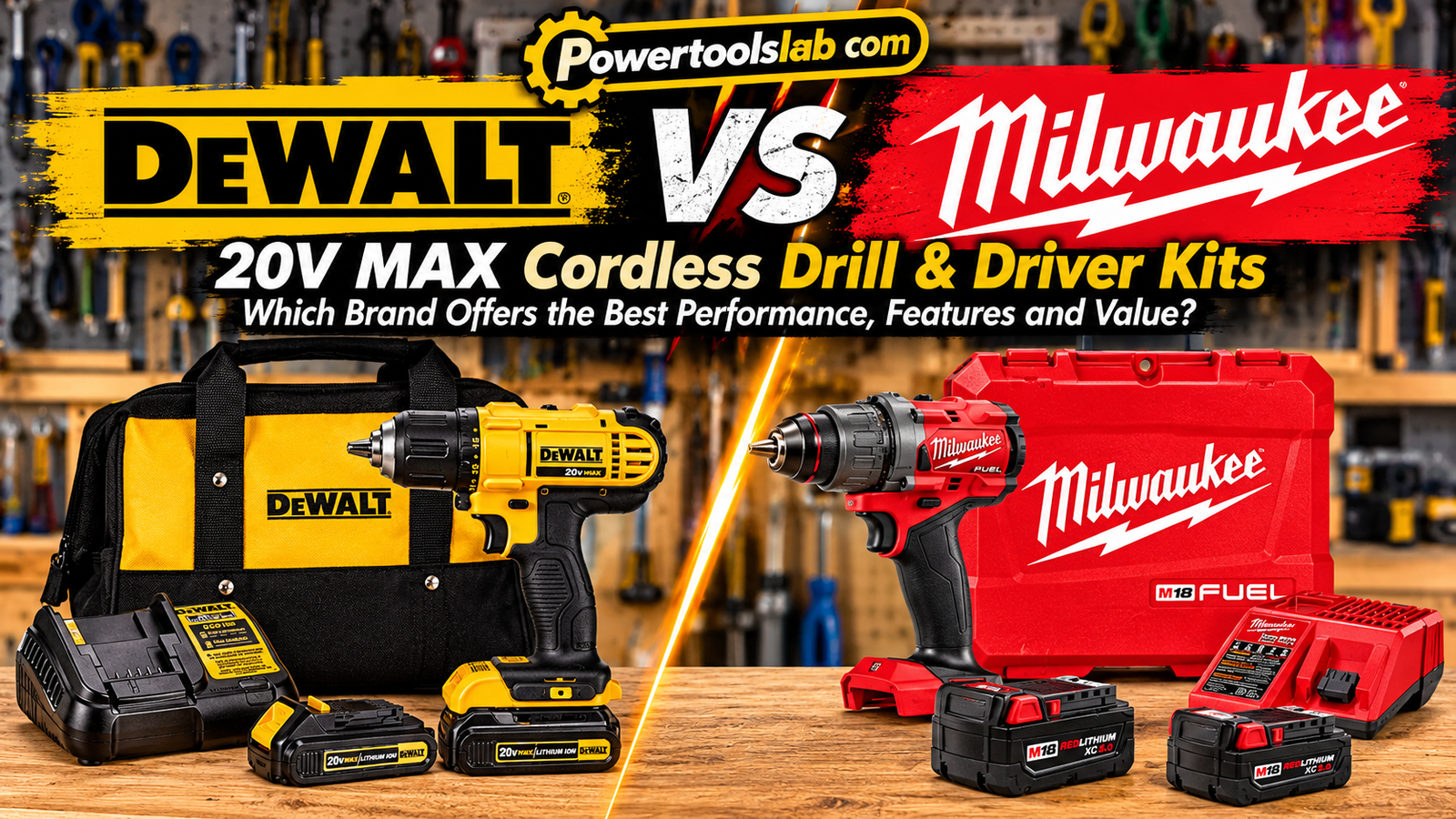
DEWALT vs Milwaukee: Which Cordless Tool Platform Actually Earns Its Place in Your Kit?
Two jobsite giants, two competing battery ecosystems, and a whole lot of marketing noise. This is a practical, side-by-side breakdown of drills, hammer drills, impact drivers, circular saws and impact wrenches — written for people who actually have to pick one.
Introduction: Why the DEWALT vs Milwaukee Question Keeps Coming Up
Nobody buys a drill. People buy into a system — and that is exactly why this comparison is harder than it looks.
Ask ten tradespeople which brand is better and you will get ten different answers, most of them delivered with the kind of conviction usually reserved for sports teams. DEWALT fans point to decades of contractor presence, an enormous accessory ecosystem, and a yellow-and-black lineup that seems to cover every task on a punch list. Milwaukee fans counter with a hard-edged focus on the professional trades, electronics that feel a generation ahead, and a platform that seems to expand every time you look away.
Both brands are owned by large, well-resourced tool groups with deep engineering budgets. Both build tools in overlapping categories that are, on paper, nearly identical: an 18-volt-class drill here, a quarter-inch impact driver there, a seven-and-a-quarter-inch circular saw for framing. But the real differences show up in the places spec sheets rarely capture — how a tool feels after the third hour of use, how quickly the charger recovers a pack mid-job, how much of a premium you pay to stay inside the ecosystem, and whether the tool you want today even exists in the brand’s catalog.
So instead of declaring a single winner and calling it a day, this guide does something more useful. It walks through the categories where these two actually compete — drills, hammer drills, impact drivers, circular saws and impact wrenches — and shows you where each brand’s particular strengths line up with the work you actually do. Along the way you will find side-by-side tables, individual product breakdowns with pros and cons, and practical buying advice about batteries, warranties and ownership cost.
If you are brand-new to cordless tools entirely, it is worth reading our overview of the major power tool brands first, and a quick look at Makita vs DEWALT or Ryobi vs Milwaukee will give you useful context about where each of these two sits in the wider market.

Quick Comparison: Our Top Picks
Every tool covered in this guide is listed below so you can scan the whole field in one place. The order reflects how each one fits into a real-world kit rather than a raw spec ranking — remember, a bare tool and a full kit solve different problems even when they look similar.
| # | Image | Product | Key Specs | Verdict | Check Price |
|---|---|---|---|---|---|
| 1 |  |
Top PickMilwaukee M18 FUEL 1/2" Drill/Driver KitBest Overall |
|
The do-everything drill most pros would grab first. | Check Price on Amazon |
| 2 |  |
DEWALT 20V MAX XR 1/2" Drill/DriverBest Premium DEWALT |
|
DEWALT’s serious drill — compact, refined, proven. | Check Price on Amazon |
| 3 | |
Milwaukee M18 FUEL 1/4" Hex Impact Driver (2953-20)Best Impact Driver |
|
Fast, controlled, and happy to work all day. | Check Price on Amazon |
| 4 |  |
DEWALT ATOMIC 20V MAX 1/4" Impact DriverBest Compact Impact Driver |
|
Short head length for tight cabinets and framing. | Check Price on Amazon |
| 5 |  |
DEWALT 20V MAX XR Hammer DrillBest Hammer Drill — DEWALT |
|
Concrete and masonry work without leaving the platform. | Check Price on Amazon |
| 6 |  |
Milwaukee M18 FUEL 1/2" Hammer DrillBest Hammer Drill — Milwaukee |
|
Serious drilling with hammer mode for tough material. | Check Price on Amazon |
| 7 |  |
DEWALT 20V MAX 7-1/4" Cordless Circular SawBest DEWALT Circular Saw |
|
Full-size blade capacity in a cordless body. | Check Price on Amazon |
| 8 |  |
Milwaukee M18 FUEL 7-1/4" Circular SawBest Circular Saw — Milwaukee |
|
Framing-grade cutting with the FUEL electronics behind it. | Check Price on Amazon |
| 9 |  |
DEWALT 20V MAX XR Impact Wrench (DCF900B)Best Impact Wrench — DEWALT |
|
Big fastener work without dragging an air hose. | Check Price on Amazon |
| 10 |  |
Milwaukee M18 FUEL Impact Wrench (2767-20)Best Impact Wrench — Milwaukee |
|
The one you want when bolts fight back. | Check Price on Amazon |
| 11 |  |
DEWALT 20V MAX Drill/Driver Kit (DCD771C2)Best Entry Kit |
|
The friendly first drill for homeowners and DIYers. | Check Price on Amazon |
| 12 |  |
Milwaukee 2656-20 M18 1/4" Hex Impact DriverBest Value Milwaukee |
|
Affordable entry into the M18 world. | Check Price on Amazon |
| 13 |  |
DEWALT 20V MAX 7-1/4" Circular SawBest Value Circular Saw |
|
Straightforward cutting for remodel and deck work. | Check Price on Amazon |
| 14 |  |
Milwaukee M18 FUEL 1/2" Drill/DriverBest Bare-Tool Buy |
|
Add muscle to an M18 kit you already own. | Check Price on Amazon |
How to read this table
Tools marked as kits include the accessories you need to start working, while bare tools assume you already own compatible batteries and a charger. If you are starting from zero, the kit route almost always costs less than buying the pieces separately.
Ready to Compare the Full Lineups?
Browse the current selection of cordless drill and driver kits from both brands.
Filter by platform so everything you buy works together.
Two Brands, Two Philosophies: What DEWALT and Milwaukee Are Actually Selling
Before comparing individual tools, it helps to understand the mindset behind each brand, because that mindset shapes everything from which tools get built to how they are designed.
DEWALT built its reputation around the working contractor. The brand’s visual identity is instantly recognizable, its distribution is broad, and its catalog is enormous — arguably one of the widest in the business. The practical effect of that breadth is choice. If a category exists, there is usually a DEWALT option, and often more than one at different price tiers. That makes the brand a natural fit for people who want a single battery platform that can cover everything from hanging a picture frame to framing a garage.
Milwaukee takes a more focused approach. The brand has historically leaned hard into specific trades — electrical, plumbing, mechanical, automotive — and builds tools around the demands of those users rather than around broad consumer appeal. You see it in the details: more electronic control, more attention to how a tool behaves under sustained load, and a willingness to build specialized tools that other brands treat as niche.
Neither approach is objectively better. A homeowner who wants one drill, one saw, and a flashlight is served extremely well by breadth. A technician who lives on an impact wrench all day benefits from the kind of specialization Milwaukee leans into. The mistake is judging both brands by the same yardstick without deciding which kind of user you are.
It is also worth noting that brand identity is not the same as tool quality. Plenty of tools from either manufacturer are excellent, and a handful in each lineup are better suited to certain jobs than others. The sections that follow get into that detail — but if you want the wider market context first, our power tool brand guide lays out how the major players differ from one another.
- Choose DEWALT if you value wide availability, a deep accessory catalog, and a platform that covers an unusually broad range of tools.
- Choose Milwaukee if you want trade-focused engineering, strong electronics, and tools designed around professional daily use.
- Choose neither dogmatically if your work is split across categories where each brand clearly leads — though staying on one battery platform does simplify life.
See the Two Brands Side by Side
Compare current combo kits to understand what each platform gives you up front.
Look at included batteries and chargers before you decide.
Battery Platforms: DEWALT 20V MAX vs Milwaukee M18
The battery is not an accessory. It is the foundation of everything you will buy after your first tool, which is why the platform decision matters more than any single model number.
Both brands run an 18-volt-class slide-pack system. In practical terms that means the tools deliver similar voltage categories, both use packs that slide onto a rail rather than plugging into a tower, and both offer a range of pack sizes so you can trade runtime against weight. Where they differ is in the wider experience around the battery: charger speed, pack lineup, how the tool manages power under load, and how the pack physically integrates with the tool.
DEWALT’s 20V MAX naming reflects a marketing convention common in North America, while Milwaukee’s M18 branding describes the same general class in more straightforward terms. Both systems are well supported, widely stocked, and backed by extensive accessory ecosystems. If you are trying to choose between them purely on voltage, you are chasing a distinction that barely exists in practice.
The more useful comparison is about how the platform behaves. Higher-capacity packs give tools more sustained output and longer runtime, at the cost of weight and bulk. Compact packs make a tool noticeably nicer to use overhead or in a cabinet, but they run down faster under heavy load. Serious users tend to own a mix — compact packs for drilling and driving, larger packs for sawing and grinding — and both brands support that approach.
A quick word about third-party batteries
Both brands design their tools and packs as an integrated system, with electronics that communicate about temperature, load and state of charge. Bargain packs from unknown manufacturers can undercut that relationship in ways that affect both performance and safety. If budget is tight, a smaller official pack is a better long-term move than a suspiciously cheap large one.
There is also the question of corded versus cordless at all. For stationary, high-draw tools, corded still wins on sustained output and price. For everything on a moving job, cordless wins on convenience. Our guide to corded versus cordless drills walks through that trade-off in detail.
Charging deserves a mention too. Both brands offer chargers that handle packs at different speeds, and both support multi-bay charging setups for users running multiple tools. If you expect to work long days away from power, buy enough packs to keep one on the tool, one on the charger, and one cooling.
Build Out Your Battery Lineup
Compare spare packs and chargers for both the 20V MAX and M18 platforms.
Match capacity to the tools you actually use most.
Motors and Tool Technology: Brushless, XR, FUEL and What Actually Matters
Marketing language around motors has become genuinely confusing. Let us clear it up before comparing specific tools.
A brushed motor uses physical brushes to deliver current to the spinning part of the motor. It is a mature, inexpensive design that works well and is simple to manufacture. A brushless motor replaces those brushes with electronic commutation. The practical benefits are less internal friction, better efficiency, more consistent output as the load changes, and less maintenance over a long service life. The trade-off is cost, because the tool needs electronics to manage the motor.
DEWALT reserves its XR designation for its higher-performance brushless tools, while Milwaukee uses FUEL for the same general idea. In both cases the label signals more than just the motor: it typically means the tool includes more sophisticated control electronics that manage output based on what the tool is being asked to do. Under a heavy load, that control can mean the difference between a tool that bogs down and one that keeps pushing.
For light household use — assembling furniture, hanging shelves, occasional drilling — a brushed tool is entirely adequate and costs meaningfully less. For daily use, dense materials, long fasteners or repeated heavy cuts, the efficiency and control of a brushless design earns its price quickly. If you want the deeper technical explanation, our comparison of brushless versus brushed motors covers the mechanics.
One nuance worth knowing: a brushless tool on a small compact pack will not always outperform a brushed tool on a large pack. The whole system — motor, electronics and battery — determines performance. When you compare two tools, compare them on similar packs or the comparison is meaningless.
- Brushed tools are best for occasional use, tight budgets and light-duty tasks.
- Brushless tools are best for daily use, sustained load, and anyone buying for the long haul.
- Electronics matter as much as the motor — control systems affect how the tool behaves under pressure.
Shop Brushless Tools by Category
Filter by brushless motor design to see the highest-output options.
Compare what each brand includes in its premium tiers.
Drill/Driver Showdown: Where DEWALT and Milwaukee Draw First Blood
The drill/driver is the tool most people buy first, and it is the one they form an opinion on fastest. Here are four options that represent the two brands at different tiers.
| Product | Platform | Motor | Best For | Verdict |
|---|---|---|---|---|
| Milwaukee M18 FUEL 1/2" Drill/Driver Kit | M18 | Brushless | Heavy daily drilling | The most complete package for working pros. |
| DEWALT 20V MAX XR 1/2" Drill/Driver | 20V MAX | Brushless | Refined all-round use | A polished, balanced drill for demanding work. |
| Milwaukee M18 FUEL 1/2" Drill/Driver | M18 | Brushless | Expanding an M18 kit | Buy it bare and save if batteries are covered. |
| DEWALT 20V MAX Drill/Driver Kit (DCD771C2) | 20V MAX | Standard | Home and DIY use | Approachable, capable and easy to live with. |
DEWALT 20V MAX Cordless Drill/Driver Kit (DCD771C2)
This is the drill that introduces most people to the DEWALT platform, and it is easy to see why. It is compact enough to feel unintimidating, light enough that nobody gets tired holding it overhead, and part of a kit that gets you working out of the box rather than sending you back out for a battery.
Key Features
- Compact drill/driver format that fits comfortably in a hand and a tool bag
- Runs on the DEWALT 20V MAX platform, so every battery you buy works across the range
- Sold as a kit with battery and charger, making it a genuine starter package
- Straightforward two-speed style control that is simple to learn
Pros
- Excellent first drill for homeowners and DIYers
- Comfortable in extended overhead use
- Wide accessory and battery availability
Cons
- Not aimed at sustained heavy-duty drilling
- Serious users will eventually want an XR-tier model
DEWALT DCD771C2
See current pricing and kit contents.
Check what is included before ordering.
DEWALT 20V MAX XR 1/2" Drill/Driver
This is DEWALT’s answer to the question “which drill should I own if I use one every day?” The XR line represents the brand’s higher-performance tier, and this model shows why: it feels more controlled than entry-level tools, and it behaves better when the material pushes back.
Key Features
- Brushless XR-series motor design for improved efficiency and output
- Half-inch chuck that accepts the full range of common drill and driver bits
- Part of the 20V MAX platform with broad battery compatibility
- Built for the kind of repeated use that punishes lesser tools
Pros
- Noticeable step up in control and consistency
- Compact relative to the work it handles
- Excellent fit with the rest of the DEWALT range
Cons
- Sits at the premium end of the DEWALT lineup
- Overkill for very light household tasks
DEWALT 20V MAX XR 1/2"
Compare current offers and package options.
Look for kit versus bare tool listings.
Milwaukee M18 FUEL 1/2" Drill/Driver Kit
If you want one tool purchase that sets you up properly, this is a strong candidate. The FUEL designation signals Milwaukee’s brushless, electronically controlled tier, and the kit format means you are not immediately hunting for a battery and charger.
Key Features
- Brushless FUEL motor with the electronic control Milwaukee is known for
- Half-inch chuck suitable for a very wide range of bits and applications
- Kit format with battery and charger for immediate use
- Runs on the M18 platform shared across a large professional tool range
Pros
- Excellent capability under sustained load
- Complete package for anyone starting fresh
- Strong match for heavy drilling and driving
Cons
- Priced like a professional tool
- More capability than casual users will need
Milwaukee M18 FUEL Kit
Our top overall pick in this comparison.
See the full kit contents and current pricing.
Milwaukee M18 FUEL 1/2" Drill/Driver
This is the same class of drill as the kit above, but bought on its own terms. If you already own M18 packs and a charger, buying bare is the smartest financial move in cordless tools — you pay for the tool and skip the hardware you already have.
Key Features
- Brushless FUEL motor design for demanding drilling and driving
- Half-inch chuck for full accessory compatibility
- Bare tool configuration that adds capability to an existing kit
- Shared battery platform across the wider M18 range
Pros
- Cost-effective if you already own M18 batteries
- Same professional-tier performance as the kit version
- Takes up little space in an existing tool setup
Cons
- Not a starter option — you need batteries already
- No charger or pack included
Milwaukee M18 FUEL Bare Tool
The most economical upgrade for M18 owners.
Confirm battery compatibility before buying.
For more options beyond these four, our roundup of the best drills for DIY and pro use covers the wider field, as do our dedicated looks at the best DEWALT drills, the best Milwaukee drills, and the best cordless drills overall. And once you have one, our guide on how to use a drill covers technique and bit selection.
Drill/Driver Verdict
DEWALT leads on approachability and range breadth.
Milwaukee leads on sustained professional performance.
Hammer Drill Head-to-Head: When Wood Turns to Concrete
A hammer drill looks almost exactly like a regular drill/driver until you hit masonry. Then the difference is impossible to miss.
While a standard drill applies only rotational force, a hammer drill adds a rapid forward-and-back hammering action that helps the bit chew through brick, block, concrete and stone. It is not a rotary hammer — it will not replace one for heavy anchor work — but for the masonry drilling most people encounter, from tapcon screws to mounting brackets, it is exactly the right tool.
Both brands build hammer drills in their premium tiers, which makes this a straightforward comparison of execution rather than of features. The section below covers the two strongest contenders.
| Product | Platform | Chuck | Motor | Best For |
|---|---|---|---|---|
| DEWALT 20V MAX XR Hammer Drill | 20V MAX | Standard XR | Brushless | Remodel work across mixed materials |
| Milwaukee M18 FUEL 1/2" Hammer Drill | M18 | 1/2" | Brushless | Tough masonry and dense material |
DEWALT 20V MAX XR Hammer Drill
For anyone already in the DEWALT ecosystem who periodically runs into masonry, this is the natural addition. It gives you the hammer function without asking you to buy into a second platform, and it behaves like the rest of the XR range in hand.
Key Features
- Hammer drilling capability for masonry, brick and block
- Brushless XR-series motor design for consistent output
- Full 20V MAX battery compatibility across the DEWALT range
- Dual-purpose role as both a drill and a hammer drill
Pros
- One tool covers wood, metal and masonry
- Feels familiar to anyone used to DEWALT drills
- Great for remodel and installation work
Cons
- Not a substitute for a rotary hammer on heavy anchors
- Hammer mode adds wear over time on continuous use
DEWALT 20V MAX XR Hammer Drill
See current pricing and available packages.
Pair it with a quality masonry bit set.
Milwaukee M18 FUEL 1/2" Hammer Drill
Milwaukee’s FUEL hammer drill is aimed squarely at people who do this kind of work repeatedly. It pairs the hammer mechanism with the brand’s brushless electronics, and the result is a tool that stays composed when the material gets difficult.
Key Features
- Brushless FUEL motor with electronic output management
- Half-inch chuck for a broad accessory range
- Hammer drilling mode for masonry and hard material
- M18 platform compatibility for battery sharing across tools
Pros
- Strong performance in demanding drilling
- Well suited to professional daily use
- Controlled behaviour under sustained load
Cons
- Premium pricing tier
- Heavy use benefits from larger battery packs
Milwaukee M18 FUEL Hammer Drill
Compare current listings and kit options.
Check pack compatibility before you order.
If you are unsure whether you need the hammer function at all, our breakdown of hammer drills versus regular drills explains exactly which materials justify it and which do not.
Hammer Drill Verdict
Both are excellent. Choose based on your platform and workload.
Buy masonry bits separately for the best results.
Impact Driver Duel: Compact Power and Control
If the drill/driver is the most common first tool, the impact driver is the one people become evangelical about after they own one.
Instead of relying purely on the user’s grip and the motor’s torque, an impact driver uses a rotational hammering mechanism that delivers bursts of force as resistance builds. The practical result is that long screws go in straight and fast without your forearm doing the work — and without the cam-out and stripped heads that plague regular drills on heavy fasteners.
Both brands build excellent impact drivers, and this is arguably the category where their design philosophies diverge most visibly. Here are three options that span the range.
| Product | Platform | Collet | Motor | Best For |
|---|---|---|---|---|
| Milwaukee M18 FUEL 1/4" Hex Impact Driver (2953-20) | M18 | 1/4" hex | Brushless | All-day professional driving |
| DEWALT ATOMIC 20V MAX 1/4" Impact Driver | 20V MAX | 1/4" hex | Compact series | Tight spaces and overhead work |
| Milwaukee 2656-20 M18 1/4" Hex Impact Driver | M18 18V | 1/4" hex | Standard | Budget entry into M18 |
Milwaukee M18 FUEL 1/4" Hex Impact Driver (2953-20)
This is the impact driver most Milwaukee users point to when asked what they would buy again. It pairs the FUEL brushless platform with the kind of fine control that makes delicate work possible alongside brute-force fastening.
Key Features
- Brushless FUEL motor with intelligent output control
- Quarter-inch hex collet for the most common driver bits
- Multiple drive modes for switching between heavy and delicate fastening
- Compact body that balances well with a range of battery sizes
Pros
- Excellent control across different fastener sizes
- Comfortable through long driving sessions
- Professional-grade durability
Cons
- Premium positioning
- Bare tool — batteries sold separately
Milwaukee M18 FUEL Impact Driver
Our top impact driver in this comparison.
See current pricing and available bundles.
DEWALT ATOMIC 20V MAX 1/4" Impact Driver
DEWALT designed the ATOMIC series around one idea: serious capability in the smallest reasonable package. If you have ever tried to drive a cabinet screw inside a carcass or work between studs, you understand the value of a shorter tool immediately.
Key Features
- Compact ATOMIC-series design for tight-access work
- Quarter-inch hex collet compatible with standard driver bits
- Full 20V MAX battery platform compatibility
- Low weight and short head length for reduced fatigue
Pros
- Genuinely fits where larger drivers do not
- Light enough for overhead and ladder work
- Strong match for finish and cabinet work
Cons
- Compact size trades some sustained output
- Best paired with lighter packs
DEWALT ATOMIC Impact Driver
Compact power for tight-access fastening.
Check current pricing and kit availability.
Milwaukee 2656-20 M18 18V 1/4" Hex Impact Driver
Not every tool in a kit needs to be the flagship. This model is about getting into the M18 ecosystem at a sensible price while still delivering the performance that made impact drivers essential in the first place.
Key Features
- Quarter-inch hex collet for standard impact-rated bits
- M18 18V platform compatibility across Milwaukee’s range
- Compact body that is easy to handle for extended periods
- Straightforward, no-nonsense operation
Pros
- Approachable way into the M18 system
- Handles everyday driving with ease
- Great secondary tool alongside a premium driver
Cons
- Lacks the electronic refinement of FUEL tools
- Less suited to continuous heavy fastening
Milwaukee 2656-20 Impact Driver
Smart value entry into the M18 platform.
See what is included in the listing.
Wondering whether an impact driver can replace a drill outright? Our comparison of impact drivers versus drills explains what each one does best, and our wider guide to the best impact drivers covers more models.
Impact Driver Verdict
Milwaukee wins on control and sustained driving.
DEWALT wins on compact access and weight.
Circular Saw Comparison: Seven-and-a-Quarter Inches of Difference
Circular saws are where battery platforms face their toughest test. Sustained cutting draws far more power than drilling or driving, and the tool has to deliver that power without stalling mid-rip.
The seven-and-a-quarter-inch blade is the standard framing and remodel size, giving you the depth of cut needed for common lumber and sheet goods. Both brands offer it in cordless form, and both have matured the design to a point where cordless circular saws are genuinely credible replacements for corded models on most tasks.
| Product | Platform | Blade Size | Motor | Best For |
|---|---|---|---|---|
| Milwaukee M18 FUEL 7-1/4" Circular Saw | M18 | 7-1/4" | Brushless | Heavy framing and repeat cuts |
| DEWALT 20V MAX 7-1/4" Cordless Circular Saw | 20V MAX | 7-1/4" | Standard | General remodel cutting |
| DEWALT 20V MAX 7-1/4" Circular Saw | 20V MAX | 7-1/4" | Standard | Deck and outdoor projects |
DEWALT 20V MAX 7-1/4" Cordless Circular Saw
DEWALT has been building circular saws long enough that the fundamentals here are solid: the guard action is predictable, the shoe sits flat, and the tool feels like it was designed by people who cut sheet goods for a living.
Key Features
- Seven-and-a-quarter-inch blade capacity for standard framing depth
- Cordless design running on the 20V MAX platform
- Standard right-blade configuration familiar to most users
- Suitable for framing, sheet goods and general construction cutting
Pros
- Familiar handling and confident guard behaviour
- Full blade size in a cordless format
- Strong fit with the rest of the DEWALT range
Cons
- Runtime scales heavily with battery size
- Continuous ripping benefits from larger packs
DEWALT 7-1/4" Circular Saw
See current pricing and blade details.
Consider a spare blade for cleaner cuts.
Milwaukee M18 FUEL 7-1/4" Circular Saw
This is Milwaukee putting its FUEL electronics behind a category that really needs them. Circular saws punish weak motor control — you feel it instantly as the blade slows in a deep cut — and this is the design where that control pays off most clearly.
Key Features
- Brushless FUEL motor designed for sustained cutting load
- Seven-and-a-quarter-inch blade size for standard material depth
- M18 platform compatibility for shared batteries and chargers
- Built around demanding professional cutting tasks
Pros
- Holds pace through demanding cuts
- Excellent match for framing and structural work
- Consistent behaviour under load
Cons
- Heavy cutting drains packs quickly
- Professional pricing
Milwaukee M18 FUEL Circular Saw
Our pick for heavy cordless cutting.
Check current offers and package options.
DEWALT 20V MAX 7-1/4" Circular Saw
Here is the value play in DEWALT’s saw lineup. It covers the same seven-and-a-quarter-inch cutting duties in a package aimed at users who cut regularly but not relentlessly.
Key Features
- Seven-and-a-quarter-inch blade for standard construction depth
- 20V MAX platform for battery sharing across the range
- Right-blade format that most users find intuitive
- Practical fit for deck building, fencing and general outdoor work
Pros
- Great capability for the price tier
- Easy to set up and adjust
- Good balance of size and cutting capacity
Cons
- Not positioned as the premium DEWALT saw
- Best suited to moderate cutting volumes
DEWALT 7-1/4" Circular Saw
Capable cutting at a sensible tier.
See current pricing and availability.
Saws are a deep category, so there is plenty more to explore. Start with our guide to the types of power saws, then compare the best power saws, the best power circular saws, and the best cordless circular saws. For brand-specific detail, see our DEWALT circular saw review and Milwaukee circular saw review. And if you are deciding between saw categories altogether, our comparisons of circular saws versus miter saws and table saws versus circular saws will point you in the right direction.
Circular Saw Verdict
Milwaukee leads for heavy cutting volume.
DEWALT leads for general-purpose versatility.
Impact Wrench Battle: Where the Fasteners Fight Back
Impact wrenches used to belong to the air-compressor world. Cordless versions have changed that completely, and this is the category where the performance gap between competing designs is easiest to feel.
An impact wrench delivers rotational blows to loosen and tighten large fasteners — lug nuts, structural bolts, machinery mounts. Where an impact driver is built for screws and smaller fasteners, an impact wrench is built for the jobs that used to require a compressor, a hose and a lot of patience.
| Product | Platform | Class | Best For |
|---|---|---|---|
| DEWALT 20V MAX XR Impact Wrench (DCF900B) | 20V MAX XR | High torque | Automotive and structural fastening |
| Milwaukee M18 FUEL Impact Wrench (2767-20) | M18 FUEL | High torque | Stubborn, corroded large fasteners |
DEWALT 20V MAX XR High Torque Impact Wrench (DCF900B)
This is DEWALT’s argument that cordless belongs in the world of heavy fastening. It is built around high-torque work and it belongs to the XR tier, meaning you get the more refined electronics alongside the raw capability.
Key Features
- High-torque class wrench for large fasteners
- Brushless XR-series motor with managed output
- 20V MAX platform compatibility with the wider DEWALT range
- Designed to replace pneumatic wrenches for many tasks
Pros
- Serious fastening capability without an air hose
- Refined control reduces over-tightening risk
- Strong choice for automotive and structural work
Cons
- Large and heavy by nature
- Over-specified for light fastening
DEWALT DCF900B Impact Wrench
High-torque cordless fastening power.
See current pricing and compatible batteries.
Milwaukee M18 FUEL Impact Wrench (2767-20)
Ask professional mechanics which cordless impact wrench changed their workflow and this model comes up constantly. It is the tool that made many of them leave the compressor behind, and it is built with the kind of headroom you want when a fastener has been seized for a decade.
Key Features
- Brushless FUEL motor tuned for high-torque output
- Half-inch drive class for common impact sockets
- M18 platform compatibility across the professional range
- Built for repeated heavy fastener work
Pros
- Outstanding at breaking stubborn fasteners loose
- Built for daily shop and site use
- Excellent socket and accessory ecosystem
Cons
- Premium price positioning
- Heavy packs recommended for sustained work
Milwaukee 2767-20 Impact Wrench
The wrench that convinces people to skip the compressor.
Check current pricing and drive size.
Impact Wrench Verdict
Milwaukee has the enthusiast reputation here.
DEWALT counters with a highly refined XR design.
Ecosystem, Tool Range and Keeping It All Organized
Once you own two or three tools on a platform, your buying decisions stop being about individual tools and start being about the system. This is where the platform question becomes real money.
Both DEWALT and Milwaukee maintain enormous catalogs that extend far beyond the categories covered here — lights, radios, fans, vacuums, oscillating tools, sanders, grinders, nailers, plumbing presses, and much more. The practical question is not “does this brand make the tool I want today?” but “will this brand make the tool I need two years from now, and will it run on the batteries I already own?”
DEWALT’s breadth is one of its defining strengths. The range covers such a wide array of categories that most users can stay inside the ecosystem for an entire career. Accessory support is similarly broad, with batteries, chargers, bits, blades and storage solutions available almost everywhere tools are sold.
Milwaukee’s range is equally deep but is weighted toward the professional trades. If your work involves electrical, mechanical, plumbing or automotive tasks, you will find purpose-built tools here that other brands simply do not offer. The flip side is that the platform leans professional, and entry-level options are fewer.
The storage question nobody thinks about until it matters
After a few tools, storage becomes a genuine problem. Both brands offer modular storage and transport systems designed to stack and lock together. Choosing one that matches your platform means fewer adapters and a cleaner van or garage — and if organization is a challenge, our guide to organizing power tools in the garage is worth a read.
For a broader look at how the whole market fits together, see our power tool brand guide. And if your needs extend into sawing categories beyond circular saws, our roundups of the best reciprocating saws and the best jigsaws cover tools that pair naturally with either platform.
Expand Your Platform
Explore storage, lighting and accessory options in both ecosystems.
Match everything to the batteries you already own.
Ergonomics, Durability and Using Tools Safely
Spec sheets do not describe how a tool feels at hour four. That is where ergonomics and build quality become the real differentiators.
Grip shape, balance point, trigger feel, how the tool sits on a surface, how the light illuminates the work area, how much vibration transfers to your wrist — none of this shows up in a feature list, but all of it shapes whether you reach for a tool willingly or avoid it. Both brands have invested heavily here, and both have their partisans. The honest advice is that grip comfort is subjective: what fits one hand beautifully can feel wrong in another.
Durability is more measurable. Professional-grade tools from both brands are built to survive drops, dust and daily transport. Common failure points across any brand are switches, chucks and battery contacts — and those tend to fail through contamination and rough handling rather than through design flaws. Keeping tools clean and dry does more for longevity than any other single habit.
Safety Comes First, Always
Cordless does not mean harmless. Circular saws throw debris and can kick back; impact tools can round fasteners and send tools skittering; drills can bind and twist wrists. Wear eye protection, keep guards in place, use the right accessory for the material, and never defeat a safety feature to speed up a job. Our guide to what should never be engaged when using power tools covers the specifics.
Maintenance Basics That Extend Tool Life
- Blow dust out of vents and chucks regularly — contamination is the enemy of brushes, switches and bearings.
- Store batteries at moderate temperature and keep contacts clean.
- Let hot packs cool before recharging to protect their long-term capacity.
- Use sharp, correct accessories; forcing a dull bit damages both the bit and the tool.
- Watch for warning signs like unusual smells or smoke and stop immediately — see our guide on why a drill might be smoking.
Protect Yourself and Your Tools
Compare safety gear and cleaning accessories for workshop use.
Good habits cost far less than replacement tools.
Value and Cost of Ownership: What You Really Pay For
Sticker price is only the beginning of the conversation. The real cost of a cordless platform is spread across tools, batteries, chargers, accessories and how long all of it lasts.
Start with kits versus bare tools. If you own nothing, a kit almost always wins — the battery and charger you need are bundled at a lower effective price than buying them separately. If you already own batteries and a charger, buying bare tools is the single biggest saving available in cordless tools, and it is worth doing deliberately.
Next, consider how many batteries you actually need. Light users can manage with one or two. Anyone working full days should plan for at least three so a pack is always charging. Batteries are typically the most expensive consumable in the system, so choosing a platform with an accessible pack lineup matters over time.
Then there is durability and support. Both brands have extensive service networks and established warranty processes, though specific terms vary by product and region — always check the current warranty on the listing before buying. A tool that can be repaired is worth more over a decade than one that is disposable, and both manufacturers build their professional tiers with serviceability in mind.
A simple cost rule of thumb
Think in terms of cost per job rather than cost per tool. A premium tool that saves fifteen minutes a day across a year is cheaper than the bargain version that saves money once. The opposite is also true — if you use a tool twice a year, the entry tier is genuinely the smarter purchase.
For help picking accessories that actually matter, our guides to the best angle grinders and best miter saws cover adjacent categories where the same budget logic applies.
Compare Kits and Bare Tools
Look at what is included before comparing prices.
A kit usually costs less than buying pieces separately.
Which Should You Buy? A Decision Framework That Actually Helps
After all of that, here is the honest answer: both brands make tools that are more capable than most users will ever fully need. The better question is which platform fits the way you work.
Buy DEWALT if…
You want the widest possible range of tools and accessories, you value availability and value, and you want a platform that scales easily from light household work to serious contracting.
Buy Milwaukee if…
You work in the trades, you use tools hard every day, and you want the kind of electronic control and specialized tooling that shows up under sustained load.
Buy neither exclusively if…
Your work spans categories where one brand clearly leads. Some professionals deliberately run two platforms — but it costs more and complicates charging.
Category Winners at a Glance
| Category | Winner | Why |
|---|---|---|
| Drill/Driver | Milwaukee M18 FUEL Kit | Complete, capable, and ready for daily professional use. |
| Compact Drill | DEWALT DCD771C2 | Approachable, lightweight and ideal for home projects. |
| Impact Driver | Milwaukee 2953-20 | Best blend of control, speed and long-session comfort. |
| Compact Impact Driver | DEWALT ATOMIC | Shortest path into tight spaces without losing capability. |
| Hammer Drill | Tie — both excellent | Choose based on platform; performance is close in real use. |
| Circular Saw | Milwaukee M18 FUEL | Handles heavier cutting volume with better composure. |
| Impact Wrench | Milwaukee 2767-20 | The go-to choice for stubborn, heavy fasteners. |
If you are entirely new to cordless tools, our guide to the best power tools for beginners is the right place to start — it explains which tools to buy first and which to leave for later.
Make Your Decision
Compare the top picks one more time before ordering.
Match the tool to the work you actually do.
Frequently Asked Questions
Is DEWALT or Milwaukee better overall?
Neither brand is universally better. DEWALT offers exceptional breadth and value across a huge catalog, while Milwaukee leans toward trade-focused engineering and electronic control. The right choice depends on how often you use tools, which categories matter most to you, and whether you already own batteries in either system.
Are DEWALT 20V MAX and Milwaukee M18 batteries interchangeable?
No. The two platforms use different physical connections and different electronic handshakes, so packs are not cross-compatible. Once you choose a platform, your batteries stay within that brand’s ecosystem.
Should I buy a kit or a bare tool?
If you own no batteries or chargers, buy a kit — it is almost always cheaper than assembling the pieces separately. If you already own a platform’s batteries and charger, buying bare tools saves meaningful money and gives you exactly what you need.
Does a brushless motor really make a difference?
Yes, particularly for regular use. Brushless designs run more efficiently, hold output better under load and have fewer wear components. For occasional light tasks, a standard motor is perfectly adequate and costs less.
Do I need an impact driver if I already own a drill?
They do different jobs. A drill is better for precise holes and controlled driving; an impact driver excels at driving long fasteners quickly with much less effort. Most users who own both end up using the impact driver far more than they expected.
Which brand is better for heavy-duty work?
Both build genuinely professional-grade tools. Milwaukee’s premium tier has a strong reputation for sustained heavy use and advanced electronics, while DEWALT’s XR range competes closely and benefits from very broad support and accessory availability.
Are these tools suitable for beginners?
Absolutely. Entry-level models from either brand are approachable and forgiving, and both platforms let you grow into more capable tools later without replacing your batteries. Starting with a compact drill/driver kit is a sensible first step.
How long do cordless tool batteries last?
It depends heavily on use patterns, temperature exposure and charging habits. Keeping packs out of extreme heat, avoiding repeated deep discharges where possible, and letting hot packs cool before charging all help preserve capacity over time.
Can a cordless circular saw replace a corded one?
For most framing, remodel and outdoor work, yes — especially with a larger battery pack. Continuous heavy ripping at a stationary bench is still the strongest argument for corded power, though cordless models continue to close that gap.
Should I buy a hammer drill or a rotary hammer?
For occasional holes in brick, block or concrete, a hammer drill is ideal and covers normal drilling too. For repeated anchor installation or large-diameter holes in hard concrete, a rotary hammer is the correct tool — see our guide to hammer drills versus regular drills for more detail.
Are third-party batteries safe to use?
Batteries are the one place we recommend staying with the tool manufacturer. Packs communicate with the tool to manage temperature and load, and unofficial packs can undercut those protections in ways that affect both safety and performance.
What accessories should I buy first?
Eye protection, a quality drill and driver bit set, and at least one spare battery will improve your experience more than almost any other purchase. After that, buy accessories matched to the specific work you do rather than large assorted sets.
Still Deciding?
Browse customer questions and listings for the tools above.
Reading real owner feedback helps confirm your choice.
Conclusion: Pick the Platform That Matches Your Work
The DEWALT versus Milwaukee debate tends to generate more heat than light, but the underlying question is genuinely simple. Both brands build excellent cordless tools across drills, hammer drills, impact drivers, circular saws and impact wrenches. The difference lies in emphasis.
DEWALT gives you breadth, accessibility and value, with a catalog wide enough to cover virtually any task and a range of tiers that lets you match spending to real need. Milwaukee gives you trade-focused engineering and electronics that reward users who push their tools hard and often. Neither is a compromise — they are different answers to different questions.
If you are building a kit from scratch, start with the category you use most and choose the platform that serves it best. If you already own batteries, staying inside that ecosystem will almost always be the cheapest and simplest route. And if you are still uncertain, handle both brands in person before committing — grip, balance and trigger feel matter far more in daily use than any number on a box.
Whichever direction you go, buy for the work in front of you rather than the hypothetical job you might tackle someday. A tool that earns its keep every week is worth more than an impressive one that sits in a drawer.
Ready to Build Your Kit?
Start with the top-rated drill/driver kit in this comparison.
Everything else on the platform follows from there.
Pingback: Ryobi vs Milwaukee: Which Cordless Platform Wins?